


A tough journey starts, mired in controversies

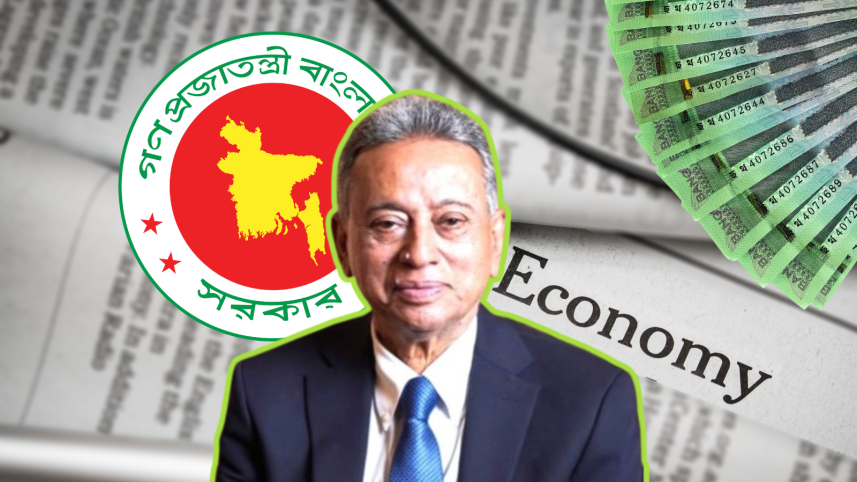
The new government’s finance minister got off to a controversial beginning almost immediately after taking office, with the abrupt departure of Bangladesh Bank Governor Ahsan H Mansur setting an uncomfortable tone.
During the interim government’s tenure, the then-governor had initiated several significant reforms to rescue Bangladesh’s badly damaged banking sector. But he was removed in such a way that shocked economists and observers. Mansur reportedly learned he was no longer governor from a television news ticker despite having met with the finance minister just the day before, when he was given no hint whatsoever of what was coming. People close to him say that even a small signal would have been enough for him to resign gracefully and leave on his own terms.

Addressing the issues will be a major challenge because he [finance minister] has inherited an economy characterised by high inflation, muted investment, and a subdued private sector response.
No one disputes that a government returning to power after two decades with a strong mandate has every right to decide who occupies the most important post in the financial sector. But the process of the governor’s removal was a bad signal that severely undermined institutional governance.
“The way it was handled completely ignored the autonomy of the Bangladesh Bank. There is a specific process for removal, and for an appointment, there should be a search committee, a shortlist, and interviews. Instead, someone was appointed within two hours without following any rules or regulations,” said Zahid Hussain, former lead economist at the World Bank’s Dhaka office.
A second controversy followed shortly after. A clause inserted into the Bank Resolution Act drew sharp criticism both inside and outside parliament. Originally introduced during the interim administration as an ordinance, it was among a small number of measures the new government chose to hold back from enactment for further review. When it was eventually passed into law, the new provision, section 18A, was added.
Opposition parties criticised the provision in parliament, and economists condemned it as a significant legislative slippage. Even the World Bank and the IMF recommended its repeal. According to sources at the finance ministry, removal of the clause was also included as a condition attached to budget support. The government is now reported to be considering an amendment to the law.
Another major challenge for Finance Minister Amir Khosru Mahmud Chowdhury has been navigating the IMF’s $5.5 billion loan programme -- and the conditions that come with it. Last November, the IMF suspended the sixth tranche, waiting for a newly elected government.
When the new government took office, it found itself facing a double bind: an urgent need for funds, and a set of reform conditions.
Opening a path out of this stalemate, the government will now exit the existing programme and start negotiations for a fresh deal. This breakthrough would give the minister some immediate relief and help keep the door open for budget support from other development partners.
“The finance minister has had to face new challenges, such as the rise in fuel prices and the need to secure foreign loans for that without relying too heavily on foreign exchange reserves. He had to tackle these issues, and he has done so reasonably well, even though it required taking unpopular steps like increasing fuel prices,” said Mustafizur Rahman, distinguished fellow at the Centre for Policy Dialogue.
Any fair assessment of the finance minister’s first 100 days must carry an honest account of what he inherited. Inflation had been running above 9 percent since March 2023. It dipped briefly after the new government took office and then rose to 9.42 percent in May, the highest in 16 months. Ordinary people have been squeezed for months between stagnant incomes and persistently high prices.
The finance minister’s tools to bring inflation down are limited: monetary policy and fiscal policy. There is pressure to cut the policy rate to stimulate investment, but no such move has been made yet. On the fiscal side, austerity measures have been taken for the second time in the current financial year. Officials at the finance ministry argue that Bangladesh’s inflation is more driven by supply chain distortions than in most comparable economies, making it harder to tame through conventional tools alone. No visible relief is yet in sight.
Investment, meanwhile, has been stagnant for several years. Public investment depends heavily on ADP implementation, which had already fallen behind during the interim period -- and continues to lag. Private sector credit growth fell below 5 percent in March. The investment drought stretching over three years shows no sign of breaking. Many had hoped the arrival of a newly elected government would end the paralysis; the ongoing distress in the banking sector and the spillover effects of the Middle East conflict appear to be preventing that.
“His first major task will be how the budget is formulated; specifically, how he presents the financing strategy, determines the government’s priorities, handles sector allocations, and manages deficit financing. Addressing these issues will be a major challenge because he has inherited an economy characterised by high inflation, muted investment, and a subdued private sector response,” Mustafizur said.
While Bangladesh’s external economy is stabilising, with steady forex reserves, stable exchange rates, and strong remittances, crucial domestic reforms are lagging. Overhauls of the banking sector, the NBR, and the stock market remain slow. “They have started working on these, yes, but our hope is that these efforts proceed with more speed,” Mustafizur said.
In this fraught landscape, Bangladesh Bank made a striking announcement just before Eid-ul-Azha: a Tk 60,000 crore stimulus package, the largest since the Covid-19 relief programmes, to revive a private sector that has been losing ground for years.
The stimulus package can be read as the government’s most forceful attempt yet to break that deadlock. Whether it succeeds will depend on questions that remain unanswered: whether banks will participate meaningfully, whether closed factories can actually be revived, and whether the injection of money into a supply-constrained economy drives growth or simply drives up prices.
The package may be well-intentioned, but critics argue it has not been sufficiently evaluated against alternatives, and that controlling inflation should remain the top priority. Additional stimulus may push prices up faster than it increases output, particularly if supply-side constraints remain unresolved.
One of the bright spots in the government’s development agenda is the launch of the Family Card programme, which could prove significant for low-income households affected by months of high prices if it is implemented effectively. Alongside direct targeted relief, the administration’s vocal emphasis on cutting red tape offers a potential structural upside.
 For all latest news, follow The Daily Star's Google News channel.
 “The finance minister has been championing the need for deregulation, especially simplifying and automating regulatory processes to reduce the cost of doing business. This is long overdue, and we hope he will deliver a time-bound roadmap for deregulation in the forthcoming budget,” said Zahid Hussain.
But even the most optimistic reading of the government’s first 100 days runs into a hard external constraint. The shadow of the Middle East conflict hangs over all of this -- a source of serious concern, by the finance minister’s own admission, and a key reason why he has repeatedly said that a visible economic recovery is unlikely within the next two years.
Comments