


Tender for idle state assets likely in Oct
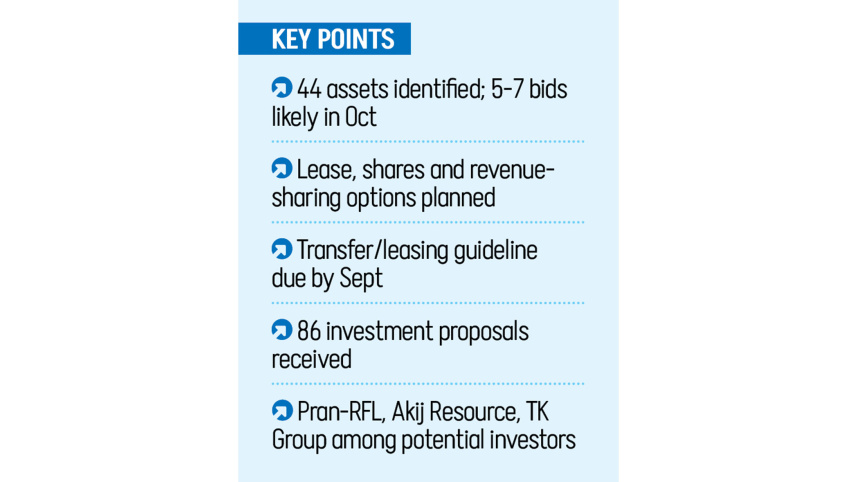
Invest Bangladesh, the newly formed apex investment authority, plans to offer the first batch of five to seven idle state-owned assets, including closed factories, to private investors through open bidding in October, a top official said yesterday.
The move aims to put unused public land and industrial facilities back into productive use through long-term arrangements with private investors, following strong interest from businesses.

Nahian Rahman Rochi, executive member of Invest Bangladesh, said the authority has received more than 86 investment proposals from four companies and 10 business groups seeking to revive closed and loss-making state-owned factories.
“We did not know initially that we would receive this much interest. Since there is so much interest, we want to go for open bidding and let anyone interested participate. We can then select the best proposal,” he said.
Competitive bidding would also improve transparency and reduce concerns about favouritism or nepotism in the selection of investors, he said.
The government has identified 44 state-owned assets for the initiative and plans to offer them in batches rather than all at once, Nahian said.
Of these, 13 are under the Bangladesh Sugar and Food Industries Corporation, 12 under the Bangladesh Textile Mills Corporation, 10 under the Bangladesh Chemical Industries Corporation, five under the Bangladesh Jute Mills Corporation and four under the Bangladesh Steel and Engineering Corporation.
Depending on the asset, arrangements could run for 10 to 30 years and may involve long-term leases, shareholding arrangements or revenue-sharing models.
The first tender depends on finalising a guideline governing the transfer or leasing of state-owned land and industrial facilities.
The Invest Bangladesh Act, 2026 provides the legal basis for such transfers, Nahian said, while a separate guideline is being prepared to set out detailed procedures.
A draft was discussed with government and private-sector representatives at a stakeholder consultation on July 27, and a revised version has since been circulated for final comments.
“We hope to receive the final inputs this month. The guideline will then go through the required legal and other approvals next month,” Nahian said, adding that bids for the first batch would follow in October if the guideline is finalised by the end of September.
He said the authority wants the process to be governed by clear rules to protect both the government and investors from disputes arising from long-term arrangements.
INVESTORS EYE AGRO-PROCESSING, EV, RENEWABLES
The 86 investment proposals cover a range of sectors, including agro-processing, electric vehicle assembly, light engineering, food processing, renewable energy and cold storage.
Pran-RFL Group has submitted 35 proposals covering 16 state-owned factories, while Akij Resource Group has submitted 12 and TK Group 10. Kazi Farms and Transcom Group have submitted four and three proposals respectively.
Several assets have attracted multiple potential investors, making a competitive process necessary, Nahian said. “If two or three proposals come to us, deciding which one is better becomes a subjective call. We want to avoid that.”
Foreign companies will also be eligible to participate, including through partnerships with local firms, provided they meet the required qualifications.
The government expects the initiative to bring idle public assets back into productive use, attract investment and create jobs. Many of the identified assets are in prime locations with existing access to infrastructure such as gas and electricity, Nahian said.
“There are many places lying unused. Northern Bangladesh, for example, has significant potential for agro-based industries,” he said.
 For all latest news, follow The Daily Star's Google News channel.
Comments