


Govt, banks step in as startup funding dries up
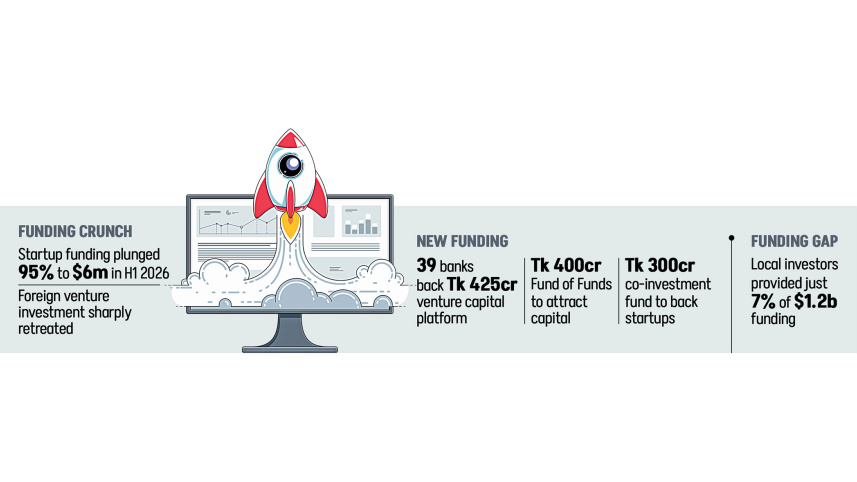
With Bangladesh’s startup ecosystem facing its worst funding drought in more than a decade, the government and banks have launched several new initiatives to provide cash-strapped entrepreneurs with fresh sources of capital.
Startup funding plunged 95 percent year-on-year to just $6 million in the first half of 2026, down from $120 million in the same period last year, according to LightCastle Partners.

The sharp decline underlines the severity of the crisis as foreign venture investment retreats from the country.
Against this backdrop, several state-backed and bank-led initiatives have emerged in recent months. These include a Tk 425 crore bank-backed venture capital platform, a Tk 400 crore government fund-of-funds and a Tk 300 crore direct co-investment facility.
Together, the initiatives are designed to build domestic sources of risk capital for startups, which have historically depended heavily on foreign investors.
BANKS STEP INTO VENTURE CAPITAL
The most significant initiative is the Bangladesh Startup Investment Company (BSIC), the country’s first large-scale, bank-backed venture capital platform.
Set up under the guidance of Bangladesh Bank and backed by 39 commercial banks, BSIC was formally launched on May 12 with an initial paid-up capital of about Tk 425 crore.
Its first investment fund, ONKUR -- Bangladesh Fund I, will provide equity financing to startups at the seed, late-seed and Series A stages. The initiative marks a move away from conventional bank lending, which is generally unsuitable for high-risk, early-stage ventures.
The participating banks can contribute up to 1 percent of their annual net profits, potentially creating a recurring pool of capital rather than a one-off financing programme.
BSIC expects to complete its first three investments by the end of 2026 after setting up its management team and investment committee. It also hopes to attract foreign co-investors, with global investment firms and funds already taking part in its launch events.
Separately, the government’s Startup Bangladesh Limited has launched the Bangladesh Fund of Funds, a Tk 400 crore initiative that will channel public money into professionally managed local and international venture capital funds.
Unlike Startup Bangladesh’s traditional model of directly investing in individual companies, the fund-of-funds will select eligible fund managers, who will then invest in Bangladeshi startups.
The model requires matching capital, which could help government investment attract additional private and foreign funding.
The initiative comes at a time when Bangladesh’s dependence on overseas investors has become increasingly clear.
Of the roughly $1.2 billion raised by Bangladeshi startups over the past decade, local investors contributed only about 7 percent, according to Startup Bangladesh.
Alongside the new fund-of-funds, Startup Bangladesh continues to operate a Tk 300 crore co-investment fund that takes direct equity stakes in promising technology-driven companies.
The government has also allocated Tk 500 crore for startup development in the current fiscal year and introduced tax and VAT incentives, including a zero percent turnover tax for eligible startups.
Together, the measures represent the government’s most coordinated effort yet to create alternative funding sources for the country’s startup ecosystem as private venture funding dries up.
MORE THAN MONEY
 For all latest news, follow The Daily Star's Google News channel.
 Rehan Asad, the prime minister’s adviser on ICT and Telecom, said venture capital and startups would play an important role in diversifying Bangladesh’s economic growth.
“Startups need more than just financing. They also need mentorship, skills, market linkages and technological support,” he said, adding that the Fund of Funds should provide these forms of support alongside investment.
“The government is committed to protecting the interests of both domestic and foreign investors and making it easier for them to repatriate lawful profits and capital,” he said. “Through collective efforts, we can build a strong startup ecosystem.”
Nurul Hai, managing director of Startup Bangladesh Limited, said the new funding initiatives would play a “significant role” in supporting the startup ecosystem amid a global funding slowdown.
“These initiatives were not in place last year. The Fund of Funds, the government’s startup allocation, Bangladesh Bank’s scheme, and the new bank-led initiative involving 39 banks are all new additions in 2026,” he said.
He added that the initiatives would create substantial new funding opportunities for startups.
Nurul said Startup Bangladesh’s Fund of Funds is now operational, with fund managers applying through an expression of interest process, while the first disbursements are expected soon. The agency will also continue making larger investments in startups, backed by the government’s funding commitment and increased allocation.
However, whether the new funds will be enough to reverse the prolonged investment slump remains uncertain, said an expert who requested anonymity.
The ecosystem still has limited domestic institutional investors, while venture capital investment accounts for only a tiny fraction of Bangladesh’s GDP, the expert added.
Syed Almas Kabir, former president of the Bangladesh Association of Software and Information Services (BASIS), welcomed the recent policy initiatives.
“These are positive policy changes because funding is the biggest challenge for startups. However, startups still have to deal with extensive paperwork, making it difficult for them to access funding easily,” he said.
Almas urged authorities to fund deserving startups based on merit without favouring particular entrepreneurs. He also called for a clear policy framework and defined exit plans for venture capital firms to build a more sustainable startup investment ecosystem.
Comments