


Stocks plunge over 100 points as sell-off spreads
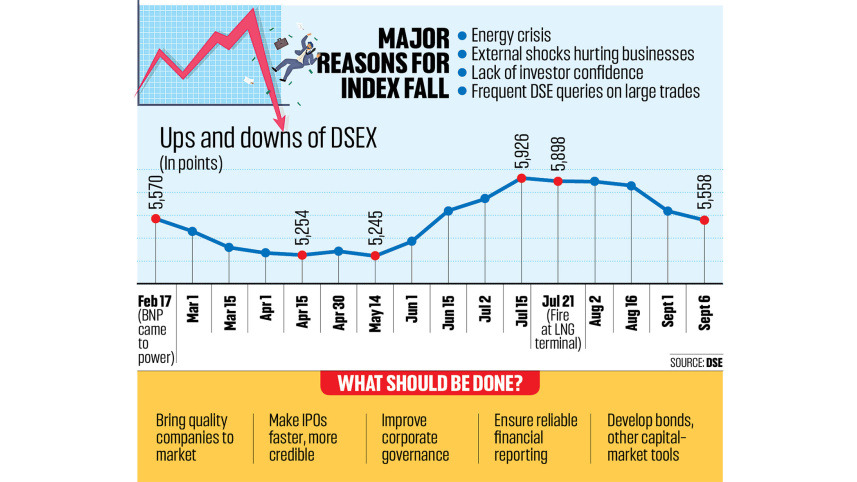
Stocks recorded a sharp fall yesterday amid heavy selling pressure as investors grew concerned over queries from the bourses about large trades, while the risk of political escalation and the energy crisis further weakened market sentiment.
The benchmark index of the Dhaka Stock Exchange, the DSEX, fell 103 points, or 1.83 percent, to close at 5,558, its lowest level in about two and a half months, according to EBL Securities. The Chittagong Stock Exchange also followed the DSE, with its benchmark CASPI index shedding 171 points, or 1.1 percent.

The DSEX reached 5,903 on August 11, its highest level since January this year. Since then, the index has fallen steadily amid persistent energy concerns and growing uncertainty over an economy that has been under strain for the past three years.
Over the past month, the DSEX has lost around 5.7 percent, or 336 points.
Investor participation also weakened. Turnover, a key measure of trading activity, fell 24 percent from Thursday to Tk 545 crore, well below the Tk 1,342 crore recorded a month earlier.
Of the 389 issues traded yesterday, 348 declined, 20 gained and 21 remained unchanged.
The DSE’s blue-chip DS30 index fell 1.1 percent to 2,116. It has declined 3.4 percent over the past month, according to DSE data.
ENERGY CRISIS IMPACT
The DSEX stood at 5,589 in February when the BNP came to power. The index then rose as investors became more optimistic, reaching 5,926 in mid-July.
Stocks, however, began to decline after a fire at the Maheshkhali offshore LNG terminal in late July halved imported gas-regasification capacity and cut supplies to the national grid by about 450 million cubic feet a day.
The incident led to severe gas shortages, which worsened in the following weeks.
Saiful Islam, president of the DSE Brokers Association of Bangladesh (DBA), said the market has actually been declining for several days as the power and gas crisis has become acute.
He said there have been reports of factories closing or failing to keep up production in line with demand because of the energy crisis.
“Many are having to operate using diesel. This will increase companies’ costs, which will directly affect their profits. When companies’ profits are affected, there will inevitably be an impact on the stock market,” said the DBA chief.
The crisis has reached a point where even government officials have not been able to give any proper assurances.
“This is affecting the indices,” Saiful added.
FREQUENT QUERIES
Saiful, who is also a director of BRAC EPL Stock Brokerage, said the practice of stock exchanges sending queries over relatively large buy or sell orders is also affecting investors.
“Whenever there is a slightly large buy or sell order, the stock exchange sends a query. This issue is becoming increasingly significant. Such practices affect investor confidence,” he said.
According to officials familiar with the matter, stock exchanges serve queries when traders place false orders to create panic. For instance, if an investor places an order to buy 10 lakh shares at a certain price and cancels it after a while, it might prompt authorities to serve a query.
 For all latest news, follow The Daily Star's Google News channel.
 Saiful said the problem is manageable.
“We will sit with the DSE very soon to discuss the matter so that they can identify those who violate the rules. But there should not be a blanket practice of sending queries whenever someone buys or sells a large volume of shares,” he added.
An analyst at Shanta Securities said queries by the stock exchanges have affected the market to some extent.
“The decline in turnover is a reflection of that,” the official said, adding, “The long march by 11-party alliance has also impacted the market due to concern over escalation of political conflict.”
EXTERNAL PRESSURES
Listed companies have been under pressure from a series of external shocks over the past several years, including the Covid-19 pandemic, the Russia-Ukraine war, US tariff measures and the Middle East crisis, said an official of Prime Bank Securities, speaking on condition of anonymity.
High interest rates have added to their difficulties, further reducing their ability to absorb shocks, he said.
“The energy shortage is also affecting their bottom line,” he added. Any development that hurts the earnings of listed companies eventually affects the market index.
According to AamarStock.com, a financial data and research platform focused on the DSE, British American Tobacco Bangladesh’s share-price fall had the biggest impact on the DSEX yesterday, pulling the index down by 6 points. Robi Axiata, Square Pharmaceuticals and Investment Corporation of Bangladesh were the other major contributors.
Industry insiders said these companies had a large impact on the index because of their high paid-up capital. However, they noted that most stocks fell yesterday, reflecting weak investor confidence.
Shahidul Islam, CEO of VIPB Asset Management Company, said falling interest rates could make fundamentally strong stocks more attractive.
“Yields on treasury and government bonds have decreased quite noticeably, dropping from around 11 percent over the last two months to nearly 9 percent now.”
“When government bond yields fall, equities or the stock market become relatively much more attractive to investors because the opportunity cost of money decreases,” he said.
Shahidul said shares of companies with strong fundamentals and real business value are currently available at highly attractive prices.
“Therefore, despite the recent market downturn, we have increased our exposure to good fundamental stocks and made new investments in our portfolio.”
Shahidul, however, said that the recent market rally had been driven mostly by low-quality stocks with weak fundamentals. “Despite these companies lacking real business foundations or dividend-paying capabilities, their prices were artificially inflated multiple times over.”
He said the current decline is primarily a correction in those stocks.
Industry experts said restoring investor confidence should be the top priority for the authorities. They called for stronger enforcement against market manipulation, better corporate governance and more reliable financial disclosures.
They also called for bringing more fundamentally strong companies to the market, speeding up the IPO process and increasing the participation of institutional and foreign investors.
Comments