


Novatek proposes $950m seabed-fixed LNG terminal

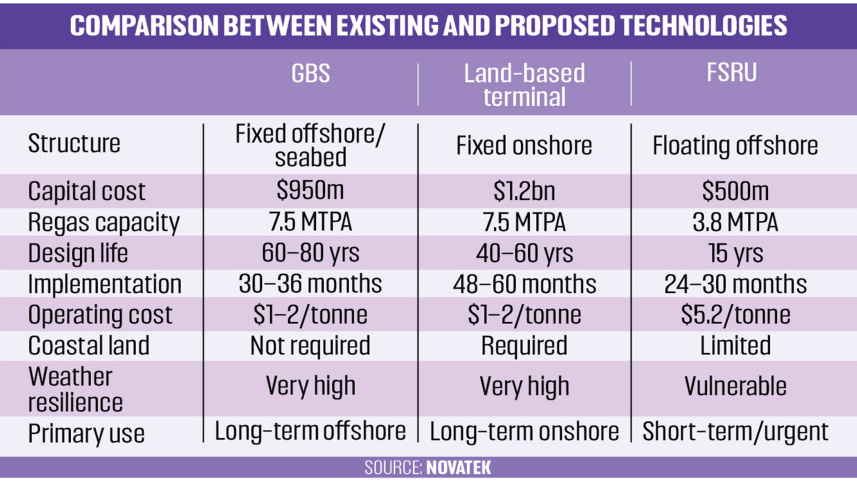
A new option for Bangladesh’s long-term LNG import infrastructure has been proposed, with Novatek Middle East presenting a $950 million gravity-based structure (GBS) as a cheaper and longer-lasting alternative to a conventional land-based LNG terminal.
The company presented the concept to Petrobangla yesterday. The proposed facility would be built in the Bay of Bengal as a fixed offshore terminal for receiving, storing and regasifying imported LNG (liquefied natural gas), with a regasification capacity of 7.5 million tonnes per annum (MTPA).

According to Novatek’s presentation, the GBS would cost about $950 million, compared with an estimated $1.2 billion for a conventional 7.5-MTPA land-based terminal. This would make the offshore option about $250 million, or 21 percent, cheaper in initial capital costs.
However, the figures are based on the company’s own estimates and have not been independently verified. They have also not been compared with the government’s feasibility study for the planned 7.5-MTPA land-based LNG terminal at Matarbari.
The proposal remains at a very early stage, and Novatek has not yet submitted a formal proposal.
“It was a very preliminary-level presentation. We have learned from them. We would discuss it later with the higher-ups,” a top Petrobangla official told The Daily Star.
OFFSHORE STRUCTURE COULD OFFER LONGER LIFE
The main difference between the proposed GBS and a conventional LNG terminal is where the infrastructure is located.
A land-based terminal keeps LNG storage tanks and regasification facilities on the coast, with LNG carriers unloading through marine facilities. A GBS would instead place the storage and regasification facilities offshore on a large reinforced-concrete structure fixed to the seabed. The gas would then be sent to the national grid through a subsea pipeline.
Both systems perform the same basic functions: receiving LNG, storing it, converting it back into gas and supplying it to the gas network.
Novatek has identified deep-sea areas around Moheshkhali and Matarbari as possible locations.
The company estimates that a GBS could be built in 30 to 36 months and have a design life of 60 to 80 years. A conventional land-based terminal would take about 48 to 60 months to build and have a design life of 40 to 60 years.
An FSRU (floating storage and regasification unit), meanwhile, could be deployed in 24 to 30 months but would have a design life of only about 15 years, according to the presentation.
Bangladesh currently imports LNG through two FSRUs at Moheshkhali and plans to add a third. The government has also revived efforts to develop its long-delayed 7.5-MTPA land-based LNG terminal at Matarbari.
The GBS proposal could therefore offer another option as Bangladesh faces a persistent gas shortage, declining domestic gas production and growing dependence on imported LNG.
Recent disruptions at the country’s FSRUs have also exposed the vulnerability of LNG import facilities to technical problems and adverse weather. Reduced LNG send-out during such disruptions has further squeezed gas supplies to power plants and industries.
TWO DESIGNS AIM TO WITHSTAND SEVERE WEATHER
Novatek has proposed two GBS configurations. The larger one would have gross LNG storage capacity of about 290,000 cubic metres, while the smaller one would hold about 194,000 cubic metres.
Both would have 7.5 MTPA of regasification capacity, 1 MTPA of LNG bunkering capacity and 42MW of captive power generation capacity. The larger structure would also be capable of receiving the world’s largest LNG carriers, according to the presentation.
Weather resilience is one of the main advantages claimed for the technology. Novatek describes the GBS as a stationary, all-weather terminal with “very high” resistance to cyclones. FSRUs, by comparison, can face operational disruptions from strong winds, high waves and currents.
 For all latest news, follow The Daily Star's Google News channel.
 These claims, however, would need to be tested for the proposed site. The presentation itself calls for a detailed study of weather and marine conditions, including extreme winds, waves, storm surges, currents, seabed conditions and the safe berthing and transfer of LNG carriers.
The main GBS facility would not require coastal land, according to the proposal. Some onshore infrastructure would still be necessary, however, to connect the subsea gas pipeline to the national transmission network.
The technology draws on GBS structures developed by Russia’s Novatek, which has used large concrete gravity-based structures for its Arctic LNG 2 project.
The application in Bangladesh would be different. The Arctic LNG 2 structures house LNG production and liquefaction facilities, while the proposed Bangladesh facility would receive imported LNG, store it and convert it back into gas for domestic use.
‘Virtual pipeline’ and regional hub planned
The proposal also includes a second phase in which small, shallow-draft vessels would transport LNG from the offshore terminal to riverbank facilities near Meghnaghat, Ashuganj, Ghorashal and Bheramara.
Novatek calls this a “virtual pipeline” that could supply major gas-consuming areas without relying entirely on the existing pipeline network.
The idea comes as the government is also exploring the use of ISO tanks from Malaysia to transport LNG to gas-starved areas outside the main gas network.
ISO tanks would carry LNG in standardised cryogenic containers by road or other transport modes and would serve relatively small volumes. Novatek’s proposed system, in contrast, would move much larger volumes using dedicated LNG vessels to riverbank regasification facilities.
Novatek also sees the GBS becoming a regional LNG transhipment and bunkering hub. The presentation identifies potential shipments from Bangladesh to India, Pakistan, Sri Lanka, Vietnam, Malaysia and Indonesia using small and medium-sized LNG vessels.
Novatek has proposed an investment model based on foreign direct investment, but the presentation does not provide details on the commercial structure, tariffs, financing costs or expected investor returns.
Comments