


Solar-powered factories weather energy disruption

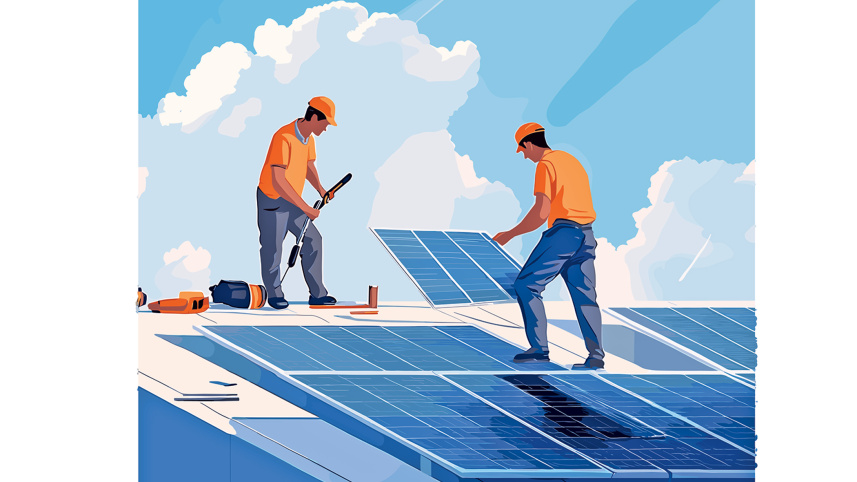
As many factories scramble for diesel to keep generators running during load-shedding, production lines at Ha-Meem Group hum on without interruption.
The difference is overhead. Over the past few years, Ha-Meem, one of the country’s largest garment exporters, has turned its rooftops into power plants, installing 12 megawatts of solar capacity at a cost of Tk 54 crore.

The investment was steep, but it is currently paying off.
“… now we are getting a good advantage. For example, during load-shedding, it works as a backup,” said AK Azad, managing director of Ha-Meem Group.
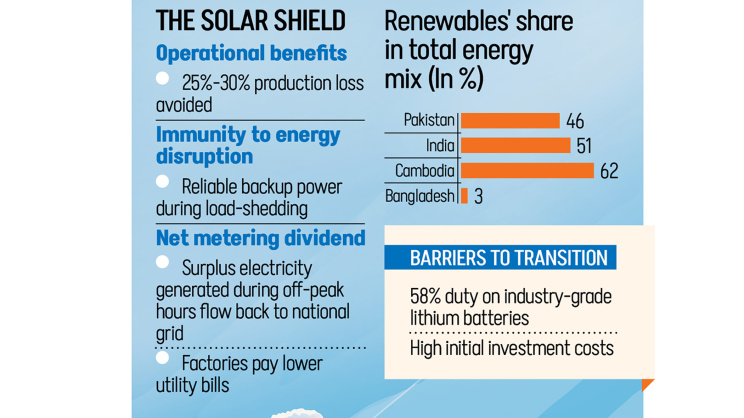
Ha-Meem’s solar system does more than keep sewing machines running. When output exceeds demand, surplus electricity flows back to the national grid under a net metering arrangement, trimming the company’s electricity bill.
Azad said that without solar power, the group would have faced serious difficulties. Frequent load-shedding and a worsening fuel shortage, caused by the US-Israel war on Iran, have pushed up costs across the production sector.
The situation has become so acute that the Bangladesh Garment Manufacturers and Exporters Association (BGMEA) recently urged the government to prioritise diesel supplies for factories through nearby filling stations.
Exporters say production capacity in major industrial hubs has already fallen by 25 percent to 30 percent as energy shortages continue to bite.
The country’s largest industrial rooftop solar system was installed at the Korean Export Processing Zone (KEPZ) in Chattogram in 2020.
This plant, operated by Youngone Corporation, currently generates 44 megawatts of solar power. It meets peak demand for factories inside the zone and sells surplus electricity to the Bangladesh Power Development Board (BPDB) through net metering.
“We are not facing problems due to diesel shortages caused by war or due to load-shedding,” said Md Shahjahan, managing director of KEPZ.
He said many factories in the zone operate little at night, leaving excess power to sell. “In that sense, renewable energy is giving us a good dividend.”
He added that greater reliance on renewable energy would shield industrial units from power cuts and diesel shortages. It could also help secure more export orders in markets such as the United States and Europe, where buyers increasingly favour greener supply chains.
Amid the energy shortage, however, not all factories enjoy full coverage of solar power.
Syed M Tanvir, managing director of Pacific Jeans Ltd, which has production units in Chattogram, said solar panels meet about 20 percent of his factory’s daytime demand.
During load-shedding, he still depends on diesel generators to run operations. Even so, solar power keeps fuel use lower than at factories without any renewable options, giving him a relative edge.
Tanvir estimates there are around 2,000 megawatts of standby generator capacity across factories in various sectors, all running on diesel. If those generators operate for four to five hours a day, fuel consumption soars.
Typically, factories require one to two megawatts for backup. Rooftop solar systems could meet much of that demand, he said. “Besides, it would reduce reliance on diesel and ease pressure on foreign currency reserves.”
HIGH COSTS HOLD BACK EXPANSION
Bangladesh remains well behind its neighbours in clean energy adoption. Non-fossil fuel sources accounted for 51 percent of India’s electricity generation in the 2025-26 financial year.
 For all latest news, follow The Daily Star's Google News channel.
 Cambodia derives 62 percent of its power from renewable sources, largely hydropower, giving its textile sector a comparatively low carbon footprint. Pakistan’s clean energy share stands at around 46 percent as of September 2025.
By contrast, renewables account for only about 3 percent of Bangladesh’s total energy mix.
Entrepreneurs say the main obstacle is cost. Renewable energy requires heavy initial investment, and import duties on equipment are steep.
In Bangladesh, industry-grade lithium batteries face a 58 percent duty. Manufacturers say that a temporary reduction, even for two to three years during the ongoing energy crisis, would encourage factories to replace diesel generators.
Their argument is that such a move would support industry and help the government save foreign currency by cutting fuel imports.
KEPZ Managing Director Shahjahan said the government could play a decisive role. With policy support, solar adoption would accelerate, lowering energy import dependence and strengthening energy security.
TRANSFORMATION NEEDS POLICY PUSH
Khondaker Golam Moazzem, research director of the Centre for Policy Dialogue (CPD), said it is good news that the companies that pioneered and invested in solar energy are getting their dividend back.
He said this would encourage others to pursue green transformation.
He also urged the government to provide immediate fiscal support so that factories are encouraged to invest more in solar.
According to Moazzem, policy backing should focus on improving merchant power plants. The government could explore regional markets for renewable energy, which would protect industry from disruptions in diesel, furnace oil and other fossil fuels.
Muzaffar Ahmed, chairman of the Sustainable and Renewable Energy Development Authority (Sreda), said many production units are struggling with fossil fuel-based energy, creating an opportunity to expand renewables.
He said Sreda would make its best efforts, although issues such as import duties fall under the National Board of Revenue (NBR).
Mahmud Hasan Khan, president of the BGMEA, said he has avoided the worst of the current energy crisis by using solar power.
Khan welcomed the government’s plan to expand solar generation but said it must be matched by genuine policy commitment.
Although a policy allows renewable energy generation through merchant power plants, the wheeling charges levied by the BPDB are too high, he said.
The BGMEA president said renewable energy must be commercially viable for producers. Without that, the transition will fail to gather pace.
Comments