


Salinity, shorter winters hamper wheat cultivation in south

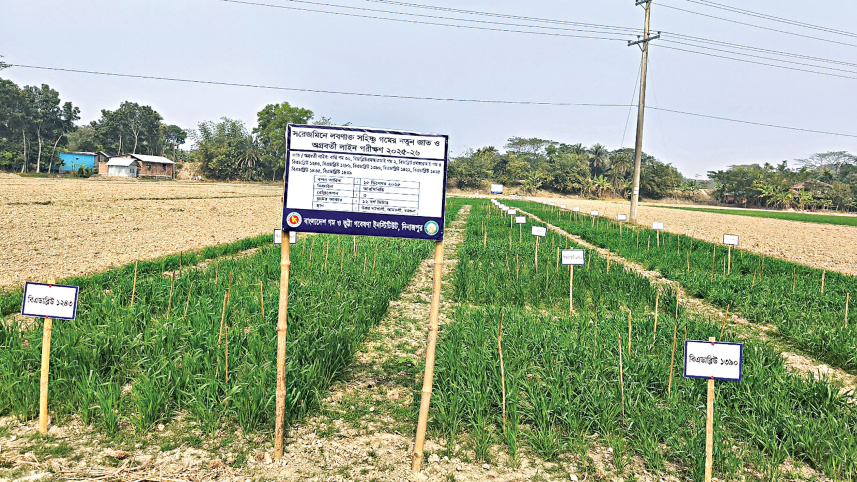
Wheat cultivation in the southern districts of Bangladesh remains handicapped by challenges such as high soil salinity, shorter winters and seed shortages, leaving vast stretches of farmland uncultivated during the dry season.
Several projects are underway in which the Department of Agricultural Extension (DAE) is working in collaboration with other government and non-government agencies, as well as foreign entities, to promote salt- and heat-tolerant wheat varieties in the region, aiming to reduce the country’s dependence on imports.

However, these sporadic projects keep failing to leave a lasting impression as farmers in the region discontinue wheat farming, leaving the lands unused in winter and turning to crops that are less troublesome to cultivate and are also more profitable.
Since 2017, the Bangladesh Wheat and Maize Research Institute (BWMRI) and Bangladesh Agricultural University have been conducting joint research to reduce wheat import dependence
In Kalapara upazila’s Nilganj union, farmer Zahidul Islam cultivated wheat on two bighas of land in 2022 and 2023 using relay cropping. The practice involves sowing two wheat crops in the same season -- the second crop is sown in the wet fields while the first, nearly mature crop, is yet to be harvested.
Under a project supported by the University of Western Australia, he and 10 other farmers in Daulatpur village received seeds, fertiliser and technical assistance.
However, after the project ended, he stopped wheat cultivation and shifted to Boro rice, leaving the fields fallow for nearly eight months.
The farmer said that salinity increases during the dry season, but regular irrigation for Boro rice keeps water in the fields, reducing salt levels.
“Boro is more profitable than wheat,” he said, adding that aside from rice, no other crop grows well in the region.
Since 2017, the Bangladesh Wheat and Maize Research Institute (BWMRI) and Bangladesh Agricultural University have been conducting joint research to reduce wheat import dependence. The initiative was supported by the Australian Centre for International Agricultural Research, Bangladesh Agricultural Research Institute (BARI), Australia’s Commonwealth Scientific and Industrial Research Organisation (CSIRO) and the University of Western Australia.
Under the project, 28 farmers in East and North Daulatpur villages of Kalapara cultivated wheat using relay cropping in 2022 and 2023. But most have stopped farming wheat following the project’s completion.
Mrinmoy Guha Neogi, deputy project leader of the University of Western Australia, said more than 1,00,000 hectares of land in Patuakhali remain fallow during the dry season.
He added that salinity in the region rises to 10-12 decisiemens per metre during the dry season, making crop production difficult.
“We tried to bring these lands under wheat cultivation. We proposed implementing the programme through the government agriculture department, but it was not adopted,” he said.
“Due to seed shortages and lack of continuation, farmers have moved away from wheat.”
“We encouraged farmers to cultivate salt-tolerant wheat varieties,” he said.
Despite challenges, the DAE continues to motivate farmers to cultivate wheat on a limited scale.
In total, wheat was cultivated on 154 hectares of land in Patuakhali, out of which 60 hectares are in Kalapara upazila alone, according to Upazila Agriculture Officer Md Arafat Hossain and Patuakhali DAE Deputy Director Md Aminul Islam.
In Dashmina Upazila’s Gachani village, farmer Md Shaheen cultivated wheat on 25 decimals of land for the first time this year.
“On the advice of agriculture officials, I planted salt-tolerant wheat. Now I am waiting to see the results,” he said.
 For all latest news, follow The Daily Star's Google News channel.
 But salt-tolerant varieties are not enough to solve the issue. Another predicament remains -- the country’s short winter and rising temperatures.
“Wheat is a cool-weather crop. But in southern Bangladesh, winter is neither intense nor long enough, which affects production,” Patuakhali DAE Deputy Director Md Aminul Islam said.
Barguna DAE Deputy Director Rathindra Nath Biswas echoed the view.
“Due to excessive heat, wheat grains often become shrivelled.”
Over the past decade, wheat acreage has fallen, giving way to more profitable crops. While disinterest in wheat farming translates to acres of fallow land in Patuakhali, farmers in some other southern districts opt for cultivating crops such as maize or papaya -- garnering higher profit.
Despite falling acreage, the spread of improved, heat- and disease-tolerant varieties helped cushion total production losses. Farmers have been shifting to varieties that mature early and can tolerate higher temperatures while giving better yields.
“From next year, we plan to promote the heat-tolerant BARI-33 variety at the farmer level,” Barguna DAE Deputy Director Rathindra Nath Biswas said.
BWMRI is working to develop salt-tolerant wheat varieties in Patuakhali, Barguna and other southern districts. The institute is conducting experimental cultivation on 10 bighas near Payra Port and Pakhimara area in Kalapara, and on one bigha in Amtali, Barguna. Several salt- and heat-tolerant varieties, including BARI Gom-30, BWMRI-2 and 4, and BW-1243, 1286, 1290, 1422, 1425, 1435 and 1439, are being tested.
Mehedi Hasan, assistant scientist of the project, said they are working to encourage farmers and expand wheat cultivation in the region.
“The results are promising. We hope increased wheat production on fallow saline lands will help reduce the country’s dependence on imports,” he said.
In its Grain and Feed Update on Bangladesh, released in December 2025, the US Department of Agriculture (USDA) predicted that wheat acreage could be 2.90 lakh hectares and production 10.5 lakh tonnes.
Local production currently meets only about 13 percent of Bangladesh’s total wheat demand, according to the USDA. The Food and Agriculture Organisation of the United Nations estimates that imports cover the rest, roughly 80 percent of national consumption.
Comments