


Rural areas lag behind as digital divide persists
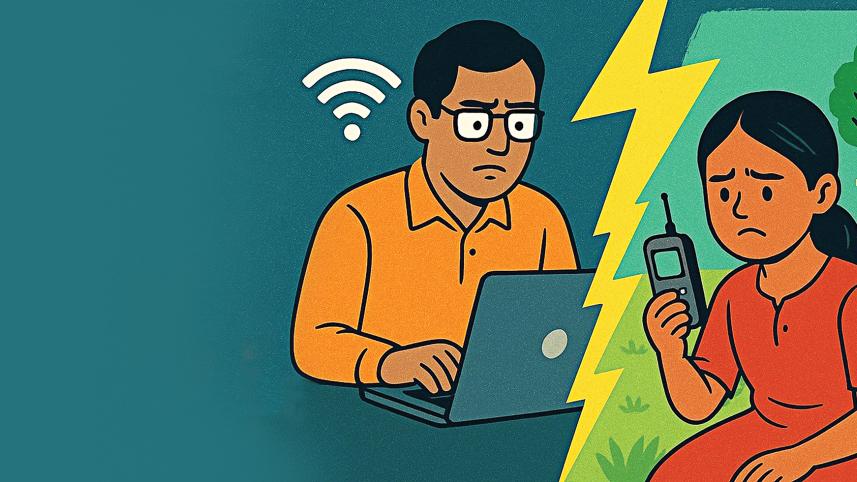
A sharp digital divide continues to shape Bangladesh’s connectivity landscape, with a 32.1 percentage points gap in internet use between rural and urban populations in the fiscal year 2024-25, according to the latest Bangladesh Bureau of Statistics (BBS) survey.
The survey shows that 43.6 percent of people in rural areas use the internet, compared to 75.7 percent in urban areas, highlighting persistent inequality in access to digital services. Overall, 53.4 percent of the population is connected to the internet, meaning nearly half of Bangladesh remains offline.

The findings were presented on Tuesday at the BBS headquarters in Agargaon in a report titled ICT Access and Use by Households and Individuals Survey 2024-25.
The divide is also visible across regions. Household internet access is highest in Dhaka, while the lowest is recorded in Panchagarh. Computer use follows a similar pattern, with Dhaka reporting the highest levels and Thakurgaon the lowest.
The survey is the first time the BBS has released ICT data at the district level, providing detailed information on smartphone and mobile phone access nationwide. It covered around 264,000 households across 64 district domains, with about 4,125 households in each district.
Feni ranks highest in household smartphone access, while Panchagarh is the lowest.
Other high-access districts include Cumilla, Chattogram, Noakhali, Brahmanbaria, Gazipur, Narayanganj, Dhaka, Chandpur and Shariatpur. The lowest-performing group includes Kurigram, Jhalokati, Sherpur, Nilphamari, Rangpur, Lalmonirhat, Thakurgaon, Dinajpur and Gaibandha.
These gaps highlight how differences in infrastructure and income continue to leave many rural communities behind in Bangladesh’s digital economy.
Zulkarin Jahangir, assistant professor at North South University and a member of Unesco AI Ethics Experts Without Borders, said the latest figures showing a wide rural-urban digital usage gap are a warning sign in the age of AI.
“The digital divide is no longer only about access; it is about meaningful engagement and the ability to benefit from digital services,” he said.
“If nearly half of rural Bangladesh remains excluded from effective digital participation, the rapid integration of AI into public services risks deepening existing inequalities, creating what I call a compounded divide.”
He added that without targeted measures such as improving digital literacy, affordability and AI-ready public infrastructure, AI could widen rather than bridge the gap.
Rehan Asad, adviser to the prime minister for telecom and ICT, recently told The Daily Star that no country can achieve technological progress without robust connectivity, describing it as the foundation of economic growth.
He pointed to global research linking faster, more reliable networks with higher GDP growth.
He also highlighted Bangladesh’s weak fibre penetration compared with peer countries and inconsistent internet speeds even in Dhaka, stressing the need for region-specific solutions after reviewing the telecom landscape.
GENDER GAP IN DIGITAL ACCESS
The survey also found a gender gap in internet use and device ownership. The smallest gap is in basic mobile phone use, at 3.2 percentage points, with 90 percent of males compared to 86.8 percent of females.
The widest gap is in smartphone ownership, at 9.5 percentage points, with 50.1 percent of males versus 40.6 percent of females.
Internet use shows a 6.4 percentage point gap, with 56.6 percent of males compared to 50.2 percent of females.
AFFORDABILITY AND ACCESS BARRIERS
 For all latest news, follow The Daily Star's Google News channel.
 Affordability remains a major barrier to internet use, with 43.6 percent of respondents citing high subscription costs and 46.4 percent pointing to expensive equipment. These challenges affect rural populations more due to lower incomes and weaker digital infrastructure.
While mobile phone use is high at 88.4 percent, only 64.4 percent own a personal handset, showing widespread shared use. At the household level, 98.9 percent have a mobile phone, and 72.7 percent have a smartphone.
Computer use remains very low at 11.3 percent, with household access at just 9 percent, limiting access to advanced digital services.
ONLINE BEHAVIOUR AND DIGITAL SKILLS
Among internet users, the most common activity in the past three months was searching for government jobs, reported by 64.4 percent, followed by sports-related content at 49.8 percent.
Only 11.6 percent engaged in online shopping during that period, while 16.9 percent contacted government services online in the past 12 months.
In terms of digital skills, 84.4 percent could use basic tools such as copy and paste, and 78.5 percent could take action following a cyberattack. However, 50.5 percent still identified viruses and malware as the biggest online threat.
Comments