


Rising borrowing costs stall mid-segment housing market
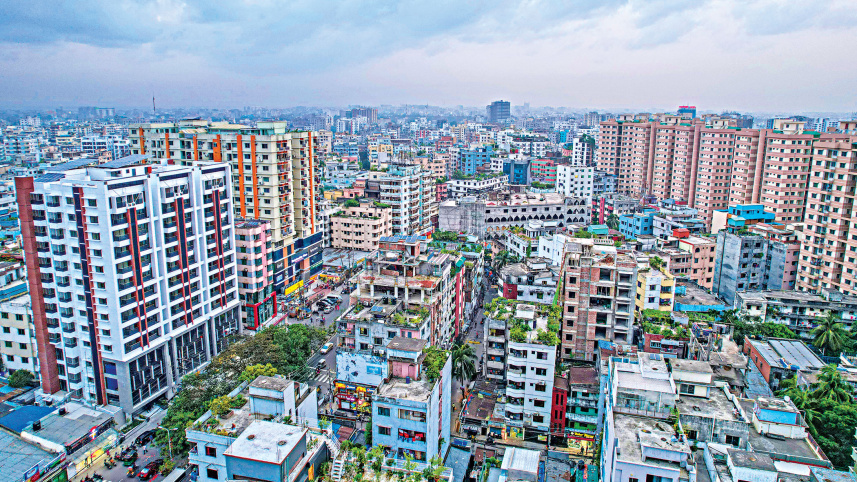
Surging home loan interest rates have brought Bangladesh’s mid-segment housing market to a near standstill in 2025, squeezing salaried buyers who depend heavily on bank financing and sharply raising monthly instalments beyond affordability.
Combined with political and economic uncertainty, the spike in borrowing costs has slashed sales, triggered cancellations and shaken investor confidence across the real estate sector.

According to Bangladesh Bank data, the interest rate on housing loans rose to as high as 17 percent in January 2024, up from a maximum of 9 percent in January 2022, and remained elevated through January 2026.
A senior official at a bank said that high interest rates have significantly affected the mortgage market since most salaried buyers rely heavily on bank financing
“High home loan interest rates, along with political and economic instability, have significantly impacted Bangladesh’s real estate sector in 2025, particularly the mid-market segment,” said Anup Kumar Sarker, senior executive director of Concord Group.
He noted that the sharp rise in borrowing costs last year dealt the biggest blow to the industry, as mid-market buyers largely depend on bank loans. Typically, buyers finance about 70 percent of an apartment’s value through loans and pay the remaining 30 percent as a down payment.
When rates were in single digits, instalments were manageable for salaried individuals. But as rates climbed to 14-16 percent amid inflationary pressure, monthly repayments rose sharply.
“Many service holders plan to replace rent payments with loan instalments to own a home,” Sarker said. “But with higher interest rates, that calculation no longer works.”
He added that sales have declined by at least 30 percent industry-wide, with even relatively stable developers reporting 20-25 percent de-growth.
Under normal conditions, Concord sells 20-30 units per month, but volumes have fallen since August 5, 2024. Rising financing costs have also dampened investor interest, making property returns less attractive in a volatile market.
A senior official at a leading private-sector bank who oversees home loans echoed those concerns, saying unusually high rates have significantly affected the mortgage market since most salaried buyers rely heavily on bank financing.
He said stricter apartment registration rules also had a notable impact on loan disbursement and overall demand, though some of those regulations have recently been eased.
The maximum home loan limit has been raised to Tk 4 crore from Tk 2 crore, a move he believes could offer some relief to prospective buyers and support a gradual recovery.
The rise in borrowing costs was not accidental. The central bank dismantled a fixed 9 percent lending rate cap and shifted to a market-driven regime as part of a broader effort to manage inflation and stabilise liquidity in the banking system.
“The transition to a market-aligned system was a necessary step to stabilise the economy,” said M Nazeem A Choudhury, deputy managing director of Prime Bank.
Market rates now typically range between 11.5 and 13.5 percent, noted Choudhury.
Under the circumstances, his bank worked to undercut that range, offering home loans at 10.5 to 11.5 percent, which he said has resulted in an uptick in borrowers transferring existing loans from competitors seeking better terms.
Developers, meanwhile, have felt the pressure from multiple directions.
Md Bahauddin Mia, director of corporate affairs and public relations at Asset Developments & Holdings Ltd, said falling apartment prices and rising construction material costs have squeezed margins.
“We witnessed a tough time. Apartment prices have declined, while material costs have increased. This imbalance has created ongoing difficulties,” he said.
 For all latest news, follow The Daily Star's Google News channel.
 He attributed part of the price decline to capital outflow among affluent buyers.
“Those who usually purchase apartments worth Tk 2 to Tk 3 crore are now investing abroad. For others, buying property in that range has become difficult,” Mia said.
Asset Developments, which focuses on the upper-middle-income segment in areas such as Uttara and Bashundhara, typically sells 150-200 units annually. Sales have slowed recently, compounded by a rise in cancellations.
“Several clients who booked apartments before August 5 later sought cancellations, citing business closures and financial constraints,” he said.
M Hoque Faisal, director of sales and marketing at Tropical Homes Limited, described 2025 as a challenging year, citing amendments to Dhaka’s Detailed Area Plan (DAP), prolonged policy revisions, banking sector instability and broader economic and political uncertainty.
He said repeated regulatory changes since 2023 created uncertainty among developers. It took nearly three years for the government to finalise the policy framework, discouraging new land acquisitions amid fears of reduced allowable space and potential losses.
He said delays in Rajuk (Rajdhani Unnayan Kartripakkha) approvals, including server downtime and the transition to an online system, further slowed new projects. Even after approval, it takes at least a year for construction to become visibly apparent.
The high-end segment has been hit hardest, with luxury apartment sales in Gulshan, Banani and Dhanmondi falling 60-70 percent, he noted.
He added that Tropical Homes, which typically sells around 300 units annually, sold approximately 250 last year, a 16 percent drop.
Industry-wide, monthly sales have fallen to 700-750 units from around 1,000, and the expected annual price appreciation of 5-8 percent has stalled, with some projects recording negative growth of 5-10 percent.
Liakat Ali Bhuiyan, senior vice-president of the Real Estate and Housing Association of Bangladesh (REHAB), said DAP delays, high interest rates and political uncertainty collectively weighed on the market in 2025.
“Now that we have an elected government, the market is expected to improve gradually,” he said.
Comments