


Proposed budget not election-oriented
The government's plan regarding revenue collection in fiscal year of 2023-24 was decided from a bureaucratic standpoint as it will increase pressure on lower-income groups, according to analysts.

The government aims to collect Tk 450,000 crore in taxes in the upcoming fiscal year but there are inconsistencies in the data on how to achieve this target, said Debapriya Bhattacharya, a distinguished fellow of the Centre for Policy Dialogue (CPD).
So, although the proposed budget is for an election year, it cannot be called election-oriented as such budgets usually feature aspects related to improving public satisfaction, which is absent here, he added.
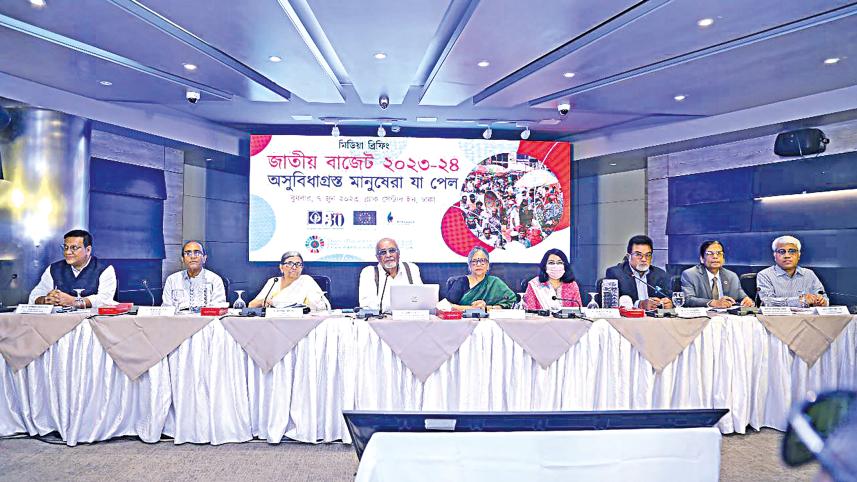
Bhattacharya made these comments at a media briefing on "National Budget 2023-2024: What did the disadvantaged people get".
Chaired by Sultana Kamal, former adviser of a caretaker government, the event was jointly organised by the CPD and Citizen's Platform for SDGs, Bangladesh, at Brac Centre Inn in Dhaka yesterday.
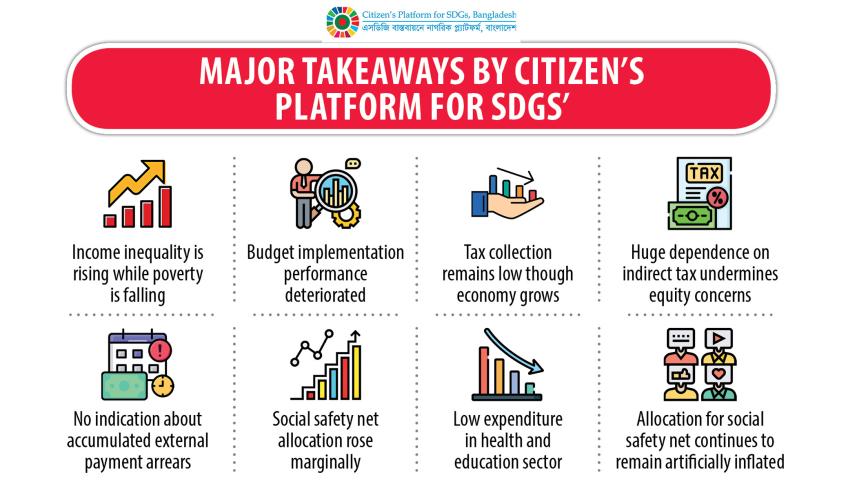
Bhattacharya, also convenor of the Citizen's Platform for SDGs, Bangladesh, said inequality has worsened, with urban inequality increasing faster both in terms of income and consumption while wealth inequality is even higher.
He said the total fund for social safety net programmes (SSNPs) were increased marginally in the proposed budget but in actuality, it declined both as a share of the national budget and gross domestic product (GDP).
Bhattacharya alleged that the government shows the SSNP allocation together with its subsidies on agriculture, tax exemptions and different allowances to make the figure larger.
But as a share of the GDP, the SSNP's allocation for compatible programmes declined to 29.2 per cent in the proposed national budget for FY 2023-24 from 29.7 per cent the year before.
In terms of its share of the budget, the SSNP's allocation was reduced to 0.7 per cent for the next fiscal compared to 0.8 per cent in FY 2022-23, he said.
Bhattacharya went on to say that Bangladesh ranks 184th out of 186 countries in terms of general government health expenditure as a percentage of the country's GDP.
The global median value for general government health expenditure as a percentage of GDP is 3.44 per cent while the government's allocation for the health sector is only 0.76 per cent for next fiscal year.
According to him, public expenditure in FY 2022-23 was to some extent, intentionally kept very low compared to the annual target.
He said attaining the public expenditure target in FY 2023-24 may require approximately 40 per cent growth over the actual achieved public expenditure by the end of the year.
Bhattacharya also said the budget did not increase in line with the growth of the economy.
In addition, the performance of budget implementation in terms of revenue mobilisation and public expenditure, such as spending under the Annual Development Programme, has deteriorated over the years.
The global median value for public expenditure is 32.2 per cent of GDP while Bangladesh ranks 119th out of 123 countries in terms of its tax-GDP ratio, he added.
Regarding investment, he said the government aims for gross investment of 33.7 per cent of the GDP in FY 2023-24. Of this amount, 27.4 per cent is expected from the private sector and 6.3 per cent from the public sector.
"But if the investment target is fulfilled, then the GDP target of 7.5 per cent will also be achieved," Bhattacharya added.
 For all latest news, follow The Daily Star's Google News channel.
 However, he said the investment target will be difficult to achieve due to the present condition of the economy considering how the target of the outgoing fiscal year could not be fulfilled.
In the outgoing fiscal year, actual achievement of the investment target was 27.8 per cent against the projection of 31.5 per cent.
Of this investment, 21.8 per cent came from the private sector against a projection of 24.8 per cent while the public sector accounted for 6 per cent against a projection of 6.7 per cent.
Samir Ranjan Nath, head of the BRAC Education Programme, said the government allocated only 1.5 to 1.6 per cent of the GDP for the education sector against its commitment of 6 per cent.
"It is not possible to ensure quality education with such a limited budget," he added.
Nath also said the proposed budget was totally devoid of measures that would help address the concerns of students from disadvantaged communities.
Fauzia Moslem, president of the Bangladesh Mahila Parishad, said women are always victims of inequality in both wealthy and low-income families.
So, even though the government allocations for women's development is very limited, it is still a positive initiative.
The government usually allocates more than Tk 32,000 crore for the skills development of women but it remains unclear how the budget is utilised.
Citing this allocation as a form of consolation prize, Moslem demanded the formation of a special division for women's empowerment and skills development.
Fahmida Khatun, executive director of the CPD, said allocations for climate change help mitigate the impacts of natural disasters while also lowering carbon emissions.
According to her, climate change is a multi-sectoral problem that has direct implications for disadvantaged people.
She suggested the government invest in measures that address climate change as the private sector will not invest in this regard considering the lack of profitability.
Asif Ibrahim, chairman of the Chattogram Stock Exchange, said the private sector is worried about the energy crisis and continuous appreciation of US dollar and inflation, which were not addressed in the budget.
According to him, energy prices have increased around 60 per cent over the past year, increasing the burden of investment.
With this backdrop, it will be difficult to increase private investment to 27.4 per cent, said Ibrahim, also a former president of the Dhaka Chamber of Commerce and Industry.
"We create employment and contribute to government revenue, so we need quality infrastructure," he added.
Ibrahim also urged for enhanced political stability to ensure higher investment from the private sector along with investment friendly policies.
However, he said there is not a single word in the proposed budget regarding the development of the capital market, where people make long-term investments.
Mustafizur Rahman, a distinguished fellow of the CPD, said the economy is passing through a tough time and so, the government should come forward with investment.
As an example, Rahman said if the government invests Tk 1, then the private sector invests Tk 3.
Regarding the slow implementation of development projects, Rahman said there are a total of 288 projects that are aged between six to 10 years.
These projects have seen cost overruns in line with time extensions for slow implementation.
If a project faces delays in implementation, the people cannot reap the benefit, he added.
Comments