


Producers now responsible for plastic waste management
A shampoo sachet used to be the manufacturer’s problem only until it left the shop. Once a customer bought it, the company’s responsibility effectively ended. The empty sachet then went into a bin, a drain or simply onto the street, with no clear obligation on the maker to deal with what happened next.
Now, that has changed as new government rules shifted responsibility for plastic packaging waste to the companies that make, import or sell those products.

The change covers a wide range of everyday products, from carbonated drinks, juices and mineral water sold in PET bottles to shampoos in sachets, sauces in packets and chips and snacks in multilayer packaging.
Companies will have to collect and recycle part of the plastic waste generated by their products after consumers use them, according to the new regulation. Failure to comply could cost companies their environmental registration and, effectively, force them to stop operating.
The Ministry of Environment, Forest and Climate Change published the “Extended Producer Responsibility (EPR) Guidelines 2026” on August 13, bringing them into immediate effect.
The guidelines apply to all recyclable and non-recyclable plastic products produced or used in Bangladesh, and cover manufacturers, importers and brand owners of listed products.
Amid growing concern over plastic pollution, the rules for the first time make producers directly responsible for managing plastic waste after their products are used. Companies will have to collect, recycle and dispose of the waste either individually or jointly.
Export-oriented industrial establishments producing goods against export orders are excluded from the rules.
The move puts Bangladesh alongside a growing number of South Asian countries trying to make producers responsible for the waste their products generate.
India introduced similar rules in 2022, while Pakistan published its Single-Use Plastic Prohibition Regulations in 2023. Sri Lanka is also moving towards a mandatory system, while Nepal and Bhutan are at an earlier stage of developing one.
Under the guidelines, the Department of Environment will list companies in phases. Large industries will be listed in the first two years, medium industries in the next two years and small industries in the fifth year.
Companies will have to register within six months of being listed. Registration will remain valid for three years but will not be renewed if a company fails to submit annual progress reports.
Bangladesh generates around 800,000 tonnes of plastic waste a year, roughly equivalent to the cargo capacity of 200 Titanics. Only about 40 percent of it is recycled, according to the Bangladesh Plastic Goods Manufacturers and Exporters Association.
FIVE TYPES OF PLASTIC WASTE, 15% MINIMUM COLLECTION
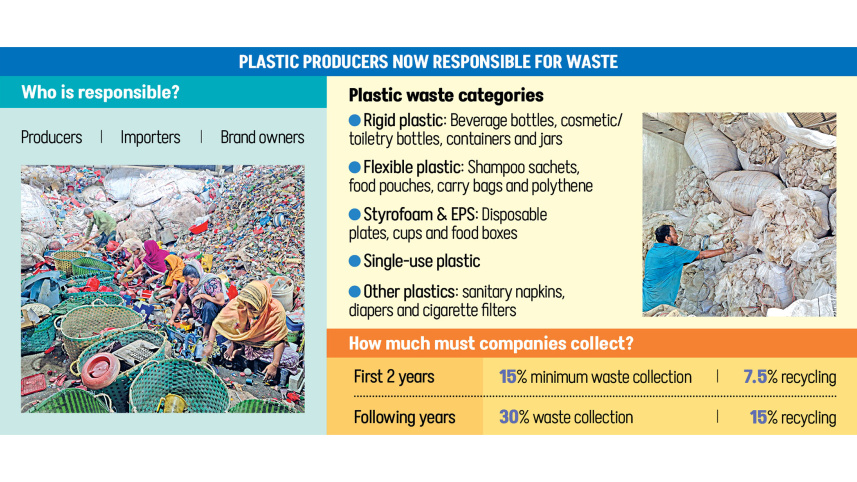
The guidelines divide plastic products into five categories.
The first is rigid plastic, covering hard and structurally firm items that retain their shape. These include soft drink and beverage bottles, toiletries and cosmetic bottles, containers and jars.
The second is flexible plastic, including shampoo sachets, food pouches, carry bags, polythene and multilayer plastic packaging.
The third is styrofoam and expanded polystyrene, lightweight foamed plastics commonly used for thermal insulation and disposable food containers. Plates, cups and food packaging boxes are included in this category.
The fourth category is single-use plastic. The fifth covers other plastic products, including sanitary napkins, nappies and cigarette filters.
Companies will have to collect at least 15 percent of their plastic waste and recycle 7.5 percent in the first two years after being listed.
 For all latest news, follow The Daily Star's Google News channel.
 The 15 percent collection target will be calculated against the total amount of plastic packaging a company manufactures or puts on the market each year. Companies will have to meet the minimum collection target for each specified category of plastic waste.
The targets will rise in subsequent years to 30 percent for collection and 15 percent for recycling.
Waste collected above the required target can be sold as a plastic credit to other institutions or in international markets through a government-approved system.
The government hopes the guidelines will make producers, importers and brand owners directly responsible for managing their products after use.
It also expects the system to expand waste collection and recycling infrastructure, bring more informal waste collectors into the formal system and help develop a circular economy.
The move is also intended to strengthen the country’s efforts to reduce plastic pollution in the marine environment and meet its international commitments on plastic pollution.
‘NO PROBLEM FOR US’, SAYS RFL
Local plastic giant RFL says it is already recycling more than 20 percent of its plastic waste and will have no difficulty meeting the new requirements.
“Becoming fully compliant will not be a problem for us,” said RN Paul, managing director of RFL.
Around 300 small and medium-sized plastic recycling plants have been set up across the country over the years, according to the Bangladesh Plastic Goods Manufacturers and Exporters Association.
Large conglomerates, including PRAN-RFL Group and Akij Group, have also invested in plastic recycling.
But the new rules could prove harder for smaller businesses.
Paul said the requirements could be difficult for smaller businesses to comply with if implemented strictly. “Plastic is a sophisticated industry. If the government enforces the requirements strictly in the future, many small businesses may be forced out,” he said.
He compared the situation with the introduction of effluent treatment plants (ETPs) around two decades ago. While large companies have gradually brought themselves into compliance, many smaller factories still do not maintain ETPs, he said.
“I think the same thing will happen here. Those of us who have already started recycling will continue to do so. Smaller businesses will comply if they can afford it; otherwise, many simply won’t,” Paul said.
“Remember how long it took to implement the polythene ban? Many years. And even now, polythene is still being used in different forms,” he said.
WHY SOME COMPANIES CALL IT ‘IMPRACTICAL’
Sayedul Azhar Sarwar, head of Business at Danish, said the government’s new plastic packaging waste rules could pose a major challenge for businesses if collection targets are applied at the consumer level.
“Suppose you use a plastic or foil packet for milk powder. How can I collect that packet from your home after you have used it?” he said.
He suggested giving incentives to recycling companies to collect plastic waste from consumers. Another option would be to introduce separate collection points in residential areas for plastic, cans and other waste.
Quamrul Hassan, business director of ACI Consumer Brands, said making manufacturers responsible for collecting and recycling plastic packaging would not be practical.
He suggested a citywide waste collection system that separates household waste into three categories: kitchen waste, dry waste such as plastic and paper, and human waste.
Plastic waste, Quamrul said, could be processed through waste-to-energy plants in major cities, although such facilities would be expensive and would require government involvement.
He said similar systems are already operating in other countries, citing his visit to Colombo, where he saw a waste management system that converts waste into fertiliser and electricity.
“Who will collect what from which company? That is simply not practical,” said Quamrul.
Shamin Ahmed, president of Bangladesh Plastic Goods Manufacturers and Exporters Association, said the regulation was not prepared in line with the industry’s proposal.
“We proposed introducing plastic collection and recycling on a voluntary basis initially, followed by a gradual mandatory rollout over the next five years,” said Shamin.
“We also suggested exempting small entrepreneurs from the requirements,” he added.
Comments