


Poultry sector gets new policy after 18 years

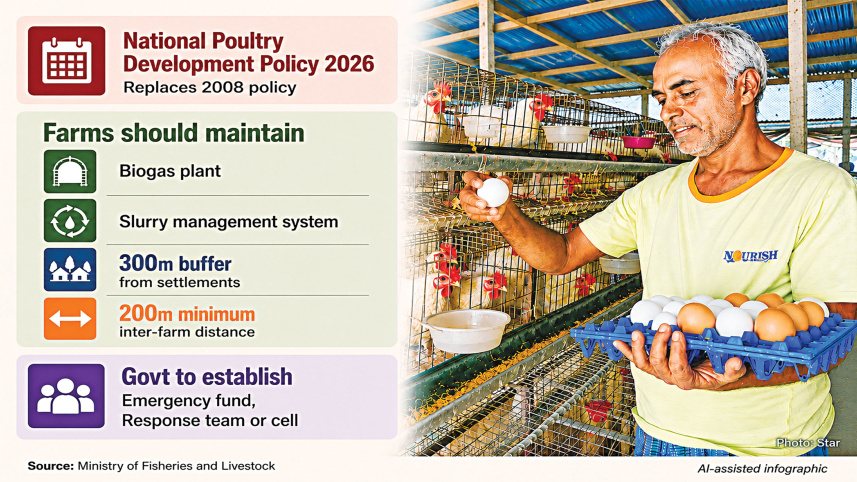
The government has introduced an updated policy for the country’s poultry sector after nearly two decades, aiming to make the industry safer and export-oriented by promoting environmentally sustainable waste management and modern production systems.
Issued on June 14, the National Poultry Development Policy 2026 supersedes and modernises the framework that had been in effect since 2008. It was formulated by the Ministry of Fisheries and Livestock.

The poultry industry directly and indirectly employs around six million people. There are currently 90,000 registered poultry farms in the country, according to the Department of Livestock Services (DLS), alongside about 200,000 unregistered farms.
The policy aims to increase egg and meat production, achieve feed self-sufficiency, eliminate harmful feed ingredients, improve breeds, conserve local varieties, strengthen animal health services, improve vaccine supply and disease surveillance, and curb excessive antibiotic use.
The policy aims to increase egg and meat production, achieve feed self-sufficiency, eliminate harmful feed ingredients, improve breeds, and conserve local varieties
Industry insiders say the update is timely and addresses several challenges facing the sector.
FOCUS ON WASTE, SUSTAINABILITY
Commercial farms shall be equipped with biogas plants and modern slurry management systems to ensure environmentally sustainable waste utilisation and disposal, according to the policy.
The Food and Agriculture Organization (FAO) of the United Nations says biogas plants can provide a decentralised energy solution for commercial poultry farms, particularly those with large bird populations. Poultry litter can be processed through anaerobic digestion to generate biogas for electricity production, reducing reliance on fossil fuels.
Such plants also improve litter management and address biosecurity concerns. The resulting slurry can be used as a bio-fertiliser, reducing the need for chemical fertilisers.
Under the policy, farms must maintain facilities for the hygienic collection, disposal and management of waste and poultry mortalities, along with appropriate water treatment systems. Plans for commercial farms must also include provisions for hygienic waste disposal, while waste management guidelines will be developed according to farm type and classification.
NEW RULES ON FARM LOCATION, BIOSECURITY
The policy states that farms shall be established in isolated locations outside densely populated areas. Commercial farms shall not be located within 300 metres of educational institutions, residential houses or other populated areas, while a minimum distance of 200 metres must be maintained between farms.
According to FAO, such buffer zones help mitigate dust and odour emissions and aid disease control.
The policy also promotes organic poultry farming to encourage indigenous poultry rearing, meet consumer demand, ensure animal welfare, and support the production and supply of organic poultry products.
It calls for ensuring the availability of quality poultry medicines and vaccines. To protect the sector from emerging infectious diseases, initiatives will be undertaken to develop and produce vaccines locally through public and private sector efforts.
An Emergency Response Team or Cell and an Emergency Crisis Management Fund will also be established.
Another key provision states that no commercial poultry farm will be allowed to operate without DLS registration.
INDUSTRY WELCOMES UPDATE, SEEKS IMPLEMENTATION
Moshiur Rahman, convener of the Bangladesh Poultry Industries Central Council and president of the Feed Industries Association Bangladesh, said the sector has changed significantly since 2008 and is now more than twice its previous size.
 For all latest news, follow The Daily Star's Google News channel.
 While the country’s land area has remained unchanged, demand for eggs and poultry meat has risen with population growth. As farm density increases, stronger biosecurity measures become increasingly important, he said.
The policy reflects efforts to address current industry challenges and align the sector with present-day requirements. However, its success will depend on effective implementation, he added.
Md Safir Rahman, secretary general of the Bangladesh Poultry Industries Association, said the policy substantially strengthens provisions on antimicrobial resistance by introducing testing requirements, implementation timelines and oversight committees that were absent from the 2008 policy.
For the first time, it formally recognises organic poultry production. Organic certification criteria include prohibitions on chemical growth promoters, genetically modified organisms and antibiotics, he said.
However, the policy does not include poultry or agricultural insurance despite industry concerns over losses from floods, heatwaves and other climate-related events, leaving farmers vulnerable to major production losses, he added.
Farida Akhter, former adviser to the Ministry of Fisheries and Livestock under the interim government, said the policy requires safe feed and prohibits the use of tannery waste.
It also states that grandparent stock and day-old chicks may be imported only when there is a demonstrated domestic shortage. Parent stock imports are permitted, but unrestricted imports are not, she added.
Comments