


Patuakhali pins hopes on EPZ for jobs, industrialisation



After completing his master’s degree, Ataur Ali has been sitting for job exams across the country. But he is hoping the Patuakhali Export Processing Zone becomes operational soon, so he can work close to home even at a somewhat lower salary.
Like Ataur, many residents of Patuakhali are looking to the EPZ for jobs. The district has very few industrial establishments, and the government’s plan to build the zone has raised hopes that local people will find industrial work without leaving their hometown.

“There are no industries in this area. If industries are established in the EPZ, other industries may also grow outside the zone by following its example,” he said.
Mohammad Majedur Rahman Khan, project director of the Patuakhali EPZ, said the zone has huge potential because of the region’s lack of industries. Many local people currently travel to other districts, including Chattogram, to work at EPZs.
“If people can work in industries here without leaving home, they will be willing to work even if the wages are somewhat lower. That is why local people are very interested in the EPZ,” he said.
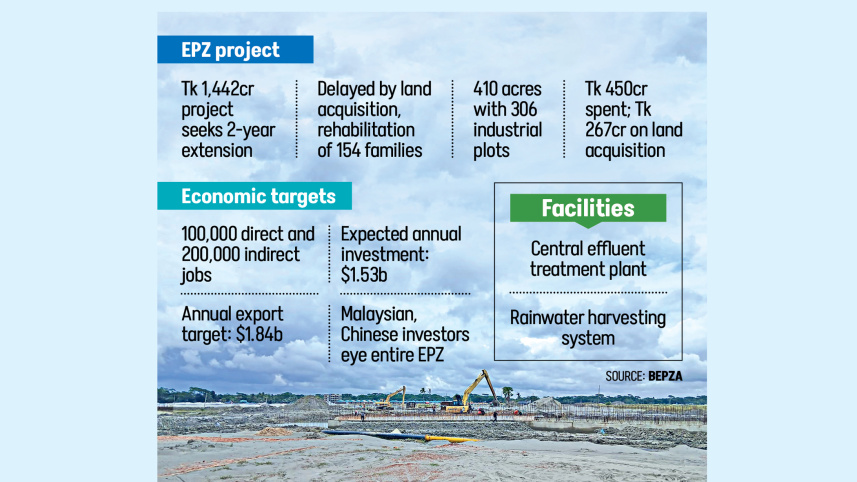
Stating that the EPZ is being developed on 410 acres of land in Patuakhali Sadar, he said it is expected to create 100,000 direct jobs and another 200,000 indirect jobs.
The project was scheduled for completion by June this year. However, land acquisition took 10 months longer than expected. In addition, 154 families were living on the site, requiring the authorities to build houses for them. The project authorities have therefore sought an additional two years to complete the project.
During the extended period, a central effluent treatment plant (CETP) will be built to ensure proper wastewater treatment. A rainwater harvesting system is also being developed. Canals are being retained so that harvested water can be reused and dependence on deep groundwater can be reduced.
The project is estimated to cost Tk 1,442 crore, of which around Tk 450 crore has been spent so far. About Tk 267 crore has gone towards land acquisition.
A visit to the site found that the EPZ area has been filled with sand, while work is still underway in some sections. The office building has been built up to several floors, but construction is still ongoing.
FOREIGN INVESTORS SHOW INTEREST
A total of 306 plots will be created in the EPZ and divided into three categories. Category A plots will be reserved for fully foreign-owned companies, Category B for joint ventures between local and foreign investors, and Category C for fully local companies.
The EPZ is expected to attract $1.53 billion in annual investment and generate $1.84 billion in annual exports.
Located close to Payra Port, about 110 kilometres from Mongla Port and beside a major road, the zone has already attracted considerable investor interest.
It has potential for various industries, including processed food and garments. Although there is no gas connection, many industries can operate without gas, and investors in such sectors have shown greater interest in the zone.
Patuakhali also produces large quantities of watermelons and fish, creating opportunities for industries that can process these local raw materials.
Entrepreneurs from Malaysia and China have shown interest in the EPZ. Majedur said a Malaysian company wants to take the entire EPZ.
Mohammad Kamal Hossain, president of the Patuakhali Chamber of Commerce and Industry, said a Chinese company had also visited the site and expressed interest in taking the entire area.
PORT, INFRASTRUCTURE REMAIN CHALLENGES
Kamal said Patuakhali had failed to develop even a basic productive sector and lacked major industries.
 For all latest news, follow The Daily Star's Google News channel.
 “At one point, Patuakhali was one of the poorest districts among the 64 districts in the country. Apart from rice, there were hardly any other crops or agricultural activities. Rice was the main source of livelihood. During the off-season, when work was scarce, many people went to Dhaka to work as rickshaw pullers and returned home when the farming season began,” he said.
He said many districts around Dhaka had developed industrial bases, but Patuakhali did not receive the same opportunity.
There had also been expectations that Payra Port would boost industrialisation, improve connectivity and strengthen the local economy. However, these benefits have not materialised as expected.
Around 6,000 acres of land were acquired for the port, displacing many residents, but local people have yet to receive the benefits they had expected. One major reason is the lack of productive industries around the port.
The port is also facing a navigability crisis. Its channel was about 7.3 metres deep when it was inaugurated, but the depth has now fallen to around 5.3 metres. As a result, large vessels cannot enter directly, and the port mainly relies on lighter vessels.
Kamal said regular dredging is needed and having the port’s own dredgers would help maintain navigability.
A large portion of the land acquired for the port is also lying unused. He said it could be used for industrial, export-import or liquefied natural gas-related activities, turning the land into an economic asset instead of a burden on the state.
Kamal said government support alone would not be enough to develop industries. Better banking facilities, reliable energy supplies and improved transport infrastructure would also be necessary.
Connectivity with Patuakhali has improved somewhat since the opening of the Padma Bridge. However, the road from Bhanga to Patuakhali and onward to Kuakata remains narrow, increasing the risk of accidents and creating difficulties for transporting goods.
Rail connectivity is also important, he said. Once railway services are introduced, transportation costs will fall, and the prospects for industrialisation will improve further.
Comments