


Paid tax early? No incentives for you

When Finance Minister Amir Khosru Mahmud Chowdhury unveiled this fiscal year’s budget, he offered good news to compliant taxpayers, particularly those who file returns early.
“All categories of taxpayers will be able to file returns throughout the year. Those who submit returns early in the year will receive tax incentives,” he told the parliament.

But there is a catch. Taxpayers who have already cleared their full income tax liability before June may be excluded from the new 5 percent early-filing incentive.
This has raised questions about fairness among taxpayers, practitioners and former officials of the National Board of Revenue (NBR).
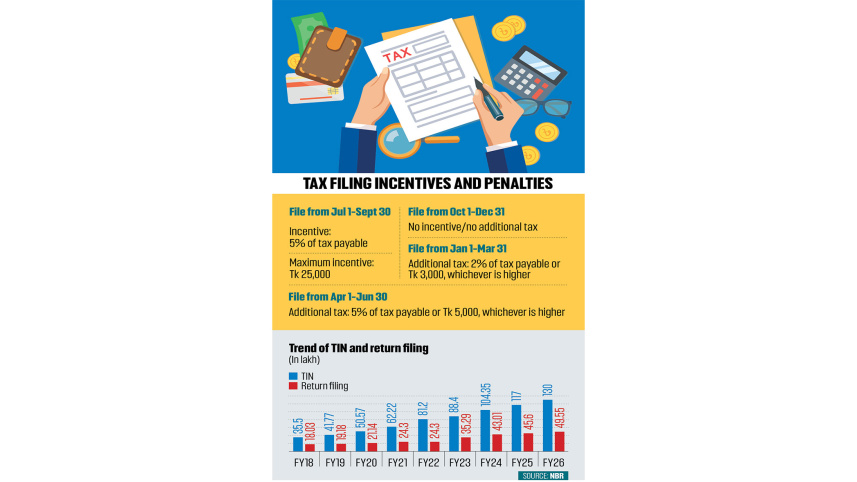
Under Finance Act 2026, individuals filing between July 1 and September 30 qualify for an incentive equal to 5 percent of tax payable, or Tk25,000, whichever is lower. The problem lies in the phrase “tax payable”, rather than “total tax liability”.
Consider a taxpayer with a final liability of Tk5 lakh who has already paid it in full through advance tax or tax deducted at source (TDS).
When the taxpayer files, there is no tax payable left after adjustments, leaving little scope for the incentive. Another taxpayer with the same liability but an outstanding balance at filing time could receive the full Tk25,000.
Tax practitioners say the provision could discourage the very taxpayers it is meant to reward.
Meanwhile, another taxpayer with an identical liability but an outstanding balance at filing time could pocket the full Tk 25,000.
“If the objective is to encourage voluntary compliance, taxpayers who have already paid their taxes should not be placed at a disadvantage,” said Sabbir Ahmed, tax practitioner and president of the Institute of Chartered Accountants of Bangladesh.
“There should be a distinction between encouraging late taxpayers to file early and rewarding taxpayers who have already demonstrated compliance,” he said.
The issue is particularly relevant for salaried employees, whose taxes are often deducted at source throughout the year, and taxpayers who pay advance tax against expected liability, since such payments are later adjusted against final liability.
Former NBR member Syed Md Aminul Karim said the provision raises questions about equity.
“The person who has been a good taxpayer and has already paid the tax earlier, he is the loser. And the person who has not paid, he is the gainer. This raises a question of equity,” he said.
Aminul said the issue could be addressed through a clarification in the relevant circular rather than a legal amendment.
“The law does not necessarily have to be changed. The explanation in the circular needs to be changed,” he said.
“Those who regularly pay their taxes are facing a disadvantage. I think this is a mistake. It should be corrected,” he added.
Snehasish Barua, director of SMAC Advisory Services Limited, said the provision could particularly disadvantage salaried employees whose taxes are fully deducted at source and deposited with the government.
“Those who work in compliant companies have 100 percent of their tax deducted and deposited into the government treasury,” he said. “So you are effectively penalising the compliant taxpayers and incentivising the non-compliant.”
He suggested calculating the incentive on gross tax liability rather than net payable amount.
 For all latest news, follow The Daily Star's Google News channel.
 “This should have been based on the gross amount, because you are not giving more than Tk25,000 anyway. Since it is based on the net amount, it is creating discrimination here,” he said.
The NBR introduced the incentive as part of changes to the return-filing framework for individual taxpayers, following repeated extensions of filing deadlines.
Under the new provision, returns filed between October 1 and December 31 will face neither incentive nor additional tax.
Those filed between January 1 and March 31 will attract additional tax of 2 percent of payable tax or Tk 3,000, whichever is higher. For returns filed between April 1 and June 30, the additional tax rises to 5 percent of payable tax or Tk 5,000, whichever is higher.
An official involved with the budget process said the new provisions need to be read together to understand the incentive and advance tax requirements.
“Whatever advance tax is payable has to be paid by June. If not, there will be additional interest on the unpaid portion,” the official said. “Suppose a person has Tk 100 tax payable. If he pays Tk 90 by June, he will pay simple interest on the remaining Tk 10.”
Asked whether the provision raises a fairness issue for taxpayers who have already paid in full, the official said, “We are ensuring fairness in this area,” adding that the issue would become clearer when the relevant provisions are considered together.
Another tax official, speaking on condition of anonymity, said the original plan was broader.
“Initially there was a plan on the whole tax liability. But it was curtailed by the high-ups,” the official said, adding that there was currently no option to address the issue unless the tax law was amended.
Comments