


Onion prices ease on higher imports, harvests of early varieties


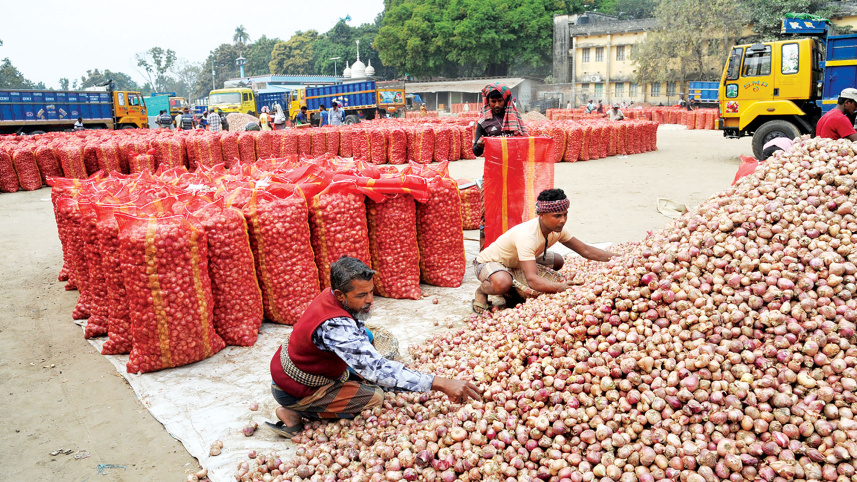
With the main harvesting season for onions beginning in early March, prices of the popular bulb have fallen over the past week amid increased availability of early-harvested onions and imports, according to traders and farmers.
Wholesale trades say prices have dropped by Tk 400 to Tk 500 per maund (about 37kg) in the past three to four days.

“Onions were selling at Tk 1,600 per maund before Ramadan but fell to Tk 1,100 to Tk 1,200 on Monday, marking a drop of around Tk 500 in a week,” said Md Robiul Islam, a wholesale trader at Pushpopara Haat in Pabna -- a hub for onions.
At the Shyambazar wholesale market in Dhaka, prices rose to Tk 35-Tk 37 per kg just before Ramadan from Tk 26-Tk 27 per kg due to a temporary supply shortfall, said Mohammad Abdul Mazed, general secretary of the Shyambazar Onion Wholesalers Association.
Higher arrivals of local onions have since pulled prices back down to Tk 28-Tk 30 per kg, he added.
“The price movement was driven by normal supply and demand conditions, not by any deliberate manipulation by traders ahead of Ramadan,” Mazed said, adding that stable supply and regular local arrivals make a further price hike unlikely.
The slowdown was visible at the market, where only five to seven trucks carried onions on Monday compared with 15 to 20 trucks on a typical day last week.
According to the Trading Corporation of Bangladesh, local onions in Dhaka were sold at Tk 40 to Tk 60 per kg yesterday, down from Tk 50 to Tk 60 a week earlier -- a 9.09 percent weekly decline.
Mohammad Humayan Farid, a retail trader at Tejturi Bazar in Farmgate, said prices were Tk 50 per kg on Tuesday, down from Tk 60 a week earlier. “Two to three days before Ramadan began, onions were sold at Tk 70 per kg, even though there was no shortage of supply at the time,” he added.
OVER 86,000 TONNES IMPORTED
Boni Amin Khan, head of the Quarantine Wing at the Department of Agricultural Extension (DAE), said the government approved 87,838 tonnes of onion imports for fiscal 2025-26, of which 86,278 tonnes have already arrived.
“Onion prices are stable, and supply is sufficient across the country, so there is no need to import more onions now,” he said, adding that further imports would be considered only if prices rise sharply.
75% KONDO VARIETY HARVESTED IN PABNA
Meanwhile, Pabna, which usually sets the highest onion production target, has already harvested 75 percent of the Kondo variety, locally known as Murikata.
According to district DAE data, 54,335 hectares were brought under onion cultivation this year, with a target of 8.45 lakh tonnes. Of this, 8,965 hectares were planted with the Kondo variety to meet winter demand.
Md Ashikur Rahman, a development officer at DAE Pabna, said about 75 percent of the Kondo variety has already been harvested, and the remaining 25 percent will be harvested over the next month.
“After the Kondo variety is finished, seed onion harvesting will begin next month. Farmers will be able to store and sell their crops throughout the year, helping them secure a fair price in the long run,” he said.
According to the Trading Corporation of Bangladesh, local onions in Dhaka were sold at Tk 40 to Tk 60 per kg yesterday, down from Tk 50 to Tk 60 a week earlier -- a 9.09 percent weekly decline
FARMERS CAUTIOUS AS COSTS REMAIN HIGH
As prices fall, many farmers are holding back produce, reducing supply in wholesale markets at the start of the harvest season.
 For all latest news, follow The Daily Star's Google News channel.
 “I cultivated 10 bighas of onions and the crop is ready for harvest, but I am not willing to harvest now because prices are too low,” said Md Montu Khan, a farmer from Ulat village.
He added that farmers usually sell 20 to 30 percent of their produce early to cover costs, but current prices are not enough to recover expenses.
Md Kamruzzaman, a leading onion trader from Durgapur village in Sujanagar upazila, Pabna, said the Kondo variety is dominating the market. “If farmers harvest seed onions before the Kondo variety clears from the market, they will struggle to recover their costs,” he said.
He added that cultivation costs have risen to over Tk 50,000 per bigha. “To make a profit, prices need to remain between Tk 1,500 and Tk 1,800. At the current rate of Tk 1,000 to Tk 1,200, farmers are facing heavy losses. Many are waiting until after Eid, when demand is expected to rise again,” Kamruzzaman said.
Robiul from Pushpopara, who supplies wholesale markets in Gazipur and Mymensingh, said transport and labour costs are Tk 180 to Tk 200 per maund. “If we buy onions at Tk 1,200 per maund, we must sell them for at least Tk 1,400 to make a small profit,” he added.
Farmers and traders are urging the government to halt onion imports to protect local growers.
“If Indian onion imports are halted during the harvesting season, farmers will get a fair price and earn a minimum profit,” Kamruzzaman said.
Comments