


One-third of listed firms saw sales decline in FY25

Listed companies endured another difficult year as macroeconomic stress and political headwinds weighed on sales and profits in fiscal year 2024-25, according to their financial disclosures.
So far, 158 listed firms, excluding banks, non-bank financial institutions and insurers, have published their financial reports.

An analysis by The Daily Star shows that overall sales growth of the companies slowed, while one-third of the companies, or 61 firms, reported a fall in sales in FY25.
Many of these firms were already under pressure from stubbornly high inflation and rising import costs due to a weaker taka.
Those strains did not ease last fiscal year. Instead, a nationwide mass uprising that ultimately ousted the Awami League government in August 2024 and subsequent political uncertainty added further stress.
Business leaders now see little improvement ahead. With the US-Israel war on Iran spilling across the Middle East, they say conditions could deteriorate sharply. Some say the fallout could rival the disruption seen during the Covid pandemic if the war drags on and energy supplies are hit.
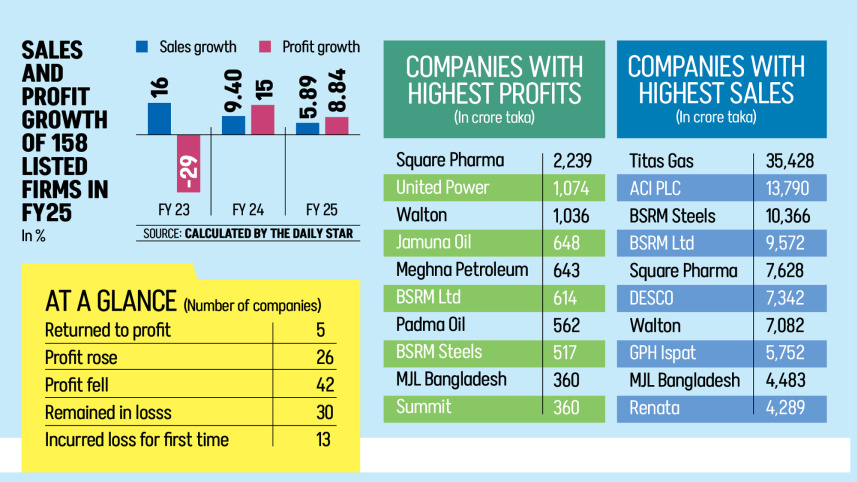
In FY25, combined sales growth for the 158 firms stood at 5.89 percent, down from 9.4 percent a year earlier. It was 16 percent in FY23.
Profit growth also slowed to 8.8 percent from 15 percent the previous year. In FY23, overall profit growth was dragged into negative territory by huge losses at state-owned Titas Gas and Dhaka Electric Supply Company (Desco).
Companies that saw sales declining in FY25 said disruptions during the July-September quarter due to the nationwide protests were a key factor. In an effort to contain the unrest, the then Awami League government imposed an internet blackout lasting at least ten days, alongside curfews and factory closures. Production suffered, and supply chains were shaken.
After the government fell, an interim administration took charge. But labour unrest in industrial belts seeking pay hikes and other perks, weak law and order, and fragile business confidence continued to squeeze company earnings.
In a bid to curb inflation and restore macroeconomic stability, the interim government raised lending rates and shelved development projects. Tighter monetary policy pushed up borrowing costs, while reduced public investment damped demand for many businesses.
“For good business, a conducive environment is necessary. But there were several headwinds in the entire last fiscal year. Those impacted the business,” said Taskeen Ahmed, president of the Dhaka Chamber of Commerce & Industry (DCCI).
He added that the strain was widespread. “Law and order situation was at its lowest level last fiscal year, while foreign investors hesitated to run businesses amid political uncertainty.”
“So, the overall business condition was under severe pressure,” he said.
Ahmed said that although borrowing costs surged, companies were unable to pass these on to consumers. It squeezed their margins.
The analysis of the financial reports shows that combined finance costs for listed firms rose by about 26 percent in FY25, even as their borrowing increased only marginally.
Throughout 2025, weak confidence and macroeconomic stress kept credit demand subdued.
Private sector credit growth slowed to 6.5 percent by June 2025, down from 9.84 percent a year earlier, according to the Bangladesh Bank. By December 2025, it slipped further to 6.10 percent, the lowest in at least four years.
Alongside supply-side pressures, demand remained weak in FY25, said Ahmed, also the vice-chairman of IFAD Group.
With inflation averaging 10.03 percent last fiscal year, according to the Bangladesh Bureau of Statistics (BBS), consumers cut back on non-essential spending.
 For all latest news, follow The Daily Star's Google News channel.
 “As a result, demand for construction-related products and other sectors that are relatively not immediately necessary dropped. It hit the overall businesses of the firms,” he added.
LARGE FIRMS SHOW RESILIENCE
Among the 158 companies, five returned to profit in FY25 after posting losses the previous year, while 26 recorded higher profits.
In contrast, profits fell at 42 firms, 30 remained in the red, and 13 newly slipped into losses.
Riad Mahmud, president of the Bangladesh Association of Publicly Listed Companies, said reduced government development spending hit many firms directly and indirectly.
He said smaller companies were more exposed to falling sales, while larger, well-governed firms proved more resilient.
“It was a testing year for companies in terms of risk management and governance, and those that lacked these were hit hardest,” said Ali Imam, founder and chief executive of EDGE Asset Management.
Highly leveraged firms, those relying heavily on borrowed funds, were particularly vulnerable during the downturn, he further said.
“In Bangladesh, many local companies are highly leveraged, so higher interest rates and lower sales hit them hard. By contrast, the impact was comparatively low for firms with lower leverage,” he said.
Firms with strong governance and risk management performed better, he added, as larger companies were able to capture market share and exert pricing power.
The CEO of the asset management firm cited BSRM Steels, BSRM Ltd and Square Pharmaceuticals, along with most multinationals, as outperformers.
He also pointed to stricter auditing and regulatory requirements, which have favoured fundamentally stronger firms.
OUTLOOK CLOUDED BY WAR FALLOUT
At the beginning of the year, companies expected a recovery after the national election in February. That optimism has since faded.
The US-Israel war on Iran has cast a shadow over the outlook, Imam said, with the duration and intensity of the conflict now the key variables.
The turmoil has already disrupted regional energy markets. The government is scrambling to secure fuel and liquefied natural gas (LNG) supplies even at higher prices.
Although retail fuel prices have not yet been raised, a prolonged war could force an increase.
“If fuel prices rise, it will impact almost all the firms. Only the financial sector has a positive outlook amid a high-interest rate regime,” Imam said.
Mahmud, president of the Bangladesh Association of Publicly Listed Companies and also the managing director of National Polymer Industries PLC, echoed the concern.
He said the fallout from the Middle East war could exceed that of the prolonged Russia-Ukraine war.
“Even it could be as serious as Covid,” he said.
Comments