


Most listed firms pay less than 5% dividends for FY25

The stock market’s performance depends on how well listed companies perform, but many firms disappointed shareholders in the last fiscal year, offering low dividends mainly due to weak sales and profits.
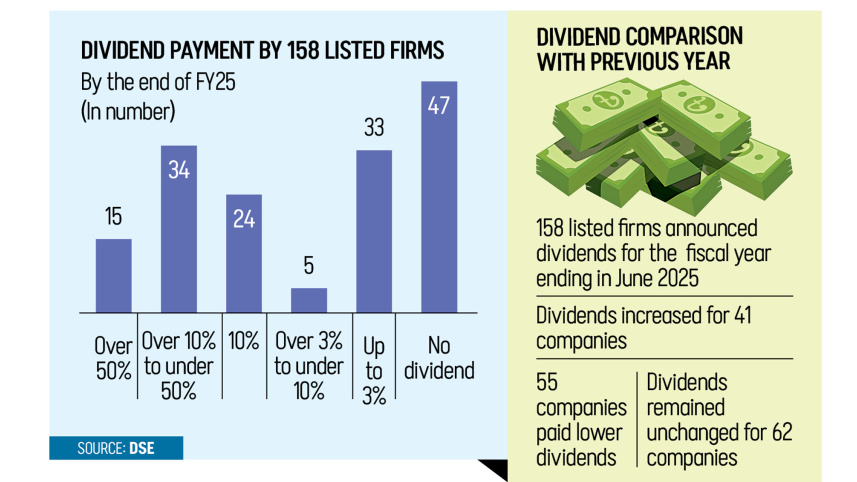
So far, 158 out of 228 listed companies -- excluding banks, non-bank financial institutions (NBFIs), and insurance firms -- have published their financial reports and announced dividends for the last fiscal year.

Among them, 80 companies provided dividends of less than 5 percent, while 47 gave no dividend at all. 49 firms declared dividends of more than 10 percent, and 24 companies offered exactly 10 percent.
Data showed that dividends of 41 companies increased, 55 paid lower dividends, and 62 kept their payouts unchanged compared to the previous year.
Rashedul Hasan, chief executive officer (CEO) of UCB Asset Management, said dividends are “very crucial for understanding a company’s willingness to share profits with minority shareholders and its ability to generate enough cash flow.”
He added that dividends also help develop the capital market, but “we do not expect all companies to pay high dividends every year.”
He explained that if a company can generate higher returns by reinvesting cash, it should retain profits instead of paying dividends.
“However, some companies avoid sharing profits with shareholders even when they earn well, which is not a good sign. Typically, well-governed firms and multinational companies provide good dividends, even if many others make high profits.”
Rashedul said many companies faced a tough year due to high interest rates and inflation. “High inflation reduced people’s purchasing power, which tightened sales, while profitability was under pressure from high bank loan rates,” he added.
Looking ahead, he said, “There is little hope for strong improvement amid the ongoing global conflicts.”
OPERATIONAL INEFFICIENCY AND MARKET CHALLENGES
In some cases, companies struggle because they cannot manage operations efficiently over the long term. Other reasons include macroeconomic shocks, loss of competitiveness, or a lack of commitment from sponsors to run the company profitably, said Kazi Monir, CEO of Shanta Asset Management.
He added that many companies fail to sustain their performance after listing, particularly when sponsors offload their shares.
“Companies are usually listed when they are performing at their peak, and sponsors often exit within three to five years. Regulators and issue managers need to be more careful and carry out stronger checks when bringing such companies to the market,” he said.
Monir also highlighted that this trend is not unique to Bangladesh. Investors are advised to carefully assess initial public offerings (IPOs) and distinguish between strong and weak companies to avoid losses.
Weak performance among many listed firms has made the stock market less attractive to investors. Data from the Dhaka Stock Exchange (DSE) shows that the benchmark index, DSEX, fell by about 13 percent during the last fiscal year.
The number of beneficiary owner (BO) accounts also dropped by 5 percent to 16.67 lakh, according to the Central Depository Bangladesh Limited (CDBL).
Despite overall weak performance, some companies continue to perform strongly and provide handsome dividends. Fifteen companies declared dividends of more than 50 percent, most of them following good corporate governance and efficient management.
Among the top dividend payers, Meghna Petroleum Limited announced a 200 percent dividend, Jamuna Oil Company Limited 180 percent, Walton Hi-Tech Industries PLC 175 percent, and Padma Oil Company Limited 160 percent. Square Pharmaceuticals PLC provided a 120 percent dividend, while Eastern Cables Limited and Eastern Lubricants Blenders Limited each declared 80 percent.
Other high-paying companies include United Power Generation & Distribution Company Limited at 65 percent, IBN Sina Pharmaceutical Industry PLC 64 percent, Renata PLC 55 percent, Mobil Jamuna Lubricants Limited 52 percent, Kohinoor Chemical Company (Bangladesh) Limited 50 percent, BSRM Limited 50 percent, BSRM Steels Limited 50 percent, and Runner Automobiles PLC 55 percent.
 For all latest news, follow The Daily Star's Google News channel.
Comments