


Money and inflation

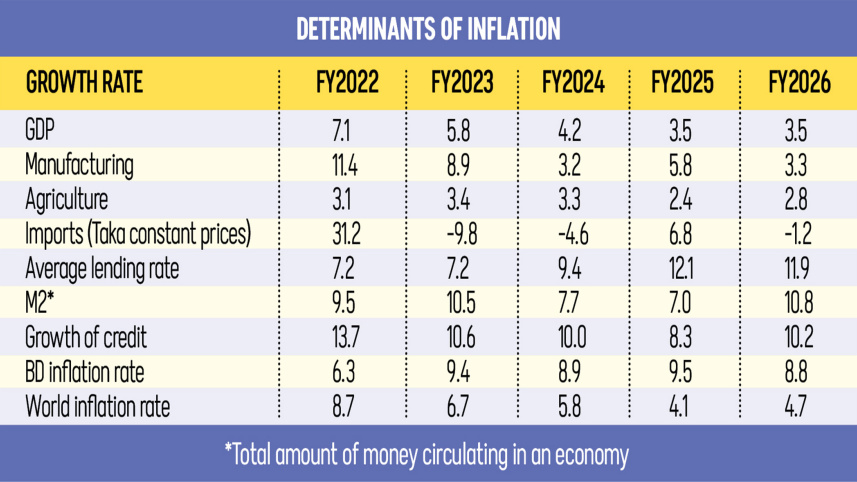
Bangladesh has been experiencing a long episode of near-double-digit inflation since FY2023. This inflation rate considerably exceeds the global inflation rate. Efforts to control inflation have yielded some limited results, but the inflation rate remains persistently high, hovering around 9 percent annually. Along with rising inflation, GDP growth has slumped. This has raised the question, is Bangladesh passing through a phase of stagflation?
Sustained high inflation, along with a sharp deceleration in GDP growth, has hurt employment and increased poverty. The World Bank estimates that the incidence of both poverty and extreme poverty has increased since 2022. This reversal of poverty progress is a serious social problem. The employment challenge is reflected in the reduction in employment in all three broad sectors of agriculture, industry and services.

This stagflationary phase cannot prevail for long without creating social discontent and must be addressed swiftly. The policy focus should concentrate on lowering the inflation rate sustainably, while supporting the recovery of GDP growth.
The first question is why the inflation rate is persistently high in Bangladesh even as global inflation has fallen. In a market economy, prices are determined by demand and supply. The aggregate price level for the economy as a whole, which is the weighted average of individual prices, is similarly influenced by forces of aggregate demand and supply. So, the inflation rate, defined as the rate of change of the aggregate price level, is determined by factors that affect the growth of aggregate demand and supply.
The oldest theory of inflation, known as the quantity theory of inflation, owes its origins to Polish mathematician Nicolaus Copernicus and states that the rate of growth of prices (inflation) is the difference between the rate of growth of money supply and the rate of growth of real GDP. While this simple theory has faced fierce criticism from Keynesian economists, it has grown in sophistication, led by monetarist economists like Milton Friedman. The Keynesian economists have argued that the demand for money can change and affect the velocity of circulation and thereby destroy the one-to-one correspondence between the growth of money supply and inflation. Yet, the substantial role of monetary impulse in affecting inflation has remained intact.
However, instead of targeting the growth of money supply as recommended by monetarists, modern central banks target the inflation rate directly by influencing the interest rate. When inflation is high, a typical central bank raises the interest rate to reduce demand through cutbacks in spending, which then lowers inflationary pressure.
In my book “Bangladesh Stabilizing the Macroeconomy” published in December 2023, I provided evidence that the main factors that initially fueled the acceleration in inflation in Bangladesh since August 2022 were the excess growth of domestic credit, mostly public sector credit, owing to the large stimulus packages of the Covid-19 period (FY20-FY21) funded mostly through budgetary deficits and money creation, the continued financing of fiscal and quasi-fiscal deficits (FY22-FY23) through money creation, and control over interest rates (July 2020-November 2023) that pushed up private sector credit growth and lowered the growth of bank deposits.
Monetary policy correction started in November 2023 when the interest rate was deregulated, and the financing of the budget deficit through money creation was stopped. These policies were strengthened in May 2024 and further tightened during August-October 2024. They have largely remained in place since then. The interest rate is now deregulated, and the official stance of monetary policy is to control inflation through interest-rate management.
Many observers are disappointed that despite considerable monetary tightening, inflation remains stubbornly high at near double digits. There is also some scepticism about whether monetary tightening has gone too far without favourable outcomes for inflation. This scepticism, however, is based on a partial view. A fuller analysis will show that the main reason the full benefit of demand tightening for lowering inflation has not emerged is because of a large supply downturn that has happened over the past several years.
GDP growth rate declined by 51 percent between FY22 and FY26. All sectoral components of GDP have experienced a reduction in growth; the sharpest cutback was registered by the manufacturing sector with a 71 percent decline in the growth rate between FY22 and FY26. At the same time, the volume of imports has been falling, with the deepest cuts in imports of consumer and capital goods. This magnitude of supply shock over a 5-year period is unprecedented in the recent history of Bangladesh and is a major factor for the persistence of high inflation.
A sustainable strategy for fighting inflation is to continue to restrain demand while seeking to restore the growth momentum for both GDP and imports. Indeed, the growth of GDP and imports is correlated, and GDP growth cannot be restored without allowing imports to grow. Similarly, to lower inflation, in addition to boosting domestic supply, it is important to lower trade barriers that restrict the import of consumer goods into Bangladesh at a time when there are supply constraints.
The policies for demand and supply management must be internally consistent. This consistency of policy-making has become a major challenge. Despite the stated monetary policy stance of monetary tightening to fight inflation, in recent months money and credit growth have exceeded prudent limits consistent with lowering inflation. After falling between FY23 and FY25, the growth of money supply accelerated in FY26 from 7 percent to 10.8 percent. Similarly, total credit grew from 8.3 percent in FY25 to 10.2 percent in FY26. Additionally, the velocity of circulation increased from 2.4 in FY23 to 3.0 in FY26, possibly reflecting higher inflationary expectations. This expansion in monetary and credit growth, along with rising velocity of circulation in the face of a falling growth of aggregate supply, has inevitably stoked inflation as predicted by the quantity theory of inflation.
The acceleration in money supply growth is partly the outcome of the creation of high-powered money through the Bangladesh Bank’s purchase of foreign assets. Financing of a large budget deficit through bank borrowing by the Treasury has also contributed to the growth of money supply and domestic credit. Indeed, the Treasury deficit financing has tended to offset the reduction in total credit growth resulting from a reduction in private credit growth and thereby lowered the effectiveness of interest rate increases in reducing inflation. While private credit growth has fallen to a mere 5.3 percent, public sector credit growth surged to 26 percent. The conduct of fiscal policy is clearly not consistent with the targets of monetary policy. Moving forward, this must be corrected.
What is the role of money and credit policies for restoring the growth momentum? Looking at the supply side, it is hard to argue that GDP growth is constrained by a lack of liquidity. While the turmoil in the banking sector has created liquidity problems for the weak banks, the strong banks are flush with liquidity because they cannot find adequate traditionally defined creditworthy borrowers who are willing to borrow.
This slowdown in the demand for credit in the organised private sector is mostly a reflection of weak profitability of investment owing to several binding constraints, including high cost of doing business, a severe energy supply crunch, weak trade logistics, and shortage of skills. These constraints must be addressed swiftly to increase investment and GDP growth, but they cannot be removed by lowering the interest rate and increasing domestic liquidity.
Channelling greater credit growth to areas where there is indeed a credit constraint, such as the micro and small enterprises sector, would support a supply response by relaxing the credit constraint. But this credit expansion must be made consistent with the growth of total credit and money supply required for reducing inflation by lowering the bank financing of the budget deficit.
The writer is vice chairperson of the Policy Research Institute of Bangladesh (PRI). He can be reached at sadiqahmed1952@gmail.com
 For all latest news, follow The Daily Star's Google News channel.
Comments