


Mobile operators protest ‘high’ taxes
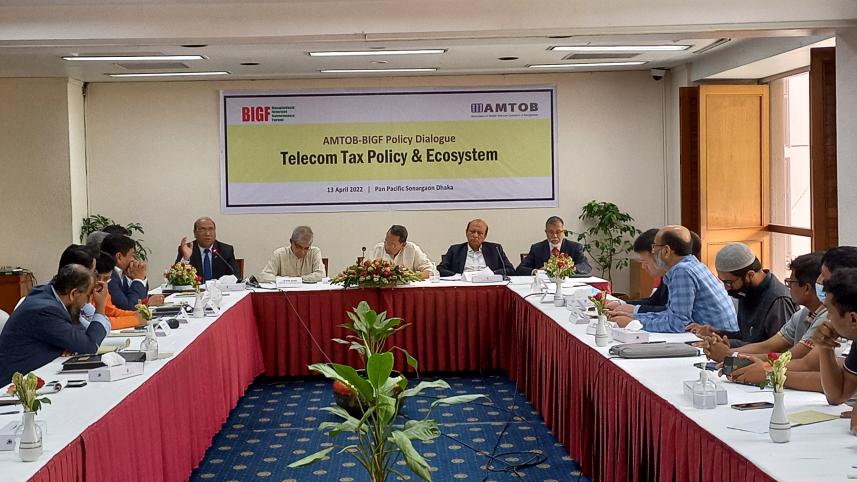
High corporate tax, minimum turnover tax and an "unfair" value added tax (VAT) rebate mechanism have been hurting the telecom industry's profitability, said the operators yesterday.
It has been undercutting the operators' ability to investment and eventually leaving customer unable to avail quality of services, they said.

They demanded a reduction of the corporate tax from 25 per cent and 32 per cent for the listed and non-listed companies from the current 40 per cent and 45 per cent respectively.
Mobile operators have to pay a minimum turnover tax of 2 per cent while other industries pay only 0.6 per cent, said the operators.
"It was imposed because the operators' revenues are very high and so it is easy to collect a large amount of tax from them," said Shahed Alam, chief corporate and regulatory officer at Robi.
"Although the revenue is high, our profit margin is very low," he said while delivering a presentation at a policy dialogue on the telecom tax policy and ecosystem.
The Association of Mobile Telecom Operators of Bangladesh (Amtob) and Bangladesh Internet Governance Forum (BIGF) organised the event at a hotel in the capital.
The VAT authorities are unfortunately reluctant to allow legitimate rebates on certain inputs, such as imported capital machinery such as batteries and cables, said Alam.
He said compared to neighbouring nations, the tax on Bangladesh's mobile sector was considerably higher. On the other hand, the operators' return on investment is "insufficient", he said.
Similarly, the operators' average income per user is lower while the cost of mobile voice and mobile internet is one of the lowest in the world, making it harder for the service providers to sustain business, he claimed.
About other challenges, he said smartphone device penetration was not growing significantly as devices were yet to become affordable to the masses.
Currently, only 48 per cent of the devices in use are smartphones while only 36 per cent can support 4G.
"Without adequate 4G device penetration, further improvement of coverage and quality will not be a commercially viable approach," Alam said.
He went on to say that revenue generation from data service was not proportional to data consumption, network utilisation and investment made for catering incremental data traffic.
For example data consumption of the three private operators has grown by over 12 times since 2016, but revenue grew by only 2.7 times.
Lawmaker Hasanul Haq Inu, chairperson of the BIGF, said while the turnover tax imposed on "harmful sectors" like that of tobacco was 1 per cent, it was 2 per cent on the mobile industry.
This is ill-judged and needs to be brought down to less than 1 per cent, he said.
"In order to build a Digital Bangladesh, the VAT on the internet needs to be lifted," he added.
"I think corporate tax should be slashed by 8 per cent to 10 per cent and brought to 30 per cent to 35 per cent," said Inu.
"The operator's demand on slashing corporate tax should be taken under consideration by the government," said Shyam Sunder Sikder, chairman of Bangladesh Telecommunication Regulatory Commission (BTRC).
 For all latest news, follow The Daily Star's Google News channel.
 However, the operators have to ensure quality of service and end call drops, said Sikder.
Telecom Minister Mustafa Jabbar said, "Excessive taxes have been a longstanding concern for telecom operators and we were trying to convince the NBR about the negative impact of high taxes on telecoms."
Khalilur Rahman, secretary to the posts and telecommunications division, Mohammad Moniruzzaman Jewel, director general of spectrum division of the BTRC, M Riyaaz Rasheed, acting chief executive officer of Robi, Abdus Salam, Ericsson Bangladesh's country manager, Hossain Sadat, acting chief corporate affairs officer of Grameenphone, and Taimur Rahman, chief corporate & regulatory affairs officer of Banglalink, also spoke.
Comments