


MFS usage restricted to basics at marginal level
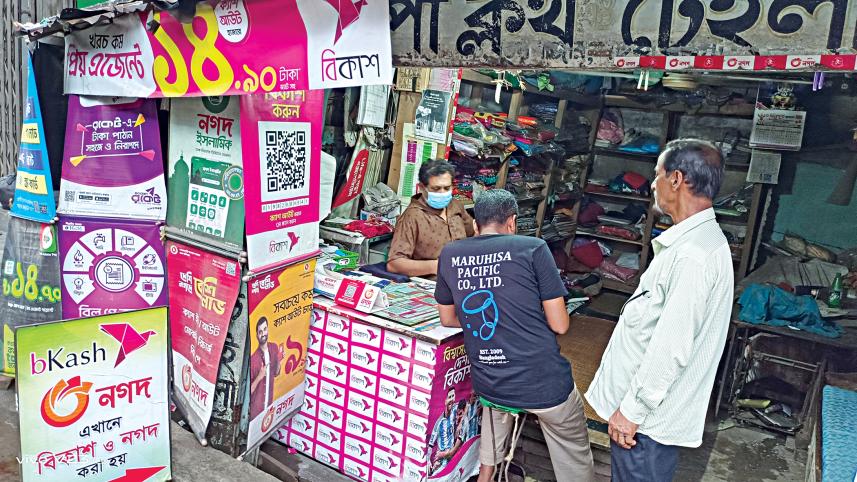
Major use cases of mobile financial services (MFS) are still confined to receiving, sending and withdrawing money at marginal levels, where the gender divide is palpable, according to three studies.
About 83 per cent of the people in plainland ethnic communities in northern Bangladesh use MFS for receiving money, as per a survey commissioned by the Policy Research Institute (PRI).

Similarly, 83 per cent of these people use the facility for sending money and 70 per cent for withdrawing money, it said.
Around 749 ethnic people in Rangpur and Rajshahi were interviewed as a part of the survey, styled "Digital Financial Services for the Plainland Indigenous Population in Northern Bangladesh".
The study found that only 6 per cent of participants use MFS for depositing money, 10 per cent for receiving government stipends for children, 8 per cent for government grants, 9.5 per cent for government allowances, and 1 per cent for paying bills.
"For driving digital financial services, purchasing through MFS has to be increased," said Ahsan H Mansur, executive director of the Policy Research Institute (PRI) of Bangladesh.
"People should be topping up their MFS accounts for spending on purchases, paying bills, fares, and more," he added.
Mansur was speaking at the National Consultation on "Digital Financial Services and Financial Inclusion at the Local Level in Bangladesh", organised by the PRI at Sheraton Dhaka yesterday.
He then said that people do not have to withdraw cash for making purchases through MFS, which ultimately reduces the transaction cost.
Another study that surveyed the Santal and Orao communities in northern Bangladesh found that only 77 per cent of the respondents own mobile phones.
The percentage of mobile phone ownership is even less among women at just 31 per cent.
Although a vast majority (84 per cent) opened MFS accounts with help from agents, only 42 per cent currently use the facility.
Three quarters of the male respondents actively use MFSs compared to only 25 per cent of the female respondents.
A major reason for not being able to use MFSs is a lack of literacy or formal education, it said.
Only 35 per cent of the respondents completed secondary education with MFS usage being higher among educated people.
Meanwhile, 27 per cent of the respondents said they lack knowledge and awareness about the facility.
The study, titled "Adoption and Potency of Digital Financial Services among Farmers in Bangladesh", highlighted the role of digital financial services (DFS) in empowering farmers and enhancing the agricultural sector.
The study involved surveying 400 farmers from the livestock, fisheries, agriculture and horticulture sectors.
It found that bKash (82 per cent) is the most popular DFS product among respondents followed by Nagad (30 per cent) and Rocket (23 per cent).
DFS is most commonly used for utility bill payments as the payment amount is comparatively small and incurs low transaction fees.
 For all latest news, follow The Daily Star's Google News channel.
 Lastly, the study on "Impact of Digital Financial Services on Poverty of Haor People in Bangladesh: Expansion and Deepening Approach", found that 65.66 per cent of respondents own bank accounts while 64.66 per cent have accounts with NGOs.
Most respondents (81.33 per cent) were found to be aware of or have knowledge regarding MFS.
Among these respondents, 52.37 per cent own and use their accounts independently while 45.65 per cent use their accounts with the help of others.
The remaining 1.98 per cent do not have their own accounts and use that of others' instead.
The study also identified several barriers to MFS usage, including complexity of transactions (25.39 per cent), unavailability of mobile phones (14.87 per cent), lack of guidance on M/DFS usage (13.42 per cent), unavailability of electricity (12.69 per cent), and absence of a photo for registration (10.70 per cent).
Comments