


Jute price spiral comes to a halt
The spiralling trend of raw jute prices has come to a halt thanks to monitoring by the authorities to curb stockpiling by traders in the last two weeks, said traders and exporters.
Raw jute traded at Tk 3,500-Tk 3,600 per maund yesterday, a rate that has been prevailing for nearly two weeks, said a trader in Madhukhali of Faridpur, one of the biggest jute growing regions in Bangladesh.

"The upward movement of prices is halted now," said Mohammad Shahidul Islam Dulal, proprietor of Progress International, a jute trader and exporter.
Prices of the natural fibre, which is mainly processed by mills and exported in the form of jute goods and yarn, started rising from the middle of December last year when it was around Tk 3,000 per maund (37 kilogrammes).
And jute millers and spinners last month collectively decided that they would not buy the natural fibre at more than Tk 3,000 per maund from January 20 after the price hit as much as Tk 3,800 per maund.
However, not all mills complied with the decision. Millers were complaining that the middlemen illegally stockpiled a major portion of the raw jute, creating an artificial crisis in the market to make an extra profit.
At the same time, foreign buyers are shifting their attention away from jute products to alternative items after failing to buy the goods made from the eco-friendly fibre at their expected prices.
The situation prompted the Department of Jute (DoJ) on January 30 to decide that it would conduct a special drive to increase the supply of raw in the domestic market and curb the hoarding of more than 1,000 maunds of raw jute.
It also called for stopping the sales of the fibre by traders who do not have licence, according to a notice.
The DoJ, on February 10, directed its field offices to send a list of traders who have licences within seven working days.
Abdul Barik Khan, secretary-general of the Bangladesh Jute Mills Association, however, said the market is yet to be stable as the supply is low.
Arju Rahman Bhuiyan, senior vice-president of the Bangladesh Jute Association, says the government's monitoring has had an impact on the market.
"Besides, mills are not buying to that extent," he said.
He cited declining demand for jute goods and yarn in Turkey, one of the main markets for jute yarn. Jute yarn brings nearly two-thirds of export earnings from jute and jute goods.
Factors such as the depreciation of Turkish lira and a switch by a section of customers to the alternative of jute yarn affected the shipment of jute goods, said industry operators.
Only raw jute exports remained buoyant.
Receipts from raw jute shipment surged 39 per cent year-on-year to $133 million in the seven months to January. It was $96 million during the same period a year ago, data from the Export Promotion Bureau showed.
Bhuiyan said exporters got higher prices as the volume of export did not increase to that extent.
Nearly 4 lakh bales of raw jute were shipped in the July-January period of the current fiscal year.
"We mainly exported to Pakistan and India, and a small quantity went to China," Bhuiyan said.
 For all latest news, follow The Daily Star's Google News channel.
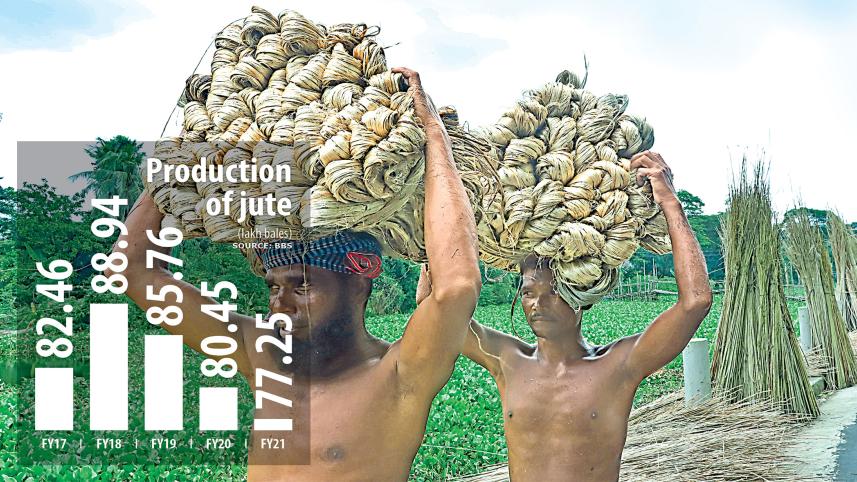
 Jute production declined 4 per cent year-on-year to 77.25 lakh bales in the last fiscal year, against 80.45 lakh bales the previous year, according to the Bangladesh Bureau of Statistics.
Comments