


Iran war could wipe out up to 3% of Bangladesh GDP

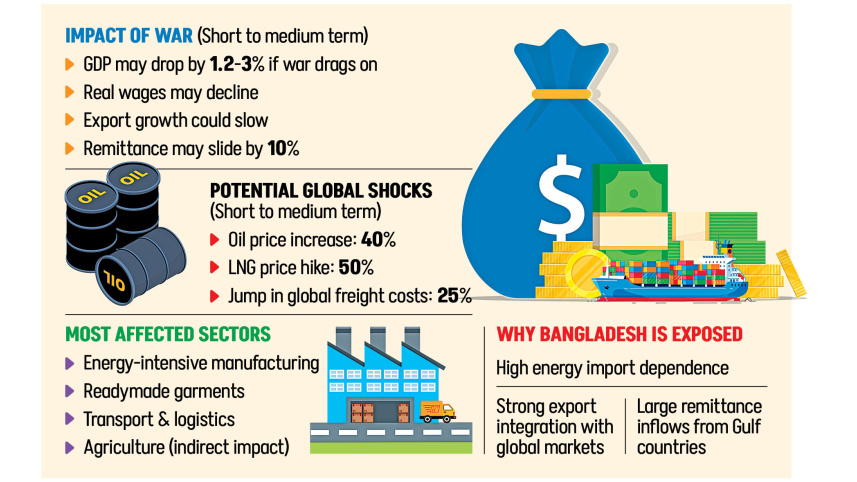
A prolonged US-Israel war on Iran could reduce Bangladesh’s gross domestic product (GDP) by as much as 3 percent over the next two years, according to a new policy analysis by the South Asian Network on Economic Modeling (Sanem).
The study says that Bangladesh’s heavy reliance on imported energy, remittances from Gulf countries, and global trade networks leaves the economy exposed to geopolitical shocks in the Middle East.

“Real wages could come under pressure and export growth would likely slow,” the report said.
The study was conducted by using the Global Trade Analysis Project (GTAP) computable general equilibrium model, a widely used analytical framework for assessing global trade and policy shocks.
Researchers modelled three scenarios to estimate the potential damage.
The first assumed a sharp rise in global energy prices, with crude oil and liquefied natural gas (LNG) prices climbing around 40 percent and 50 percent, respectively, if the conflict disrupts production or transport routes.
Higher fuel costs would push up domestic electricity generation costs, manufacturing expenses and consumer prices. Under such a situation, Bangladesh’s GDP is likely to decline by 1.2 percent, according to the paper.
“This contraction mirrors how central energy is to production and transportation throughout the economy. High fuel prices set off a chain reaction across industries, pushing production costs higher,” it said.
The second scenario examined disruptions to international trade and shipping routes, estimating a 25 percent rise in freight costs due to higher fuel prices and increased insurance premiums for vessels in high-risk maritime zones.
In this scenario, there could also be a 5 percent drop in export demand to the European and American markets. These shocks would altogether cause a 1.4 percent GDP decline, said the study.
The paper said Bangladesh’s export sectors are very sensitive to transport costs and delivery reliability.
“When exports shrink, the related backward linkages, such as textiles, logistics, and supporting services, decline. The economy, therefore, experiences a slowdown that spreads gradually through multiple layers of the production network.”
The third scenario combined several shocks at once, including a 10 percent fall in remittance inflows from Gulf countries, reflecting possible economic disruptions in the nations where millions of Bangladeshi workers are employed.
The combined shock scenario produces the largest effect, including a roughly 3 percent decline in GDP, said the paper.
Prof Selim Raihan, executive director of Sanem and author of the study, said these pressures combined could trigger moderate to significant economic stress in the short to medium term.
“This result is not surprising,” he said. “The effects reinforce each other when multiple external pressures come at the same time. Higher fuel prices raise production costs. Trade disruptions weaken export demand. At the same time, declining remittance inflows lower household income and consumption.”
“These forces work together, impacting the supply and demand sides of the economy. This is because rising costs and a weakening market mean firms cut back production. Households struggle with lower purchasing power and tighten their belts. The interaction between these changes generates a deeper slowdown than any of the shocks would create on their own.”
The paper said Bangladesh’s exports may decline by about 2 percent in the case of an energy price shock. This is because industries’ higher production costs can make Bangladeshi goods a little less competitive in international markets.
“This decline gets even larger when introducing trade disruptions. In the shipping disruption scenario, exports would shrink by about 3.4 percent. Freight costs and the uncertainty of logistics are significant here.”
In the combined scenario, however, that pressure is multiplied. Exports drop by nearly 6 percent, a sign of the cumulative effect of rising costs, reduced demand, and shipping disruptions, it added.
 For all latest news, follow The Daily Star's Google News channel.
 The report said Bangladesh’s export-oriented garments sector stands out as one of the most vulnerable sectors in both of the simulations. Its output may decline as much as 4.5 percent.
But the transport and logistics sector would be the worst hit, by as much as 5 percent, energy-intensive manufacturing 4 percent, and agriculture 1.5 percent, according to the findings.
Prof Raihan said in the case of a prolonged war, the effect could be felt in around two years. “In fact, the impact can be larger if the situation gets worse,” he said.
The paper said Bangladesh’s development model has relied on export-led manufacturing and overseas employment, but that same integration exposes it to external shocks when geopolitical crises erupt elsewhere.
The study recommends diversifying energy sources, improving trade logistics infrastructure, expanding export markets and broadening strategies for overseas employment.
Comments