


Interim govt stabilised economy but fell short on reform
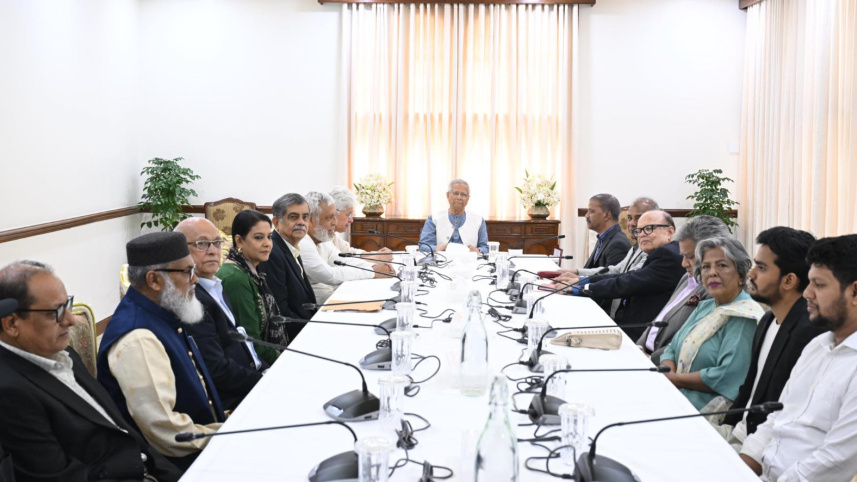
The interim government succeeded in preventing a deeper economic and geopolitical slide during a highly volatile period, but failed to translate that stability into meaningful institutional reform, transparency, and inclusive governance, said speakers at a policy dialogue on Saturday.
Economic analyst Mamun Rashid argued that although the interim government inherited an economy on the brink, particularly after the July 2024 uprising, its most visible achievement was halting further deterioration rather than delivering a decisive turnaround.
 For all latest news, follow The Daily Star's Google News channel.
 “The fall was stopped, not reversed,” said former banker Mamun Rashid at a virtual discussion titled “Interim Balance Sheet”, organised by the Power and Participation Research Centre (PPRC).
The economy in early 2024 was “going nowhere”, with macroeconomic indicators under severe stress. The period following the political transition marked a shift from decline to stabilisation, particularly in foreign exchange reserves, remittance inflows, and banking discipline.
Reforms in the banking sector, such as reconstituting bank boards and initiating forensic audits, particularly in troubled Islamic banks, were the most visible actions of the interim government.
Anwar-Ul-Alam Chowdhury (Parvez), president of the Bangladesh Chamber of Industries, alleged that advisers relied excessively on bureaucrats, often without understanding the real-world impact of policy decisions
Still, these measures largely reflected “business-as-usual” governance rather than a deeper transformation.
“We did not see the kind of modernisation in economic management that many expected after the movement,” he said, adding that conflicts of interest, bureaucratic dominance, and informal influence networks remained largely intact.
Private sector credit growth had slowed to 6.1 percent, while implementation of the annual development programme stood at just 17.28 percent in six months, said Anwar-Ul-Alam Chowdhury (Parvez), president of the Bangladesh Chamber of Industries.
He alleged that advisers relied excessively on bureaucrats, often without understanding the real-world impact of policy decisions.
“They thought they knew everything,” he said, adding that access to decision-makers was limited and engagement with businesses remained weak.
Public expectations after August 2024 were that social polarisation would decline and that a culture of open debate would emerge, said Rounaq Jahan, a political scientist.
“That did not happen,” she said.
While people are now speaking more openly, they are increasingly being labelled or targeted, creating a climate of fear.
She cited attacks on cultural and media institutions such as Prothom Alo, The Daily Star, Udichi, and Chhayanaut as examples of shrinking civic safety.
Jahan criticised the interim government for attempting too many ambitious reforms without sufficient consensus, particularly constitutional changes, while neglecting electoral preparation.
“Given the history of controversial elections, ensuring a credible next election should have been the priority,” she said.
The interim period coincided with rising regional and global instability, including uncertainties over water sharing with India and trade disruptions under the Trump administration in the US, said M Humayun Kabir, president of the Bangladesh Enterprise Institute.
While political parties mentioned geopolitics in their manifestos, concrete strategies were lacking.
Kabir welcomed Bangladesh’s economic partnership agreement with Japan, calling it a “bold step”, but criticised the interim government for failing to build strong institutional coordination across the foreign affairs and commerce ministries.
The interim government managed two critical challenges: halting macroeconomic decline and navigating a sensitive geopolitical environment, said Hossain Zillur Rahman, executive chairman of PPRC, who moderated the dialogue.
However, he warned that stability without transparency and social accountability could not deliver lasting change.
“The bureaucracy has further strengthened its grip on society, reflecting a continuation of colonial mindsets,” he said.
Rahman stressed that elections alone would not resolve systemic problems but could serve as a catalyst for rebuilding political dialogue and trust between parties and citizens.
Comments