


India now moves to levy anti-subsidy duty on jute goods

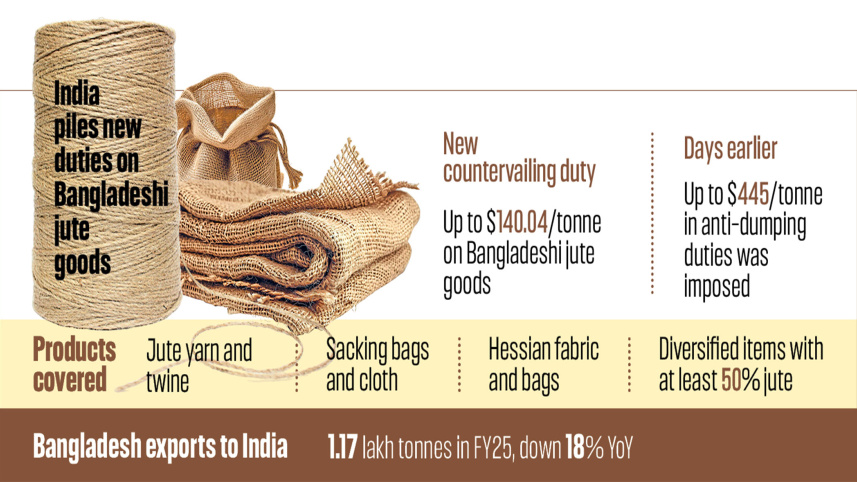
Days after imposing fresh anti-dumping duties on jute goods, India has recommended anti-subsidy duties of up to $140.04 per tonne on jute products imported from Bangladesh.
India’s Directorate General of Trade Remedies (DGTR) recommended the duty after investigating imports from Bangladesh and Nepal.

The new tariff, known as a countervailing duty, is intended to offset subsidies provided by exporting countries. The DGTR launched the investigation last year following petitions from the Indian Jute Mills Association (IJMA) and the A.P. Mesta Twine Mills Association (AJMA), which represent Indian millers.
It examined market and import data for the 12 months from April 2024 to March 2025.
The investigation covered jute yarn and twine, sacking bags and cloth, hessian fabrics and bags, and diversified jute products containing at least 50 percent jute.
In its final findings, published on September 28, the DGTR recommended a duty of $101.54 per tonne on Bangladeshi jute products exported by Sagar Jute Spinning Mills Ltd and Oriental Jute Mills Ltd.
A total of 24 Bangladeshi millers co-operated with the investigation and were assigned specific duty rates. Six sampled millers were placed in three exporter groups with specific rates, while 18 non-sampled co-operating millers face a uniform duty of $116.48 per tonne.
A total of 24 Bangladeshi millers co-operated with the investigation and were assigned specific duty rates. The six sampled millers were placed in three exporter groups, with rates ranging from $101.54 to $132.36 per tonne, while 18 non-sampled co-operating millers face a uniform rate of $116.48 per tonne.
All other Bangladeshi jute goods exporters face a residual countervailing duty of $140.04 per tonne. Nepalese exporters face anti-subsidy duties ranging from $54.77 to $60.54 per tonne, according to the final findings.
The latest measure comes as Bangladesh’s jute goods shipments to India have already declined.
Bangladesh’s jute goods exports to India fell 18 percent year-on-year to 1.17 lakh tonnes in fiscal year 2024-25, according to the DGTR.
On September 24, India’s finance ministry imposed anti-dumping duties of up to $445 per tonne on jute products from Bangladesh, including jute yarn and twine, following a mid-term review completed in June.
Before the latest anti-dumping order, India had imposed duties ranging from $19 to $352 per tonne on jute yarn and twine, hessian fabric and jute sacking bags from Bangladesh and Nepal.
Those duties were later expanded to cover jute sacking cloth from Bangladesh, contributing to a slump in shipments to one of the country’s largest export markets for jute goods.
Bangladesh earned $1.16 billion from jute and jute goods exports in FY21, according to the Export Promotion Bureau (EPB). Shipments fell to $820 million in FY25 before exports recovered by 8 percent year-on-year to $884 million in FY26.
Mostafa Abid Khan, chief executive officer of the Bangladesh Foreign Trade Institute (BFTI), a think tank under the commerce ministry, said the latest measures by Indian authorities would further affect jute goods exports to the neighbouring country.
However, he said subsidies are never given to any specific producer. “As far as I know, they are given by a country to a sector. So, countervailing duties imposed on a specific industry should not be considered valid.
“Besides, it is our understanding that while imposing anti-dumping duty on jute products, subsidies provided to the sector were not adjusted. Therefore, it is obvious that anti-dumping duties contain subsidy effects as well. Therefore, as per Article VI of GATT-1994, countervailing duty cannot be imposed on jute products when such anti-dumping duties are in force. It is a real concern for Bangladesh,” he added.
Tapash Pramanik, chairman of the Bangladesh Jute Spinners Association (BJSA), questioned how countervailing duties could be imposed when an anti-dumping duty is already in place.
He said the incentive structure enjoyed by the jute industry a decade ago, or before that, no longer exists. But Indian authorities are not taking Bangladesh’s concerns into account.
 For all latest news, follow The Daily Star's Google News channel.
 “We would urge the government to challenge the move by India in the international arena,” he added.
Comments