


Hilsa exported to India just a quarter of quota
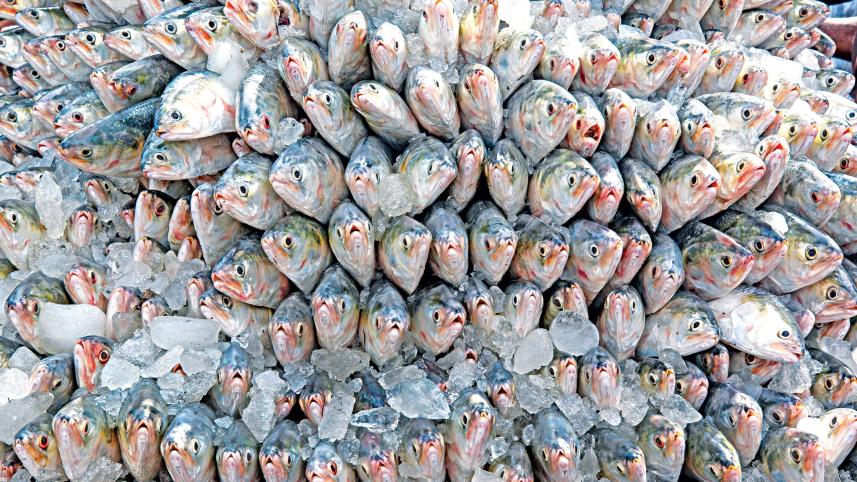
Exporters have utilised just around 24 per cent of a government quota on selling hilsa to India within the stipulated timeframe which came to an end on Friday.
Bangladesh has maintained a ban on the export of its national fish since August 2012. But it annually lifts the restriction for neighbouring India during Durga Puja, the biggest religious festival of Bangalee Hindus, as a goodwill gesture.

This year the commerce ministry in two circulars on September 20 and September 23 informed of having allowed 115 companies to each export 40 tonnes for the celebrations, which ran from October 11 to October 15.
But this coincided with a government conservation programme, specifically a 22-day ban on netting, selling and transportation from October 4 to October 25 focusing the main breeding season.
It prompted the government to extend the export period until November 5.
But only 1,100 tonnes were exported from Bangladesh to Kolkata until October 3 and none afterwards, well below the limit of 4,600 tonnes.
In the second phase after October 25, no trader exported hilsa, said Shafiqul Islam, customs revenue officer (exports) at the Benapole land port, which is the sole port through which the export is allowed.
Exporters said there was no such conservation-focused ban in India, for which their fishermen continued catching the fish at sea and supplying it to their markets.
At present, hilsa is cheaper in Kolkata.
In late September, each kg was being sold to India at $10 or roughly Tk 854. In contrast, in the wholesale markets of Bangladesh, those weighing over one kg were being sold at around Tk 1,200 and less than one kg at Tk 650.
The exporters said the price difference dissuaded them.
There is not that much of a demand for hilsa in India now, said Amin Ullah, president of the Bangladesh Frozen Foods Exporters Association.
The 24-day time window for the export was too short for collections and transportation and too many companies were granted export permission, he said.
"Before Durga Puja, the people of Kolkata wanted hilsa. But due to the ban, the exporters could not export hilsa there at that time. Then, India imported hilsa from Myanmar. Hilsa is now cheaper in the Kolkata market," said Ullah.
Now a huge amount of hilsa is in Kolkata which were brought from many other parts of India and Myanmar. So, the price has fallen. In such a situation, Bangladeshi traders will not be able to benefit by exporting hilsa there, said exporters.
Babul Akhter, president of Bangladesh Non-Packer Frozen Foods Exporters' Association, said the 10-day extension was not enough to open a letter of credit in a bank and reach the fish to its destination.
It would have been better if the export timeframe was of one to one-and-a-half months, he said.
"At present the supply of hilsa in the country's market is low and the price is high. In such a situation, it was not the right decision to extend the period for hilsa export," he added.
Bangladesh caught some 5.5 lakh tonnes of hilsa in fiscal 2020-21 whereas 5.33 lakh tonnes in fiscal 2019-20 and 5.15 lakh tonnes in fiscal 2018-19.
The rising trend gave hope to the Department of Fisheries to estimate that around 6 lakh tonnes will be caught in the current fiscal year.
 For all latest news, follow The Daily Star's Google News channel.
 The department gives the credit to the conservation programme running since 2017, which includes a 65-day ban on catching hilsa at sea.
It says hilsa has the highest contribution of over 12.09 per cent in the country's fish production.
Comments