


Heavy rain, upstream water damage crops in six districts


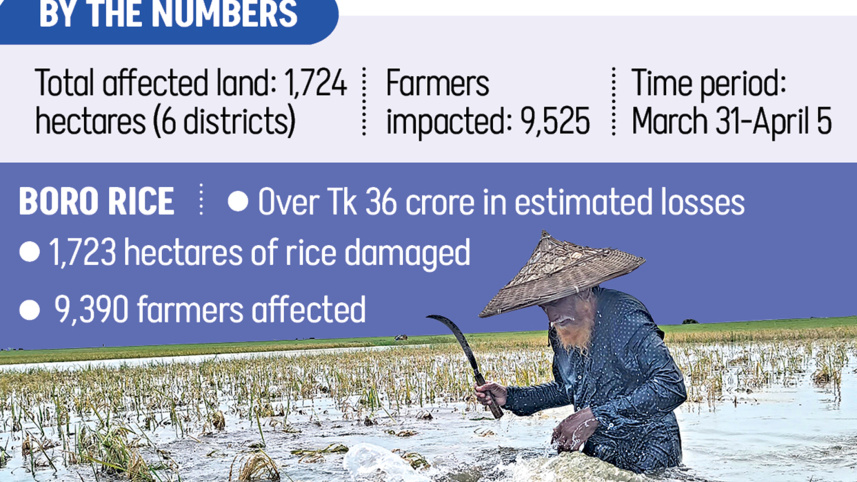
Abdur Rahman, an elderly farmer from Bhukshimail union in Kulaura upazila of Moulvibazar, took loans to cultivate Boro paddy this season, hoping for a good harvest and some financial relief.
But back-to-back storms, heavy rain, and water flowing from upstream areas have destroyed that hope.

“I invested all my savings and even took loans to cultivate Boro on five acres of land. Now the entire crop field is under two to three feet of water. Not a single grain of paddy can be saved,” he told The Daily Star on Friday.
“Now I don’t know how I will repay my debts or support my family,” he lamented.
Abdur Rahman is not the only one facing this predicament. Data from the Department of Agricultural Extension (DAE) shows that storms, rain, and the onrush of water from the upstream between March 31 and April 5 affected 1,724 hectares of farmland across six districts, harming 9,525 farmers.
The affected districts are Sunamganj, Habiganj, Moulvibazar, Nilphamari, Kishoreganj, and Netrokona.
Boro rice bore the brunt of the damage, covering 1,723 hectares. Total losses are estimated at over Tk 36.36 crore, affecting 9,390 farmers.
Maize was also damaged on one hectare of land, causing losses of about Tk 4 lakh and affecting 135 farmers.
Sultan Miah, a farmer from Dekhar Haor in Sunamganj Sadar upazila, said, “A government-built dyke on the western side of the haor has increased water pressure and broken part of the dyke we built to protect our crops.”
He added that hundreds of acres of Boro crops are now at risk of total failure.
Tara Miah, a farmer from Tanguar Haor in Madhyanagar upazila of Sunamganj, said the situation this year was unexpected.
“In 2017 and 2022, flash floods destroyed our crops. That was understandable as those were natural disasters. But this year, just a few days of rain caused waterlogging and damaged most of my crops,” he said.
GOVT RESPONSE AND REHABILITATION PLANS
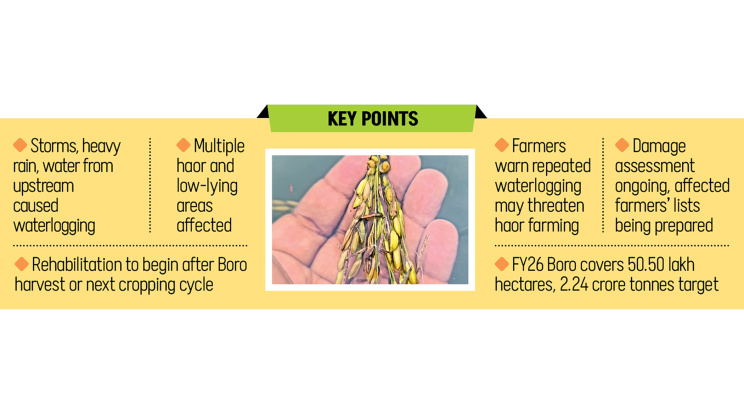
Md Mosharraf Hossain, additional director of the DAE in Sylhet, said authorities are assessing the situation.
“We are preparing a list of farmers who lost crops due to recent waterlogging. We will send the list to the ministry for further instructions,” he said.
“Right now, our main focus is harvesting paddy. We will start a rehabilitation programme for affected farmers after the Boro season ends, or before the next season begins,” he added.
According to provisional DAE data, Boro paddy cultivation reached 50.50 lakh hectares in the fiscal year 2025-2026 (FY26), a 3.29 percent increase from the previous year.
Production has also risen in recent years, increasing from 2.01 crore tonnes in FY22 to 2.13 crore tonnes in FY25, with a target of 2.24 crore tonnes set for the current season.
Obaidur Rahman Mondol, director of the Field Service Wing at the DAE, said incentive distribution for jute farmers -- who sow seeds from March to May -- in affected areas has already been completed after identifying eligible beneficiaries.
He added that while government policy focuses on supporting the next cropping cycle, areas such as Kishoreganj are facing difficulties due to the absence of a follow-up crop.
 For all latest news, follow The Daily Star's Google News channel.
 Mondol also said the worst damage was reported in Itna, Nikli, and Mithamain upazilas of Kishoreganj, adding that a report has been submitted and any further action will follow ministry approval.
A recent US Department of Agriculture (USDA) report on Bangladesh forecasts that for marketing year 2026-27 (MY27), the total rice harvested area will be 11.8 million hectares, with production estimated at 37.4 million tonnes.
It said the harvested area is expected to rise by 0.4 percent compared to MY26, but production may fall by 0.7 percent due to lower yields from the ongoing Boro season.
The USDA report added that lower Boro rice yields are due to disrupted irrigation and fertiliser use, caused by fuel and fertiliser shortages linked to the Middle East conflict.
As of the third week of March 2026, limited rainfall has helped crop growth to some extent, but farmers remain concerned about shortages of diesel needed to operate shallow and low-lift irrigation pumps.
Comments