


Half of Japanese firms in Bangladesh expect profits in 2026

Nearly half of Japanese firms doing business in Bangladesh are expecting to post operating profits this year, thanks to rebounding business confidence after national polls, strong domestic demand and cost competitiveness, according to a survey.
The number is up by more than 8 percentage points from 2024 and stands at the highest level since 2019.

“Profit growth is expected to be driven mainly by three factors: greater political and social stability after the election, rising expansion plans among Japanese firms, and growing opportunities in non-manufacturing sectors,” said Kazuiki Kataoka, country representative of Japan External Trade Organization (Jetro).
The Japanese government-backed agency promoting trade and investment conducted the survey titled “Business Conditions Survey 2025”. The report will be officially released by Jetro’s Dhaka office today.
Currently, around 340 to 350 Japanese companies operate in Bangladesh, and the number is gradually increasing.
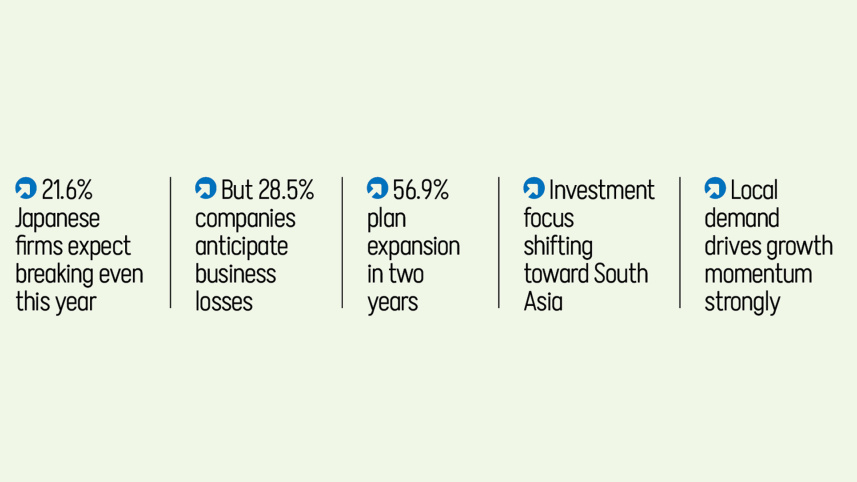
Survey data shows that 21.6 percent of Japanese firms foresee breaking even this year, while 28.5 percent anticipate losses.
Alongside improving profit expectations, 56.9 percent of Japanese firms plan to expand their businesses in Bangladesh within the next one to two years, underscoring strong investor confidence. Only a small number of firms indicated plans to scale down, while the remainder expect to maintain current operations.
The primary driver of expansion is rising local market demand, cited by 66.7 percent of respondents. Firms also pointed to improved competitiveness and growing acceptance of their products and services.
Expansion plans vary across sectors. While 62.2 percent of firms in non-manufacturing sectors intend to expand, compared with 47.6 percent in manufacturing, Bangladesh continues to attract interest as a production base.
Kataoka said that Japanese firms are gradually redirecting investment focus from Southeast Asia to South Asia, with Bangladesh emerging as a key destination alongside India and Pakistan.
“Bangladesh is among the countries where Japanese firms show strong expansion interest compared to several Southeast Asian markets,” he added.
The rising interest reflects growing opportunities in urban consumption, particularly in Dhaka, where purchasing power is rising alongside demand for higher-quality goods.
On Japanese investment, Kataoka said it is difficult to determine an accurate figure, as many companies channel funds through third countries, meaning such investments are not reflected in official Japanese data.
However, direct investment from Japanese sources alone is estimated at no less than $400 million.
Despite the improving outlook, structural challenges continue to weigh on businesses.
Companies report that time-consuming tax procedures, regulatory uncertainty, bureaucratic inefficiencies, and inconsistent policy implementation remain major hurdles, often slowing operations and complicating long-term planning.
“These issues will take time to resolve, but improvements in government procedures could attract more Japanese investment,” Kataoka said.
He also pointed to broader concerns, including social instability and an underdeveloped legal system, which continue to affect operational efficiency and investor confidence.
Kataoka added that firms are likely to prioritise developing a skilled workforce for employment in Japan, as the country’s ageing population continues to grow. Bangladesh could play a key role in supplying workers, particularly in engineering, agriculture, and construction.
 For all latest news, follow The Daily Star's Google News channel.
Comments