


Govt clarifies stance on LDC graduation
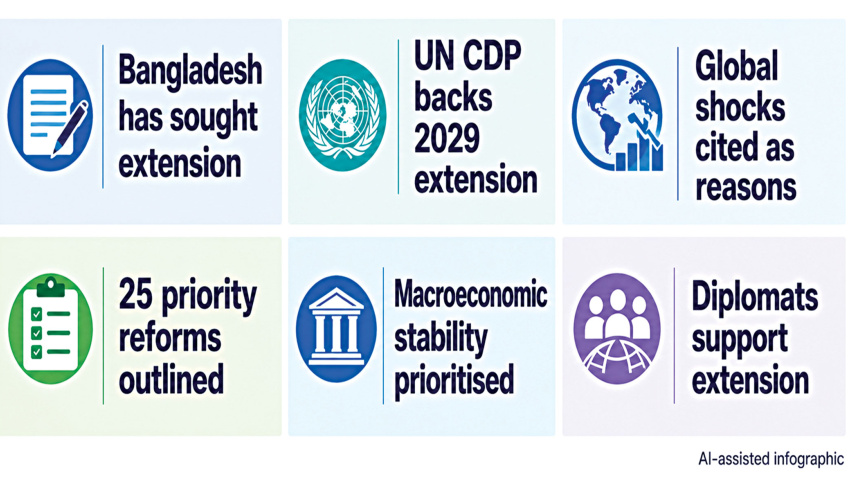
Bangladesh is seeking an extension of the preparatory period for its graduation from the Least Developed Country (LDC) category to complete key reforms and ensure a smooth transition, rather than delay the graduation itself, Commerce Minister Khandakar Abdul Muktadir said yesterday.
“We are not asking to postpone graduation. We are seeking the time needed to complete critical reforms and ensure a stable and effective economic transition,” he said at a seminar on the rationale for extending Bangladesh’s preparatory period for LDC graduation at the Planning Commission.

The Economic Relations Division (ERD) under the finance ministry, in collaboration with the commerce ministry and the foreign ministry, organised the event, according to a press statement.
The seminar briefed members of the diplomatic community, development partners and other stakeholders on Bangladesh’s preparedness for LDC graduation, progress in implementing the Smooth Transition Strategy, and the rationale for seeking an extension of the preparatory period to ensure a smooth and sustainable transition.
Bangladesh is scheduled to graduate on November 26 this year, with businesses urging the authorities to seek a delay, citing inadequate preparation to cope with the loss of tariff preferences in major export markets and increased competition.
After assuming office, the present government formally requested the United Nations Committee for Development Policy (UN CDP) on February 18 to extend the preparatory period.
Prime Minister Tarique Rahman also wrote to the UN Secretary-General seeking his personal support for the request.

In early June, the UN CDP recommended extending Bangladesh’s graduation by three years to 2029 and submitted its assessment report to the United Nations Economic and Social Council (ECOSOC), which will forward the recommendation to the United Nations General Assembly for final approval.
Commerce Minister Muktadir said a series of unprecedented global and domestic challenges -- including the Covid-19 pandemic, disruptions to global trade, geopolitical tensions, high inflation, supply chain disruptions and domestic macroeconomic pressures -- had significantly constrained Bangladesh’s ability to fully utilise the original preparatory period.
As a result, he said, the government’s immediate priority is to restore macroeconomic stability while implementing critical structural reforms.
He said the government had already adopted a comprehensive reform agenda comprising 25 priority areas, including macroeconomic stabilisation, trade and investment reforms, deregulation, enhanced competitiveness, institutional strengthening and human capital development.
Muktadir also highlighted the government’s efforts to reduce the time required to start a business from one year to just 14 days.
At the event, State Minister for Planning Md Jonayed Abdur Rahim Saki said continued support from development partners would be essential to sustain the country’s reform efforts.
In a presentation, ERD Secretary Md Shahriar Kader Siddiky outlined the major economic, structural and external challenges facing Bangladesh, explained the rationale for extending the preparatory period, and presented the government’s time-bound reform roadmap for effectively utilising the proposed additional period.
Ambassadors of Sweden, Norway, Indonesia, Switzerland, Thailand, Nepal and Vietnam addressed the seminar.
Members of the diplomatic community observed that the global trading environment is undergoing rapid transformation and stressed the importance of maintaining the momentum of Bangladesh’s reform agenda.
Representatives of diplomatic missions, development partners and the private sector underscored the importance of export diversification, financial sector reforms, broadening the tax base and improving the business environment to support Bangladesh’s smooth graduation from LDC status.
Members of the diplomatic community also expressed continued support for Bangladesh’s request to extend the preparatory period.
 For all latest news, follow The Daily Star's Google News channel.
 Ad Interim UN Resident Coordinator in Bangladesh Geetanjali Singh, Foreign Secretary Asad Alam Siam, Finance Division Secretary Md Khairuzzaman Mozumder, Commerce Secretary Md Ataur Rahman Khan, Executive Chairman of the Bangladesh Investment Development Authority Ashik Chowdhury, and National Board of Revenue Chairman Ahsan Habib were among the senior officials present.
Among business representatives, President of the Bangladesh Association of Pharmaceutical Industries Abdul Muqtadir, President of the Footwear Leathergoods and Accessories Exporters Association Syed Nasim Manzur, and representatives of the Bangladesh Garment Manufacturers and Exporters Association (BGMEA) and the Dhaka Chamber of Commerce and Industry (DCCI) attended the seminar.
Distinguished Fellow of the Centre for Policy Dialogue Prof Mustafizur Rahman and Executive Director of the South Asian Network on Economic Modeling Selim Raihan were also present.
Comments