


Gas shortage brings DAP fertiliser production to a halt

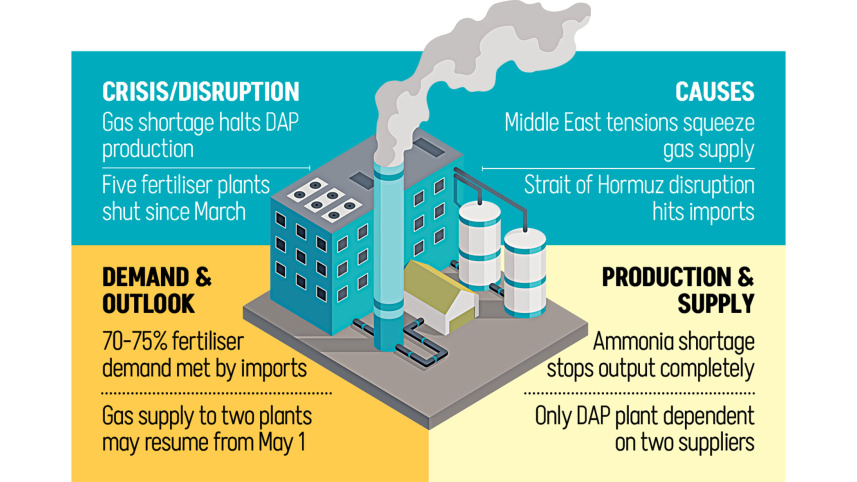
An acute shortage of ammonia has closed down production at the state-owned DAP Fertilizer Company Limited (DAPFCL), marking a fresh setback for the country’s fertiliser supply chain, officials said.
The closure of five of the country’s six urea factories is behind the crisis, they claimed.

The ammonia needed for production at the factory is primarily sourced from Chittagong Urea Fertilizer Company Limited (CUFL) and Karnaphuli Fertilizer Company Limited (Kafco).
These two fertiliser factories were among the five shut down in early March, as a precaution amid fears of gas supply disruptions caused by geopolitical tensions in the Middle East. They are yet to resume operations, and ammonia supply to the DAP facility remains cut off.
The DAP plant exhausted its stock of the indispensable raw material on Saturday. Fertiliser output had stopped around 7:00 pm, Deputy General Manager (Commercial) Robiul Alam Khan confirmed.
“If gas supply to those plants resumes, they can restart production, and we will receive raw materials again. There is no alternative source at the moment,” he told The Daily Star.
DAP production requires phosphoric acid and ammonia.
“We have sufficient phosphoric acid in stock, but without ammonia, production cannot continue,” Robiul Alam Khan added.
Typically, the plant produces around 500 tonnes of fertiliser daily using imported phosphoric acid and ammonia supplied by Kafco and CUFL.
The most recent batch of 3,000 tonnes of ammonia from Kafco had sustained production till Saturday, Khan said.
DAPFCL had managed to continue operations for nearly one and a half months using existing stock, but was forced to shut down after the reserves ran out.
Located in Rangadia of Anwara upazila in Chattogram, DAPFCL operates under the Bangladesh Chemical Industries Corporation (BCIC) of the Ministry of Industries.
Established to meet domestic demand for nitrogen and phosphorus-based fertilisers, the plant has been in commercial operation since 2006 and remains the country’s only DAP-producing plant. It has two units with a combined production capacity of 800 tonnes per day.
The plant produced around 92,600 tonnes of DAP in fiscal year 2023-24 and about 49,500 tonnes in fiscal year 2024-25, reflecting a sharp decline amid supply disruptions.
According to BCIC and the Ministry of Agriculture, the country’s total annual fertiliser demand is estimated at 6.5-6.9 million tonnes, including 2.7 million tonnes of urea, 752,000 tonnes of TSP, 1.507 million tonnes of DAP, 2.6 million tonnes of NPKS and 987,000 tonnes of MOP.
Around 1.4 million tonnes of DAP are imported. A significant portion comes from Morocco, Tunisia, China, and Saudi Arabia.
BCIC officials said geopolitical tensions in the Middle East and disruptions in shipping through the Strait of Hormuz have created uncertainty over timely imports.
Authorities initially shut five urea fertiliser factories for 15 days from March 4 as a precaution amid concerns over gas supply disruptions linked to the Middle East conflict and the Strait of Hormuz closure.
However, the shutdown has stretched well beyond the initial timeline, with plants still idle after more than six weeks.
Even Kafco, initially operating at limited capacity, was forced to suspend production late last month due to worsening gas shortages.
 For all latest news, follow The Daily Star's Google News channel.
 BCIC officials said around 197 million cubic feet of gas per day are required to run the five major urea plants at full capacity, underscoring the severity of the supply crunch.
“We have been unable to produce around 7,100 tonnes of fertiliser daily from these plants for the past one and a half months,” BCIC Director (Production and Research) Md Moniruzzaman said.
He added that gas supply to Shahjalal Fertilizer Company Limited and CUFL is expected to resume from May 1.
“Once ammonia production restarts, we expect the DAP plant to receive feedstock and resume operations,” he said.
Comments