


Garment industry running out of time to go green: CPD
Bangladesh’s garment industry must accelerate its shift to cleaner energy as rising power costs, dwindling gas supplies and tougher climate rules increasingly threaten the sector’s competitiveness, according to a new study by the Centre for Policy Dialogue (CPD).
Greater use of renewable energy and more efficient machinery could help factories cut energy costs while meeting growing environmental requirements in key export markets, the study found. The findings were presented yesterday at a national dialogue on industrial decarbonisation at BRAC Centre Inn in Dhaka.

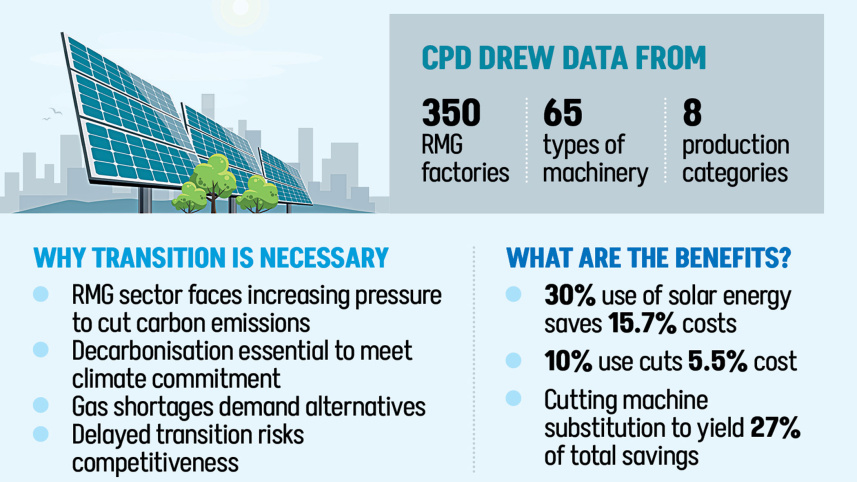
The study drew on data from 350 RMG factories and 65 types of machinery across eight production categories.
It identified rooftop solar as a clear opportunity, which can potentially lower electricity costs and reduce factories’ exposure to volatile fossil fuel prices.
Average monthly energy expenditure among surveyed factories stood at Tk 9.98 lakh. Meeting 30 percent of energy needs through solar could cut costs to Tk 8.46 lakh, a 15.7 percent saving, the study found.
Machinery upgrades offer another opportunity, it noted. Cutting machines represent only 5.5 percent of installed capacity but could generate 27 percent of potential replacement savings. Sewing machines account for about 85 percent of machine stock but offer less than 3 percent savings potential. Smaller factories, however, face financing constraints and older machinery.
Speaking at the event, Asif Shahriar, assistant vice-president of Infrastructure Development Company Ltd (IDCOL), said limited financing capacity, a shortage of capable renewable energy service companies and the absence of standardised investment assessments are holding back industrial adoption.
Smaller factories often struggle to access financing because individual projects are too small for conventional financing models. He suggested grouping several small projects and financing them together.
Asif also backed operating expense, or OPEX-based, models in which third parties install and operate renewable energy systems while factories pay for the service, reducing the need for large upfront investments.
Fazle Shamim Ehsan, executive president of the Bangladesh Knitwear Manufacturers and Exporters Association, said European decarbonisation requirements leave Bangladesh with little room for delay.
He noted that Bangladesh is already behind several competing garment-producing countries in renewable energy use.
He said incentives often look better on paper than they work in practice. Even his LEED-certified platinum factory has not received the full benefit of a promised tax incentive because of how income tax is collected and adjusted.
“If the incentive does not reduce the actual tax burden, then what is the point of giving it?” he asked.
He also cautioned against assuming every industrial process can simply be electrified. New industrial zones should instead be planned around shared energy infrastructure, including steam generated as a by-product of power plants.
For existing factories, rooftop solar and efficient machinery offer quicker options, but both require financing and regulatory changes. “Funds are available, but they are not accessible enough,” Fazle Shamim said.
Mostafa Al Mahmud, president of the Bangladesh Solar and Renewable Energy Association, also criticised taxes on solar panels, batteries and other equipment.
Bangladesh now needs an emergency response in the energy sector, said Khondaker Golam Moazzem, research director at CPD.
Gas reserves are nearing depletion, while new exploration has not kept pace with demand. Industries will therefore need alternatives for gas-dependent boilers, diesel-based transport and irrigation.
The challenge extends beyond factories and financiers, pointed out Shamim Munir Uddin, director of the Ethical Trading Initiative.
Workers should also be involved in improving energy and resource efficiency through training and greater awareness at the factory level, he said, calling for closer scrutiny of how automation is affecting energy consumption.
 For all latest news, follow The Daily Star's Google News channel.
 Policy remains a critical piece of the puzzle. Shamim Munir Uddin pointed out that factories importing renewable energy equipment are subject to around 15 percent VAT and 2 percent advance tax, creating a combined burden of roughly 17 percent.
Such measures can work against the government’s own renewable energy goals, he said.
Vidiya Amrit Khan, vice-president of BGMEA, said Bangladesh’s garment industry risks losing competitiveness if it fails to become more sustainable.
European regulations increasingly require detailed reporting on carbon emissions, energy use, water consumption and chemical discharge. Such requirements are expected to become more consequential for exporters by 2030, she said.
The biggest obstacle may be policy rather than technology, Vidiya said, with high financing costs, collateral requirements and proposed charges on open-access renewable power potentially making clean energy more expensive than conventional power. That could discourage investment, she added.
Comments