


Food exports to the Gulf feel war shock


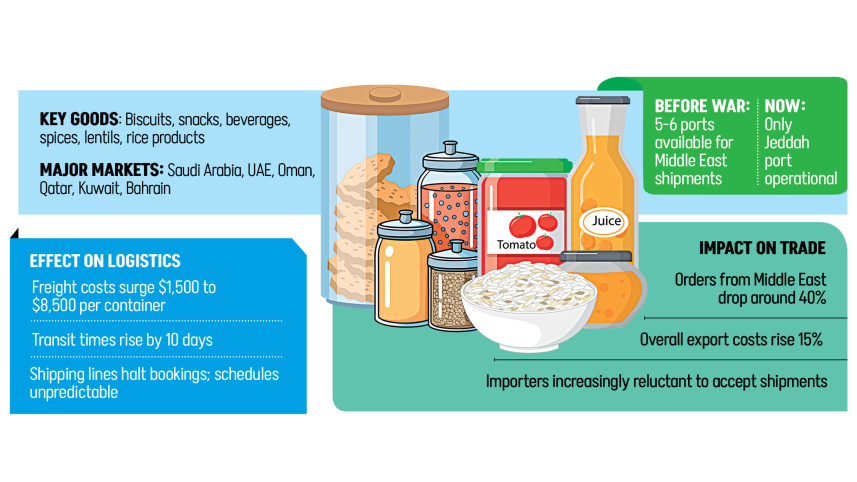
The country’s merchandised shipments of processed foods and agricultural products to Gulf nations are facing a serious shock from the war in the Middle East, with freight charges soaring fourfold and new orders plunging.
Before the US and Israel launched the war on Iran on February 28, sending a container of processed foods cost around $1,500. Manufacturers say rerouting has now pushed the price to roughly $6,500.

“Besides, the volume of orders from Middle Eastern markets has declined by around 40 percent compared to pre-war levels,” said Ahsan Khan Chowdhury, chairman and chief executive officer of PRAN-RFL Group.
Bangladesh exports a wide range of products to the Gulf, including spices, biscuits, puffed rice, chanachur, noodles, mustard oil, beverages and other snacks. The main customers are Bangladeshi migrant workers in the region and members of the diaspora.
Official data puts the size of the market at more than $100 million. Major destinations include Saudi Arabia, the United Arab Emirates, Oman, Qatar, Kuwait and Bahrain.
Chowdhury, the CEO of PRAN-RFL Group, one of the largest food and beverage brands in Bangladesh, said shipments to Middle Eastern countries were previously routed through five to six ports.
“But after the Strait of Hormuz was closed and other ports came under retaliatory attacks, exporters were left with only Jeddah port operational,” he said. “This pressure on the Saudi Arabian port on the Red Sea has largely contributed to the rise in freight charges.”
Apart from these issues, he added that sending products to Middle Eastern markets now takes longer.
“Although factory production has not yet been affected, if the current situation persists, a reduction in production will likely become unavoidable in the near future,” he commented.
Rezaul Hoque Khondaker, manager for international marketing at local food processor Bombay Sweets and Company Limited, said the company suspended Middle East orders and halted production in late February, anticipating further escalation after the attack on Iran.
“At that time, only one shipment had already left Chattogram via Colombo for Qatar, and recalling it was not viable,” he said. “Despite shrinking margins, we proceeded with delivery to minimise losses and sought partial compensation from importers.”
Sayedul Azhar Sarwar, head of business at Danish Foods Ltd, a concern of Partex Star Group, said rising freight rates have introduced a new “war cost” that is significantly increasing overall expenses.
“Importers are increasingly reluctant to accept deliveries as higher costs erode competitiveness, particularly for goods already in transit,” he said.
He estimated that overall costs have risen by at least 15 percent, prompting many buyers to delay orders in the hope of more stable conditions.
He also said that job uncertainty among migrant workers is beginning to affect consumption, which could dampen demand for non-essential food items.
Luthful Kabir Shaheen, director for business development at City Group, said shipment schedules had become increasingly unpredictable, causing delays not only in the Middle East but also in Europe and the US, with transit times extending by around 10 days.
He, however, said production remains broadly stable, with companies adapting by routing goods through alternative Gulf hubs such as Dubai. “Despite steady demand for essential food items, the export process has become more complex, requiring greater operational flexibility.”
Similar to City Group, Sameera Rahman, head of export at Meghna Group of Industries, said their output for Middle Eastern markets remains steady.
“Our manufacturing operations are fully functional, supported by coordinated supply chains and careful resource planning,” she said. “But logistics remain under strain.”
She added that many shipping lines have paused new bookings and cancelled existing ones, disrupting dispatch schedules, while rising risk premiums were further driving up costs.
 For all latest news, follow The Daily Star's Google News channel.
 “War risk surcharges have nearly doubled freight costs on some routes, including shipments to Oman,” added Rahman.
According to the Export Promotion Bureau (EPB), processed food exports to the Middle East stand at $40-$45 million annually, while the broader agricultural sector earned $65.24 million in the fiscal year 2024-25.
Comments