


Evening shop closure risks hurting 60% of retail sales
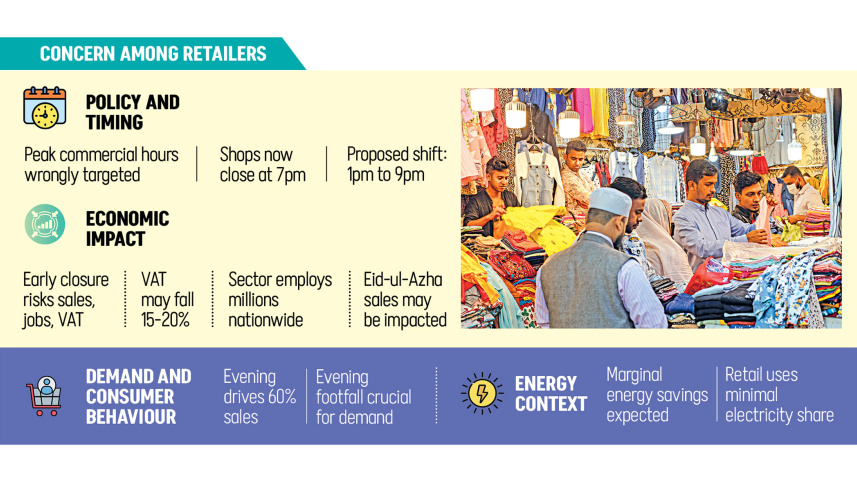
Retailers have expressed reservations about the government’s order to shut shops by 7pm, saying that it could deal a heavy blow to businesses, as nearly 60 percent of daily retail sales take place after dusk, making the evening hours the lifeblood of the sector.
They say the government’s early closure move, meant for saving energy, may do little to ease the strain as retail businesses account for only about 3 percent of national energy consumption. And as summer sets in and temperatures rise, electricity use during the day far exceeds that of the evening, when cooling loads usually fall.

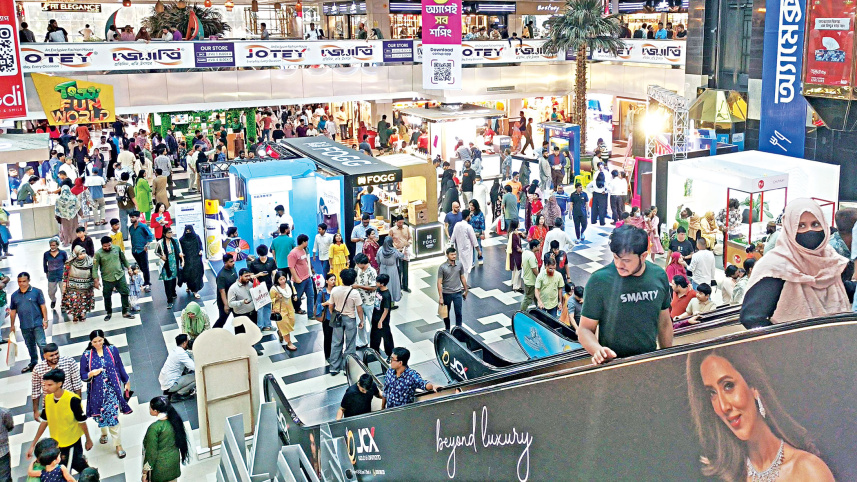
Apart from hitting sales, businesses say cutting off the peak trading window will affect employment and government revenue.
In the wake of a fuel crisis caused by the US-Israel war on Iran, the government last week announced that shops and malls across the country would close at 6pm. The decision was due to take effect yesterday.
Business leaders, however, urged the prime minister to allow shops to remain open until 8pm. In response, the government yesterday extended the deadline by one hour to 7pm.
Even so, top business figures said the measure would wipe out a large share of sales and might not resolve the energy problem.
“Most people are at work during the day and not shopping. Restricting those evening hours does not just inconvenience customers, it cancels purchases that would not otherwise happen at all,” said Kamruzzaman Kamal, marketing director at PRAN-RFL Group, one of the largest local conglomerates.
PRAN-RFL Group runs around 3,000 outlets nationwide and employs a large workforce, including full-time and part-time staff.
Kamal said reduced operating hours could affect jobs, particularly part-time workers such as students who depend on evening shifts.
According to estimates, the retail sector employs around 84 lakh to 1.20 crore people and contributes around 14 percent to 15 percent of GDP. For many, fewer working hours mean lower incomes.
Industry estimates also suggest that cutting evening trade could reduce value-added tax (VAT) receipts by 15 percent to 20 percent.
Khalid Mahmood Khan, co-founder and chief executive of fashionwear retailer Kay Kraft, said shops draw more electricity during the day because of higher cooling loads.
“Therefore, the government’s early closure policy raises questions about whether it saves energy or simply moves the pain around,” said Khan, also the senior vice-president of the Fashion Entrepreneurs Association of Bangladesh.
He said tightening peak-hour operations would disrupt buying patterns, reduce tax receipts and affect the production networks that feed into retail.
Saikat Azad, head of distribution at Transcom Electronics, described what the early-closure policy looks like from the shop floor.
“By the time customers get through the traffic and summer heat to reach a mall, the shutters are already down,” said Azad.
“For us, that lost window means lost revenue, and the VAT and tax implications follow directly,” he commented.
Azad said the consumer outlook is already shifting. “With fuel shortages and transport disruptions adding uncertainty, households are already pulling back. Non-essential purchases are being put off as people are repairing old appliances rather than replacing them.”
He added that sales during the last Eid were weak. With shorter operating hours and logistical strain, the upcoming season could be worse if sales centred on the upcoming Eid-ul-Azha falter.
 For all latest news, follow The Daily Star's Google News channel.
 He said that none of the effects would remain isolated. “When one slows, others follow. Reduced cash flow at one end ripples across the market, shrinking overall activity.”
Against the backdrop of energy shortages and a tight business climate, Syed Nasim Manzur, managing director of Apex Footwear, proposed an alternative aimed at striking a better balance.
He suggested shifting shop hours from 1pm to 9pm. The idea is to reduce electricity use during the hotter midday peak while keeping the busy evening hours intact.
Rather than imposing blanket closures, the footwear manufacturer advocated “smart load management”, including keeping air conditioners at 25 °C or above, reducing decorative lighting in malls, adopting energy-efficient equipment and enforcing stricter discipline over energy use at the store level.
Setting out the broader picture, he said the commercial sector accounts for 8 percent to 10 percent of national electricity consumption, with retail contributing just 2 percent to 3 percent.
“Closing shops early would impose heavy economic costs for only marginal energy savings,” added Nasim Manzur.
Comments