


EPA set to redefine Bangladesh-Japan trade landscape

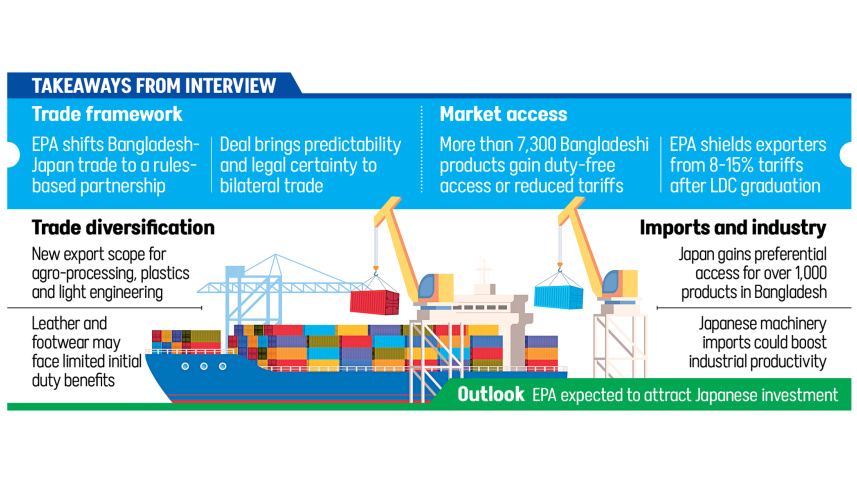
The Economic Partnership Agreement (EPA) signed between Bangladesh and Japan on February 6, in Tokyo is poised to transform the trajectory of bilateral trade between the two countries, said Tareq Rafi Bhuiyan (Jun), president of the Japan-Bangladesh Chamber of Commerce and Industry (JBCCI).
In an interview with The Daily Star, Bhuiyan described the agreement as Bangladesh’s first comprehensive EPA and a landmark shift from a unilateral preference-based arrangement to a structured, rules-based bilateral trade framework.

“This is not just about tariff cuts,” he said. “It institutionalises our trade relationship with Japan. It provides predictability, transparency and legal certainty — all of which are essential for sustainable trade growth.”
He said Japan has long been one of Bangladesh’s key trading partners, particularly as a destination for ready-made garments (RMG) and textile products.
However, he said with Bangladesh set to graduate from least developed country (LDC) status in the near future, concerns had emerged over the possible erosion of preferential market access.
He said under the existing Generalized System of Preferences (GSP) schemes, Bangladeshi exports enjoy duty-free or preferential treatment. After graduation, those benefits would no longer automatically apply.
“Without the EPA, our exporters, especially in garments, could have faced tariffs of 8 percent to 15 percent or more in the Japanese market,” Bhuiyan said. “That would have significantly affected our price competitiveness.”
He noted that the EPA secures duty-free or reduced-tariff access for more than 7,300 Bangladeshi products, including RMG, textiles and a wide range of manufactured goods. This ensures continuity in market access and shields exporters from sudden tariff shocks.
“For our bilateral trade, this continuity is critical. It means buyers in Japan can continue sourcing from Bangladesh without disruption, and our exporters can plan long-term investments with confidence,” he added.
While garments dominate Bangladesh’s exports to Japan, Bhuiyan said the EPA opens opportunities to diversify the trade basket.
The agreement includes provisions on customs facilitation, standards, sanitary and phytosanitary measures, intellectual property and digital trade — all of which reduce non-tariff barriers and enhance transparency.
“Many exporters struggle not just with tariffs but with complex procedures and compliance requirements,” he said. “Clearer rules and improved cooperation between customs authorities will lower transaction costs and reduce uncertainty.”
He believes that sectors such as agro-processing, leather goods, light engineering products, plastics and specialised manufacturing can gradually expand their presence in Japan if supported by quality improvements and compliance with Japanese standards.
However, he acknowledged that some leather and footwear products may not receive full duty benefits under the initial framework, which could create competitive pressure in certain segments.
“Industry stakeholders have raised concerns, particularly in leather. While the overall agreement is positive, sectors that do not receive immediate duty-free access will need to focus more on quality, branding and niche positioning,” he said.
On the import side, the EPA grants Japan preferential access to Bangladesh’s expanding domestic market for more than 1,000 products, including steel, machinery, auto parts and electronics. Some tariff reductions will be phased in over periods extending up to 18 years.
Bhuiyan described the phased approach as balanced and pragmatic.
“It allows Bangladesh to liberalise gradually while giving domestic industries time to adjust,” he said. “At the same time, access to high-quality Japanese machinery and intermediate goods will strengthen our industrial capacity.”
He noted that improved access to advanced machinery and components can raise productivity in Bangladesh’s manufacturing sector, which in turn enhances export competitiveness in third-country markets.
“In bilateral trade, imports are not necessarily a threat. Strategic imports — especially capital goods and technology — can support export expansion,” he said.
 For all latest news, follow The Daily Star's Google News channel.
 Bhuiyan emphasised that the EPA has broader implications for supply chain integration between the two countries.
Japan is actively seeking to diversify and strengthen its supply chains in Asia. Bangladesh, with its competitive labour force, growing industrial zones and strategic location, can position itself as a reliable partner.
“The agreement reduces trade risks by establishing clear dispute settlement mechanisms and regulatory transparency,” he said. “This gives Japanese firms greater confidence in sourcing from and investing in Bangladesh.”
He added that improved customs cooperation and streamlined procedures will reduce delays and enhance reliability — a key factor in modern supply chains.
“As supply chains become more integrated, bilateral trade will not only grow in volume but also in sophistication,” he said.
Bhuiyan stressed that small and medium enterprises (SMEs) must be prepared to take advantage of the EPA’s opportunities.
Export-oriented SMEs in garments are already integrated into global value chains, but other sectors may require capacity building.
“Compliance with rules of origin and technical standards will be crucial,” he said. “Government agencies and business associations must work together to ensure that exporters understand and utilise the agreement effectively.”
He also pointed to the importance of upgrading logistics infrastructure, including ports and cold chain facilities, to support higher trade volumes.
“Trade agreements create opportunities, but implementation determines the outcome,” he added,
While the EPA may not result in an immediate surge in trade volumes, Bhuiyan expressed confidence that it will generate steady and sustainable growth in bilateral trade over the medium to long term.
“This agreement marks a transition from a unilateral preference system to a mutually negotiated partnership,” he said. “It creates stability for our exports and enables structured expansion of trade in both directions.”
He emphasised that the success of the EPA will depend on proactive implementation, regulatory strengthening and private sector engagement in both countries.
“The framework is now in place,” Bhuiyan said. “If we utilise it effectively, Bangladesh–Japan bilateral trade can expand in volume, diversify in composition and deepen in value addition.”
Comments