


EPA policy delivery key to Japanese investment
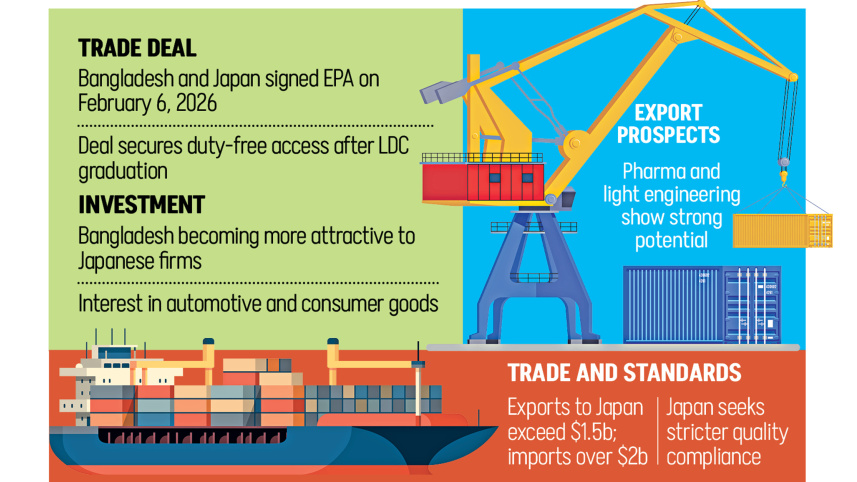
The recently signed Economic Partnership Agreement (EPA) holds significant potential to boost Japanese investment in Bangladesh, but realising those gains depends entirely on effective industrial policy implementation and institutional capacity building, diplomats and policy experts said at a seminar yesterday.
Without proper execution, however, the agreement risks remaining a symbolic document rather than a catalyst for economic transformation, they said at a seminar on “Maximising the Opportunities of the Bangladesh–Japan Economic Partnership Agreement” organised by the Centre for Policy Dialogue (CPD) at the Japan Embassy in Dhaka.

Speaking at the event, Japanese Ambassador Saida Shinichi noted that so far, Japanese investment in Bangladesh has been modest, but the potential remains high as the EPA can encourage stronger business engagement.
The deal addresses not only tariff reduction but also investment frameworks, customs procedures, regulations and rules in services, the ambassador said. It will enhance institutional capacity to facilitate Japanese investment.
However, he stressed that Bangladesh needs the right industrial policy and proper implementation is critical for realising the EPA’s potential.
Kenichi Ohno, an emeritus professor at the National Graduate Institute for Policy Studies in Tokyo, said Japanese investors talk more about India as Bangladesh does not feature prominently in their investment planning.
Implementation of industrial policy is the key for attracting investment, he said, citing Vietnam as an example of how policy execution can deliver results.
The emeritus professor suggested five conditions for effective policy formulation – the leader’s vision and commitment, policy design and consensus building, documentation and approval, substantive and meaningful participation, and a competent secretariat with sufficient authority and capacity.
Fahmida Khatun, executive director of the CPD, said the EPA would be crucial for sustaining trade and investment ties and maintaining Bangladesh’s preferential access to the Japanese market after graduating from the least developed country (LDC) category.
However, she stressed that Bangladesh must improve its business environment, strengthen compliance standards and ensure effective implementation of the agreement to fully capitalise on the opportunities.
Bangladesh’s exports to Japan have grown from less than $75 million in the 1970s-80s to about $1.26 billion in 2024, while imports from Japan now stand at nearly $2 billion.
Under the EPA, around 97 percent of Bangladeshi products – about 7,379 tariff lines – would receive immediate duty-free access to the Japanese market.
M Masrur Reaz, chairman and CEO of Policy Exchange Bangladesh, noted that the EPA comes at a crucial transitional moment for both economies.
He pointed to Bangladesh’s impending LDC graduation, the restructuring of global supply chains, growing Indo-Pacific geopolitical competition, the rise of regional trade blocs and the evolving Bangladesh-Japan bilateral relationship as key developments shaping the partnership.
He also said the EPA could help Bangladesh diversify export markets beyond the United States and Europe while supporting Japan’s “China-plus-one” strategy for supply chains.
Md Fazlul Hoque, former president of the Bangladesh Knitwear Manufacturers and Exporters Association, said Japan remains largely untapped for Bangladesh’s apparel sector.
Despite being the world’s second-largest apparel importer, Bangladesh exports only about $1.5 billion worth of garments to Japan, roughly 3 percent of its total apparel exports, he stated.
Syed Nasim Manzur, president of the Leathergoods and Footwear Manufacturers & Exporters Association of Bangladesh, called on Japan to ensure that the EPA benefits all sectors, not only garments.
He also called for economic diversification in Bangladesh, noting that more people are becoming poor, employment is falling and the country is experiencing jobless growth.
Rabiul Islam, an economist at the Asian Development Bank, said the opportunity to maximise the Bangladesh-Japan EPA is ample, but quality, compliance and social issues need to be addressed.
 For all latest news, follow The Daily Star's Google News channel.
 He suggested five key points for successful utilisation of the EPA: setting sector-specific standards for automotive, light engineering, electrical and electronics sectors; using Japanese FDI in export processing zones; implementing infrastructure standards; promoting industrial associations; and deepening cooperation for certification.
Mohammad Mahfuz Kabir, research director of the Bangladesh Institute of International and Strategic Studies, said Japan’s cooperation is needed for Bangladesh’s plea to the UN for a three-year extension of LDC graduation.
Monzur Hossain, member of the general economics division of the Bangladesh Planning Commission, said the EPA aims to ensure duty-free and quota-free market access for Bangladesh in Japan post-LDC graduation.
It covers 17 sectors including trade in goods, customs procedures, trade facilitation, investment, e-commerce, intellectual property and services.
Potential challenges include implementation gaps, export diversification, compliance with Japanese standards and institutional coordination, he said.
However, Kazuiki Kataoka, country representative of the Japan External Trade Organisation in Bangladesh, said the EPA could help mitigate the risks of LDC graduation but alone may not guarantee a surge in foreign direct investment.
Improving the overall business environment will be essential to attract Japanese investors, he said, adding that proper implementation of the deal’s provisions on customs procedures, intellectual property and regulatory rules could support that process.
Owais Parray, senior economic advisor of the United Nations Development Programme in Bangladesh, said success depends on proper implementation of effective industrial policy.
A dedicated team is also needed for policy implementation, he said.
Hiroshi Yoshida, senior representative of JICA Bangladesh Office, assured his organisation’s continued support to Bangladesh, and suggested the introduction of one stop services in the investment related offices.
Tareq Rafi Bhuiyan, president of the Japan-Bangladesh Chamber of Commerce and Industry, said the agreement, signed on February 6, was a timely safeguard for Bangladesh for the post-LDC era as it ensures continued market access for garments under flexible rules of origin.
Comments