


Energy decisions critical for macroeconomic management
Energy-related decisions will be critical for the country’s macroeconomic management, according to economist Debapriya Bhattacharya, who called for careful assessment of policy options and coordination with the finance ministry.
Without such coordination, any decision taken solely by the energy ministry could put the economy at risk, he said.

Speaking at a media briefing organised by the Centre for Policy Dialogue (CPD) in Dhaka yesterday, Bhattacharya, convener of the Citizen’s Platform for SDGs, Bangladesh, talked about the challenges facing the first budget of the new government.
“If the government wants to take any decision regarding fuel and energy, it should not take it without analysing the impact on the macroeconomy,” he said.
“You will have to first understand the fiscal space of the country within the existing macroeconomic situation,” said the economist.
The government must also consider the balance of payments. “How much you can import by spending foreign currency, and how much you can borrow to import high-priced fuel, needs to be analysed.”
Without this assessment, any unilateral decision by the energy ministry could jeopardise the economy. “So, coordination is necessary, but I don’t see any such coordination at this moment.”
Bhattacharya said the government needs to evaluate fuel taxes and excise duties carefully, and where the rates could be reduced.
“How much am I concerned about the diesel price hike? I have no such concern regarding the price hike of octane,” he said, adding that fuel price adjustments should vary across types and that the government must focus on sourcing fuel at lower costs.
He also noted that international diplomacy could affect fuel supply, but said, “An elected government will make a proper trade relation in the global arena, and it is normal. We cannot run the country’s trade relations by taking heed of other countries.”
However, the fuel issue remains closely linked to geopolitical tensions. “It will depend on how long the war continues.”
Bhattacharya said that the government faces a major challenge in the next national budget due to limited fiscal space, which could shrink further amid rising global fuel prices and the ongoing US-Israel war on Iran.
“Already, the fiscal space of the country is very limited and the debt burden is also high. The higher fuel price may dampen the debt burden and squeeze fiscal space further.”
He said that mitigating the energy problem will require greater import dependence, including purchasing liquefied natural gas (LNG) from the spot market at higher prices.
“If the government cannot bring fuel through the Strait of Hormuz, it will have to bring it from anywhere else. So, the costs for fuel import will rise in the coming days, which will raise pressure on the balance of payment and fiscal space of the country.”
This may force the government to take tough decisions, such as reducing taxes and duties on fuel imports, which would again strain fiscal space. “If you don’t have enough fiscal space, how will you manage the spending demands? The government will have to keep more focus on this issue.”
Bhattacharya also linked energy challenges to broader economic concerns.
“The country’s investment and job creation remain weak,” he said. “If the availability of fuel becomes more challenging, if the banking sector remains inefficient, investment and job creation may remain challenging. Food security is also vulnerable to disruptions in fuel and fertiliser supply. If food prices rise, it will directly affect food security.”
On budgeting, he advocated against setting unrealistic targets.
“Whether the next budget will be surreal will be apparent from some of its measures, such as the revenue target. If the government sets an unachievable target, it will make the budget surreal.”
 For all latest news, follow The Daily Star's Google News channel.
 He said that it is one type of “cheating system” of making a budget, realising that it will not be implemented.
“At least 20 percent of the budget is not implemented. So, the target of the NBR’s tax collection and real collection is widening year after year. This is surreal budgeting,” he explained.
He added that unrealistic budgeting also affects public spending and development plans. “We will see whether this government will make a non-achievable revenue target, and make the budget surreal like the previous government.”
Bhattacharya stressed the importance of a prudent budget under hard constraints. “A short-term roadmap is necessary for the ongoing fiscal year, considering the global concern and inheritance of a weak macroeconomic situation.”
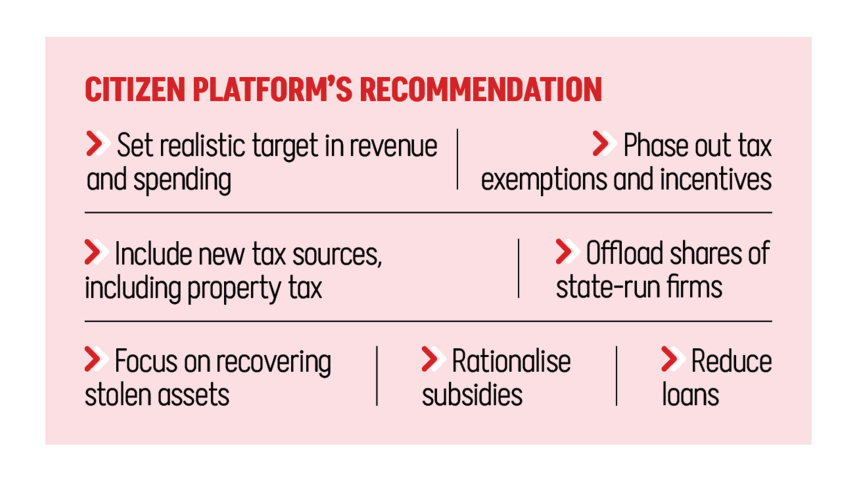
He recommended phasing out tax exemptions, broadening the tax net, increasing revenue from state-owned firms, and recovering stolen funds. On spending, he suggested adjusting subsidies, phasing out cash subsidies, limiting loans, offloading state-owned shares, and privatising inactive firms.
“The government should increase tax compliance but reduce the tax rate so that the tax net expands and fiscal space improves. By imposing tax only on income, the situation will not improve in reducing disparity. Wealth and inheritance taxes also need to be imposed.”
He also said that offloading government shares could face bureaucratic resistance. “It is a litmus test for the government.”
On debt, Bhattacharya underscored rising liabilities and the limits of foreign borrowing. “We could have borrowed from the foreign sector to mitigate the fuel situation; however, now the scope is limited as the debt burden has already mounted.”
He advised against printing money. “Even if the upcoming budget is not surreal, loans will remain constrained. If you print money, the market will realise it, forcing inflation to rise.”
Bhattacharya also talked about reviewing the recommended pay scale for public employees. The previous interim government finalised a new pay scale at the last moment but left many liabilities unresolved.
The economist recommended that the new government form its own commission to reassess pay scales, considering previous reports only as input. “There is no scope to accept the proposed pay structure unquestioningly; rather, it should be reviewed carefully and adjusted to a reasonable level.”
Comments