


Govt eyes $51b reserves in FY27

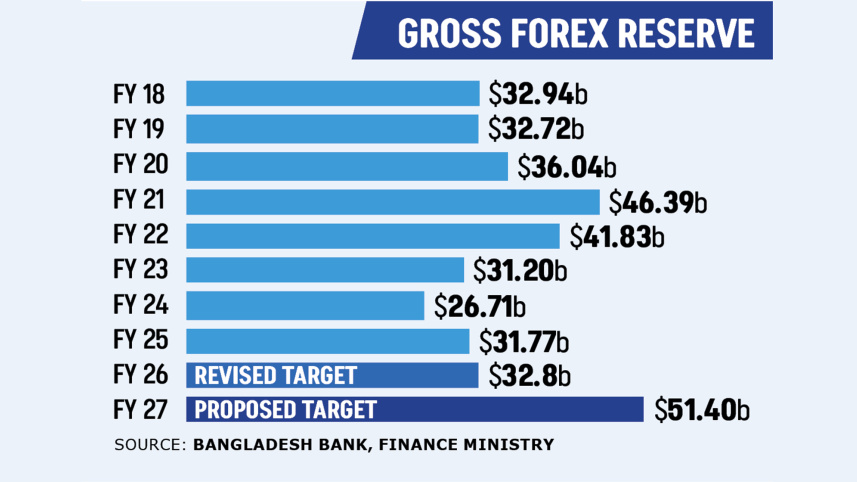
The government expects the country’s gross foreign currency reserves to hit a record $51.4 billion by the end of next fiscal year, provided that remittance inflow is strong and interest rates high.
On September 1, 2021, strong remittance inflows and lower imports sent the country’s gross foreign reserves to $48.09 billion, which remains a record.
 For all latest news, follow The Daily Star's Google News channel.
 However, the figures are not as per the IMF’s balance of payments and investment position manual (BPM6), which is followed faithfully by central banks around the world.
Gross reserves are reserve assets, which consist of gold, cash dollar, bonds, and treasury bills, reserve position in the IMF, special drawing rights holdings -- which is a form of international money created by the IMF and defined as a weighted average of various convertible currencies.
The Bangladesh Bank’s gross reserves computation factors in other components such as the Export Development Fund, sovereign guarantees for flag carrier Biman Bangladesh Airlines, the below-investment-grade securities. Subsequently, the number ends up being markedly higher.
Even with that methodology, crossing the $51 billion-mark would be a tall order given the current economic situation, according to economists.
“For reserves to reach $51 billion, remittance inflows must remain strong and ongoing discussions with development partners on budget support must progress positively. The loans need to be secured,” said Mustafizur Rahman, distinguished fellow at the Centre for Policy Dialogue.
The key issue lies in whether the government prioritises propping up foreign currency reserves or encouraging investment and job creation. If it is the latter, imports will ramp up, and it would be difficult to top up reserves.
If the finance ministry projections assume investment will rebound, imports will rise and capital machinery imports will increase, then achieving such a sharp rise in reserves will be difficult, Mustafizur said.
In the first nine months of the fiscal year, imports grew 4.55 percent, while exports fell 4.38 percent. Remittance grew 19.5 percent in the first 10 months of the fiscal year.
“Even if reserves grow, without investment and job creation, the benefit to the economy remains questionable. Thus, reserves must be satisfactory, but investment must also grow. The strategy should be balanced.”
The government must take specific steps to boost investment, he added.
At the end of June last year, reserves stood at $31.77 billion. In the original budget for this fiscal year, the target was to raise reserves to $38.9 billion, but in the revised budget, this was lowered to $32.8 billion.
Gross reserves as per the BB methodology are higher than the revised budget target due to strong remittance growth, low import growth, and despite a stagnation in export receipts.
As of May 23, which is the latest available data, gross foreign reserves stood at $34.57 billion, but it is $29.91 billion as per the BPM6 methodology.
“Due to recent export growth, continuous increase in remittance inflows, exchange rate stability, and prevailing high interest rates, foreign currency reserves may gradually increase in the future,” said a budget projection report of the finance ministry.
However, risks remain.
If the ongoing Middle East crisis prolongs, the resulting energy security crisis could increase import costs, putting pressure on reserves, the report said.
The import growth target for fiscal 2026-27 has been set at 8.8 percent, export at 8 percent and remittance growth at 15 percent.
In the first nine months of the fiscal year, an average of 89,870 workers went abroad each month, compared to 85,340 workers a year earlier.
However, in February and March, overseas worker migration slowed somewhat. War-related situations may also pose challenges for remittance inflows.
The current encouraging remittance growth, improvements in the balance of payments, exchange rate stability, positive discussions with development partners, and continued budget support will boost reserves, said a finance ministry official on the condition of anonymity.
The latest discussions with the IMF are progressing positively.
The government and IMF have agreed to exit the old $5.5 billion programme and adopt a new programme worth $5-6 billion.
“This positive progress means that in the next fiscal year, Bangladesh could receive more than $1 billion in budget support from the IMF. Additionally, the World Bank, the Asian Development Bank, and other development partners may provide $2-3 billion in budget support,” the official said.
Although this will increase interest payment expenses and future debt burdens, it will directly contribute to reserve growth, he added.
Comments