


Car sales hit 13-year low amid economic strain
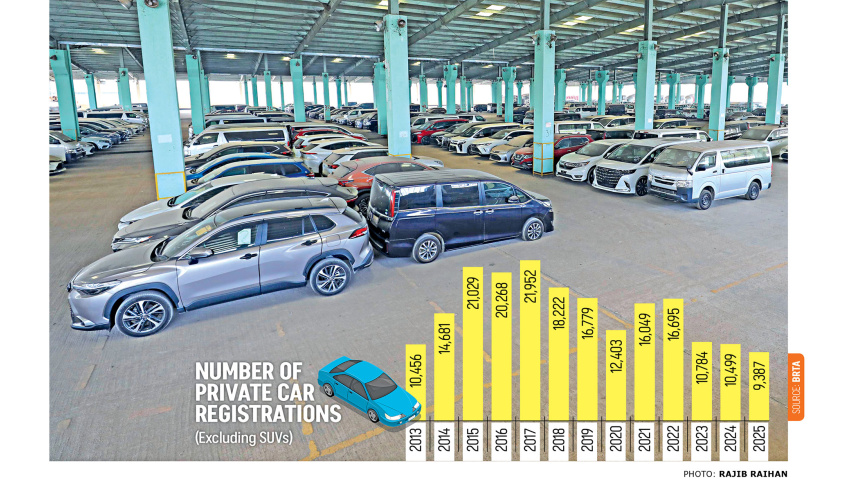
Private passenger car sales in Bangladesh have plunged to the lowest level in 13 years, reflecting persistent economic headwinds, high import costs and tightening consumer purchasing power, according to market insiders and official data.
Fresh registrations of private passenger cars fell to 9,387 units in 2025, down from 10,499 in 2024 and 10,784 in 2023, according to data from the Bangladesh Road Transport Authority.

Industry insiders say the figure marks the lowest annual registration since 2011, making 2025 the weakest year in 13 years, reflecting the drop in car sales.
The slump highlights a prolonged downturn in a market that had grown steadily before the pandemic. Insiders blamed weak business conditions, higher vehicle prices due to dollar appreciation, increased import duties and rising living costs for the decline.
Fresh registrations of private passenger cars fell to 9,387 units in 2025, down from 10,499 in 2024 and 10,784 in 2023
Mohammed Shahidul Islam, chairman of HNS Group, says a combination of economic stress and political uncertainty has led to a sharp decline in vehicle sales.
“The overall business environment in the country has been affected,” he said. “Last year, the law-and-order situation was weak, and supply chains were disrupted. Our own supply chain was also affected.”
He added that the money market was severely squeezed, creating widespread unease. “There was fear and uncertainty. Liquidity tightened, and people became cautious about spending,” he said.
According to Bangladesh Bank data, consumer lending rates rose to between 12 and 15 percent in 2025, up from 8 to 9 percent in 2022.
Rising borrowing costs further dampened demand. “Loan interest rates increased, and the cost of funds went up significantly,” Islam, also former secretary general of Bangladesh Reconditioned Vehicles Importers and Dealers Association (BARVIDA), said, adding that higher financing costs discouraged consumers from taking car loans.
At the same time, vehicle prices surged due to currency depreciation. “The dollar appreciated sharply -- at one point by nearly 40 percent. A car that used to sell for Tk 16 lakh rose to around Tk 24 lakh,” he said, citing the example of entry-level models.
According to Islam, political instability, street protests and business disruptions also eroded consumer confidence. “When there is uncertainty and businesses face harassment, people postpone major purchases,” he said.
“All these factors combined have led to the drop in sales,” he added.
Reaz Rahman, managing director of Reaz Motors, said vehicle sales last year were the lowest in 13 years, describing the market as “extremely slow”.
He attributed the downturn to rising costs, political uncertainty and tight banking conditions. Although car prices had already increased two to three years ago, further depreciation of the taka against the US dollar has pushed costs up by around 30 percent over the past two years.
“As the dollar rate increased by over 30 percent, import costs automatically went up. Duties also rose accordingly,” he said, adding that many vehicles have moved beyond the purchasing power of middle-income buyers.
Rahman, the current secretary general of BARVIDA, said instability in the political and banking sectors over the past two years weakened consumer confidence. The prolonged interim government tenure further dampened business sentiment.
He also highlighted supply constraints in Japan, the main source of reconditioned cars. Bangladesh allows imports of vehicles up to five years old, but production disruptions during the Covid-19 pandemic in 2021 and 2022 have made eligible models scarce and expensive.
“When we bid for those cars, prices are very high,” he said.
Rahman urged the government to allow imports of vehicles up to seven or eight years old to ease supply, lower prices, and increase revenue.
 For all latest news, follow The Daily Star's Google News channel.
 Arif Khan Bipu, managing director of Motors Bay, says financial hardship and weak business sentiment are the main reasons behind the slowdown in vehicle sales.
“In my view, people are reluctant to spend large amounts of cash,” he said. Buying a car worth Tk 40 lakh to Tk 60 lakh ties up significant funds, while taking a loan creates repayment pressure. “When business is slow, customers worry about how they will service instalments. This financial strain is a key factor.”
He said the broader economic slowdown has affected all sectors, including automobiles. Under a temporary government arrangement, large-scale investments and liquidity flows tend to weaken, discouraging big-ticket purchases.
The taka’s depreciation against the US dollar has pushed up the cost of completely built units (CBUs), making new vehicles significantly more expensive for middle- and upper-middle-class consumers, he added.
Although there has been a shift in market share with the rise of Chinese and electric brands, Bipu said official data shows overall vehicle purchases have declined.
Comments