


Boro paddy prices fall amid ample supply


Lower earnings and weak demand for freshly harvested Boro paddy this season have left many farmers frustrated, as abundant supply and ample stock have brought prices down nationwide.
The government’s recent decision to not raise Boro paddy procurement prices from last year has added to Boro growers’ discontent.

To make matters worse, millers say paddy prices have dropped at the beginning of the season due to sufficient stock, so they are not showing much interest in purchasing more.
Boro paddy accounts for nearly 55 percent of Bangladesh’s yearly rice production, and the season typically runs from December to April.
GROUND REALITY
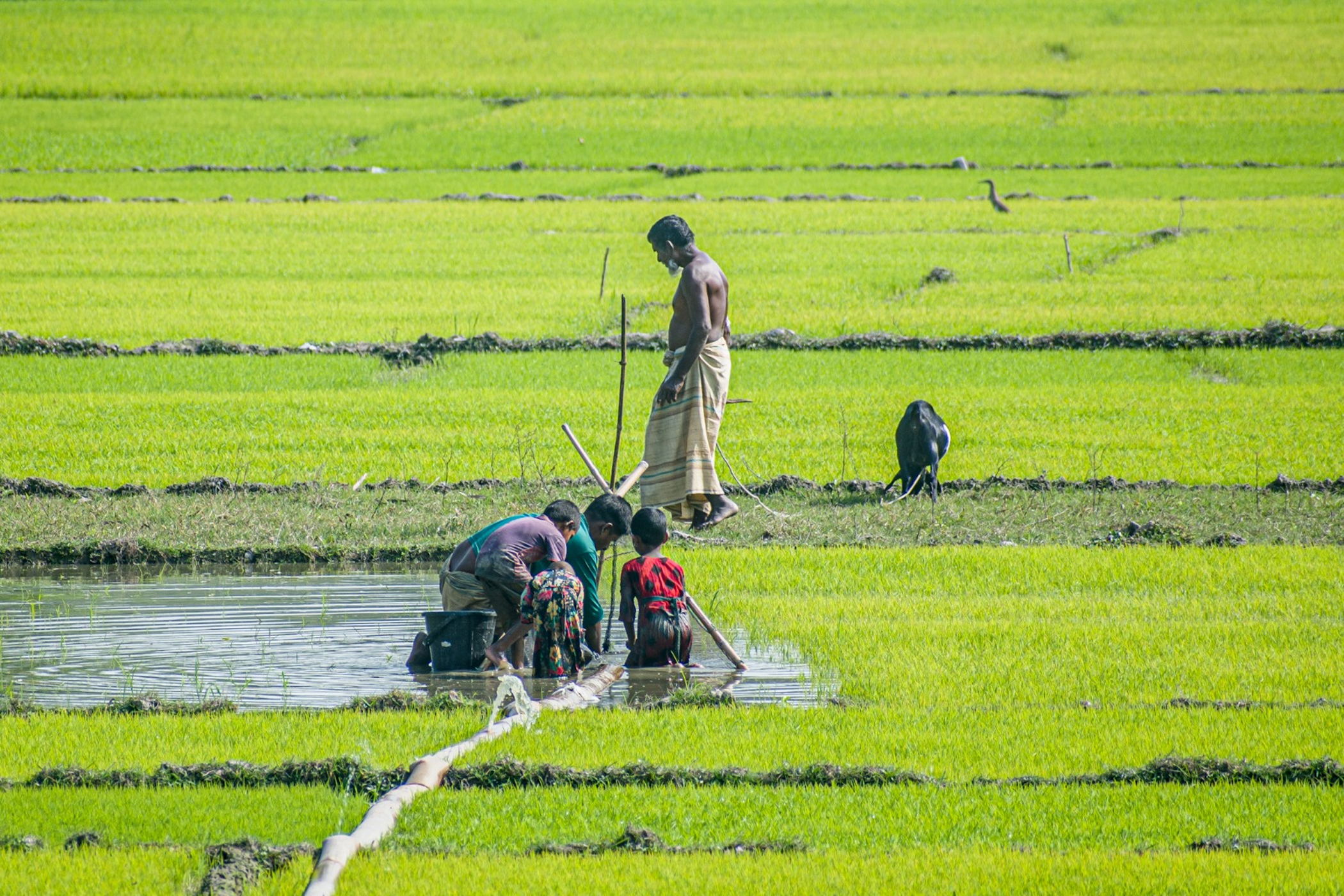
Ali Hossain, a farmer of Kauhani village in Sunamganj’s Madhyanagar Upazila, said that currently, he is selling paddy at Tk 700 to Tk 750 per maund (1 maund equals nearly 40 kg). The price was around Tk 800 last season.
“I borrowed money from local lenders to harvest, and now repaying this money has become difficult,” he added.
The government has announced that it will procure Boro paddy from growers. But to meet the criteria for procurement, farmers have to dry the paddy to a certain moisture level. Many cannot afford to dry their harvest to this level, Hossain said.
Moreover, the cost of transporting the paddy to the storage in Madhyanagar Upazila Sadar is something many cannot manage. “In this situation, farmers’ only option is to sell to local buyers at whatever low prices they offer,” he added.
The situation is much the same at Rupshi village in Mymensingh’s Phulpur upazila, said local farmer Azizul Islam.
Currently, paddy is being sold at around Tk 900 to Tk 1,000 per maund, which was Tk 1,100 to Tk 1,150 at the same time last year.
Traders are refusing to pay more than this amount, Islam said, and the situation suggests that demand is low. Recovering production costs has now become a major challenge, he added.
Low prices have added to the plight of farmers who were already reeling from crop damage due to natural disasters.
Data from the Department of Agricultural Extension shows that storms, rain, and the onrush of water from upstream between March 31 and April 5 affected 1,723 hectares of Boro farmland across six districts, harming 9,390 farmers.
A rise in costs from the government’s diesel price hike has also affected farmers beginning to harvest the highly irrigation-dependent crop, particularly in the northeastern Haor region.
LITTLE RELIEF FROM STATE PROCUREMENT
The Boro acreage stood at 50.50 lakh hectares in the current fiscal year 2025-26, posting a 3.29 percent year-on-year increase, according to provisional data from the Department of Agricultural Extension (DAE).
Production increased from 2.01 crore tonnes in FY22 to 2.13 crore tonnes in the last season of FY25. The DAE has targeted a production of 2.24 crore tonnes of Boro rice for the current season.
On Wednesday (April 22), the government said it has kept the Boro paddy procurement price unchanged this season, even though farmers say their cultivation costs have risen.
 For all latest news, follow The Daily Star's Google News channel.
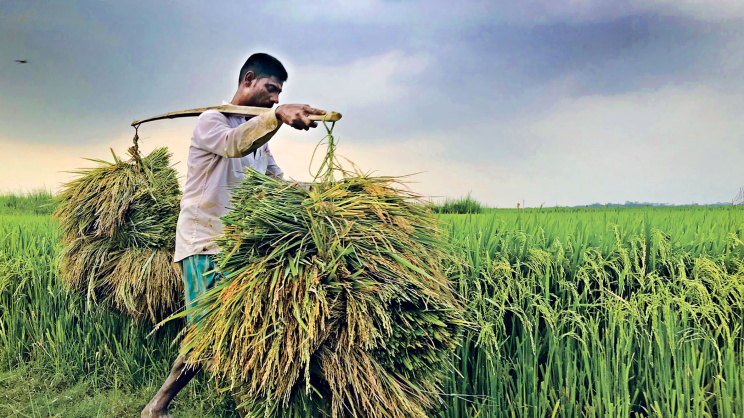
 The food ministry will buy 5 lakh tonnes of paddy -- a small fraction of the targeted production -- at Tk 36 per kg during the current season.
“Government procurement will be limited to a small quantity, and it will not significantly impact the market or alleviate the current oversupply situation,” said Chitta Majumder, managing director of the Majumder Group of Industries, a leading rice miller and importer.
Majumder said his business typically purchases stock once a year in bulk after clearing previous seasons’ stock. However, this year he was unable to sell the existing stock before the new season began, resulting in accumulated inventory and stalled sales.
He currently has in stock 21,000 tonnes of paddy and around 10,000 tonnes of rice. Due to the low demand, he has to resort to selling off his stock at a loss of roughly Tk 10 to Tk 12 per kilogram of paddy and about Tk 10 per kilogram of rice.
SUFFICIENT STOCK AND IMPORTS
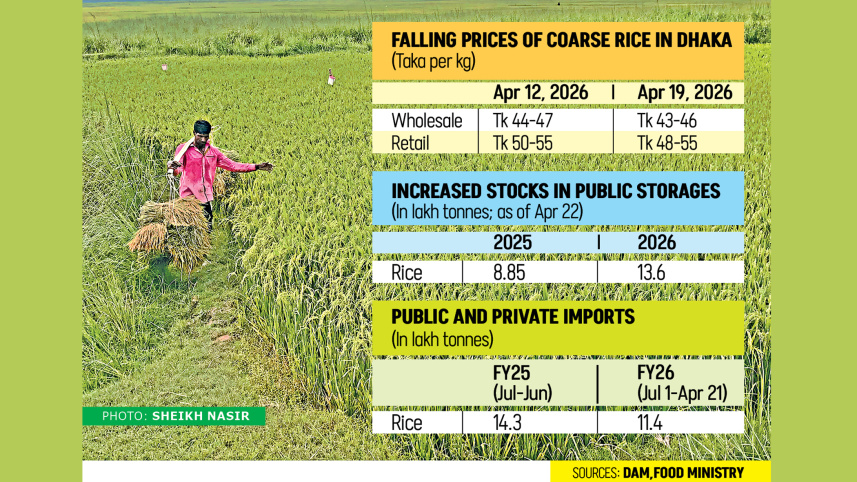
As of 22 April 2025, the country’s total stock of paddy and rice stood at 8,85,666 tonnes, including 666 tonnes of paddy and 885,000 tonnes of rice.
By 22 April 2026, total stock rose to 1,364,649 tonnes, with 67 tonnes of paddy and the rest rice, indicating a substantial increase in overall supply, according to the food ministry data.
Meanwhile, rice imports totalled 11.41 lakh tonnes between 1 July and 21 April of FY2025-26, compared to 14.36 lakh tonnes imported during the full FY2024-25 by both public and private sectors combined, the data showed.
Abdul Bayes, former vice-chancellor and economics professor at Jahangirnagar University, said fresh paddy prices are low at the start of the season due to high supply and weak demand.
Current public and private stocks are significantly higher than last year, contributing to lower prices.
He emphasised that the key issue is whether farmers are able to recover their production costs, as rising input expenses have squeezed margins.
He added that the government’s lack of urgency in procurement reflected in a minimal increase in procurement price may be linked to high stock levels, but warned that such stocks may not be sufficient in the face of potential future uncertainties.
The former professor also suggested that the government should have increased procurement prices more substantially to ensure fair returns for farmers and to avoid potential supply and price pressures later.
Comments