


Bata to make quality shoes affordable for all

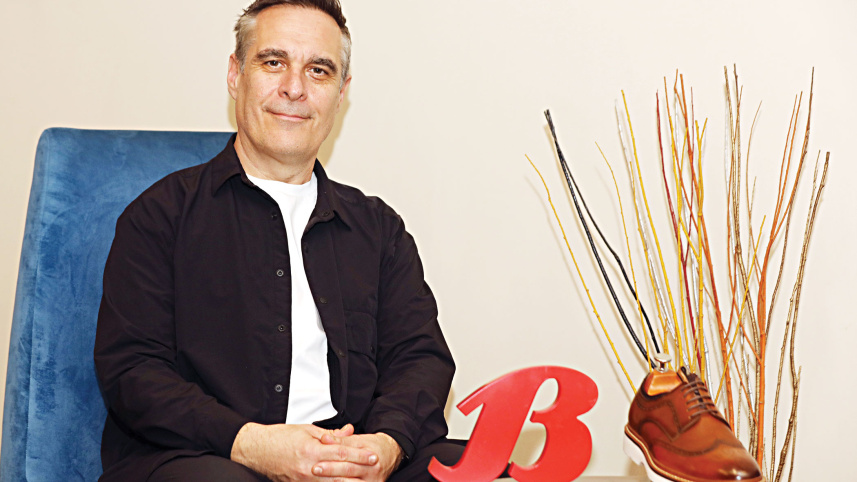
Shoemaker Bata is strengthening its presence in Bangladesh, promising to “democratise” footwear by making quality, design and comfort accessible to all, not just a narrow segment of buyers, according to the group CEO.
In his first visit to the country as the chief executive of Bata Group, Panos Mytaros said he gathered fresh insights into a market shaped by tradition, changing tastes and rising expectations.

In an interview with The Daily Star, Mytaros said he wants to modernise the brand by blending global design trends with local preferences, especially around celebrations, while ensuring high standards remain affordable across income groups.
“I find the Bangladeshi consumers very traditional. For them, celebrations matter a lot, and buying patterns increase during those times,” he said.
At the same time, he observed a clear shift in consumer behaviour. “The consumer wants quality and is ready to pay an affordable price for quality. It is not just a price-sensitive consumer base, which is very interesting,” he said. “They also want a specific taste and variety.”
Bata has been running its business in Bangladesh since 1962, and enjoys strong brand recognition. But Mytaros said that legacy alone will not secure its future.
“Consumers know Bata. We do not need to prove Bata to the consumer,” he said. “But that gives us a very big responsibility to continuously attract new consumers and be relevant.”
That relevance, he said, depends on adapting to modern expectations without losing sight of tradition. “The Bangladesh market needs more variety. It needs design which fits, and this is what Bata has to do and will do.”
Drawing on his global experience, Mytaros described Bata as a “unique” brand for its deep local roots.
“Bata is considered local in many countries because it has been there for many years. It is part of the culture,” he said. “It is not somebody selling shoes.”
That identity shapes the company’s strategy. “Bata cannot be just a global company which makes a global collection and ships it to a market,” he said. “It needs to be with the market and at the same time be global.”
Central to that approach is what he called an “unreasonably good” product proposition, which explains why a customer should choose your product, specific benefits, solutions to pain points, and competitive advantages.
“The consumer has to touch and say, ‘This is so good,’ but it is actually unreasonable economically,” he said. “There is this perception that quality and premiumness cost more, and this is something Bata has to make available for everyone.”
At this point, the idea of democratisation runs through the company’s plans.
“I call it democratise quality, democratise design, democratise comfort,” he said. “This is actually very fundamental in Bata’s history.”
He said the goal is to serve all segments of society. “We will make sneakers that are comfortable and designed for everyone. Not for the elite or only one part of the demographic,” he said. “At the end of the day, it is the same ritual we had many years ago, but modernised.”
Alongside product changes, Bata is restructuring its business model to reduce complexity while keeping local responsiveness.
“We are a very big company that operates in a highly decentralised way. It worked for many years, but it created complications,” said the CEO.
Simplification, he added, is essential. “If we offer too many things, we confuse the consumer,” he said. “Simplification starts with the product and the message.”
In Bangladesh, the company plans to focus on two core categories: leather shoes and sneakers. “Be very clear -- these are our sneakers, these are our shoes, and tell the consumer why you buy Bata,” he said.
 For all latest news, follow The Daily Star's Google News channel.
 For the focus on sneakers, Mytaros pointed to the rapid rise of casual footwear worldwide.
“Sneakers are a very big trend and have changed the shoe world in the past decade,” he said. “It is not just a choice anymore; it is part of consumers’ lives.”
Bata plans to sharpen its sneaker offer while keeping it inclusive. “You will see much more clarity, much more relevance, especially with younger audiences. But not only for them, for everyone,” he said.
Mytaros said he sees Bangladesh playing a larger part in the group’s global strategy, both as a market and a production base.
“I see a lot of design inspiration coming from Bangladesh influencing Bata,” he said. “And definitely, more manufacturing and exporting shoes from Bangladesh to other Bata countries.”
With a population of around 180 million and a fast-developing economy, Mytaros said he believes the country can become a key growth driver for the group.
On the expansion plan, the CEO said the company is preparing to expand both retail and manufacturing operations in Bangladesh.
“We need to get more Bata shoes onto people’s feet,” he said. “Many consumers do not relate to Bata today. We need to get them back.”
He said that growth will come through new stores, franchise partnerships and higher production capacity. “We have plans to expand retail, expand with partners and expand manufacturing, for Bangladesh and for export,” he said. “So yes, general expansion.”
Summing up his approach, he said, “Our mission is simple. Make great shoes that everyone can afford, not just a few.”
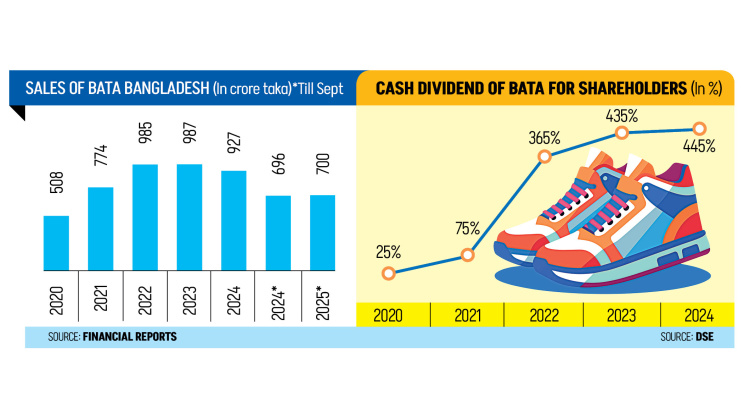
Bata Shoe Company Bangladesh Ltd reported sales of Tk 700 crore in the first nine months of 2025, up from Tk 696 crore in the same period a year earlier. In 2024, the listed multinational declared a 445 percent cash dividend for shareholders.
The company, listed on the Dhaka Stock Exchange in 1985, saw its shares trade at Tk 831 yesterday.
Comments