


Bepza attracts record $718m investment proposals in FY26
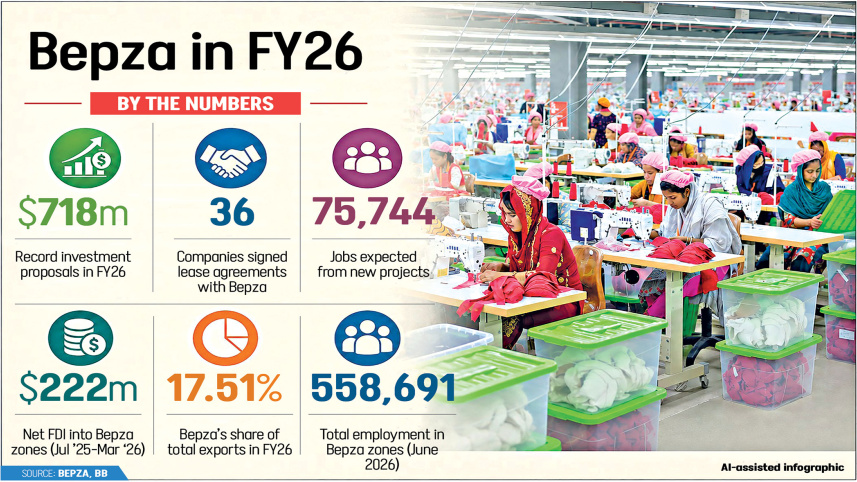
The Bangladesh Export Processing Zones Authority secured record investment proposals worth $718 million in fiscal year 2025-26, reflecting strong investor confidence in its export processing zones despite a challenging global economic environment.
In a statement, Bepza said thirty-six companies signed lease agreements with the authority during the fiscal year to establish industries in its zones. The companies are from China, South Korea, the British Virgin Islands, Singapore, the United Arab Emirates, Samoa and Bangladesh.

The commitments mark the highest investment proposals Bepza has secured in a single fiscal year, up from $498 million in FY25.
Once the projects become fully operational, they are expected to create jobs for 75,744 Bangladeshi nationals.
36 companies signed lease agreements with Bepza in FY26 to establish industries in its zones. The companies are from China, S Korea, the British Virgin Islands, Singapore, the UAE, Samoa and Bangladesh
Most of the new investments target diversified manufacturing sectors beyond traditional export industries. The planned factories will produce bags and luggage, fashion accessories, electrical and electronic products, Bluetooth headphones, airplane amenity bags, toy and fishing drones, lightweight cargo drones, footwear and footwear accessories, leather goods, light engineering products, camping furniture, greenhouse hydroponic tents, agricultural products, processed foods and household products.
Bepza remains a major contributor to Bangladesh’s foreign direct investment (FDI). Bangladesh Bank data cited by the authority showed Bepza zones recorded net FDI inflows of $221.58 million during the first nine months of FY2025-26 (July 2025 to March 2026), accounting for 19.61 percent of the country’s total net FDI inflows during the period.
Excluding working capital, actual investment in Bepza zones reached $286 million during FY26, driven by spending on capital machinery, construction materials and other productive assets.
The authority credited the continued inflow to its business-friendly environment, efficient investor services and decades of experience managing export processing zones.
It also pointed to repeat investments by existing companies as evidence of growing investor confidence. China’s Kaixi Group, for instance, signed a fresh lease agreement last year to invest $40.50 million through Kaixi Garments Bangladesh, after having already invested $60.85 million in Kaixi Lingerie Bangladesh.
The rebound comes as the country’s overall FDI also picked up in 2025, ending two consecutive years of decline, though the gains were not enough to close the gap with regional peers.
Bangladesh remained the third-largest recipient of FDI in South Asia after India and Pakistan, according to the World Investment Report (WIR) 2026, released last week by the UN Conference on Trade and Development (UNCTAD).
The report showed FDI inflows into Bangladesh rising 45 percent to $1.78 billion in 2025, up from $1.23 billion a year earlier. Bangladesh Bank data showed a similar trend, with FDI climbing 45.5 percent to $1.79 billion, which the central bank attributed to higher reinvested earnings from existing foreign investors.
The strong investment momentum came even as Bepza-run zones continued to outperform the country’s overall export sector.
Bangladesh’s total exports fell 0.58 percent to $48 billion in FY2025-26, down from $48.28 billion a year earlier.
Exports from Bepza zones, in contrast, rose 2.2 percent to $8.41 billion from $8.22 billion, lifting Bepza’s share to 17.51 percent of the country’s total exports for the fiscal year.
The authority also reported record employment in its zones, with 25,164 new jobs created during FY26. Total employment climbed to 558,691 by the end of June 2026, up from 533,527 a year earlier, the highest cumulative figure ever recorded in Bepza zones.
Product diversification has continued to strengthen the competitiveness of industries operating in the zones, Bepza said.
Of the 451 enterprises currently in commercial operation, 33 percent are engaged in readymade garment manufacturing, 18 percent in garment accessories and 8 percent in textiles, while the remaining 41 percent produce a wide range of diversified products.
Products manufactured in Bepza zones now reach 129 countries.
 For all latest news, follow The Daily Star's Google News channel.
 The authority currently operates eight export processing zones and the Bepza Economic Zone. As of June 2026, cumulative investment in its zones stood at $7.37 billion, with cumulative exports reaching $127.42 billion.
A total of 566 industrial enterprises fall under the authority, including 451 in commercial operation and 115 under implementation.
Comments