


Banks hire more women, offer less support
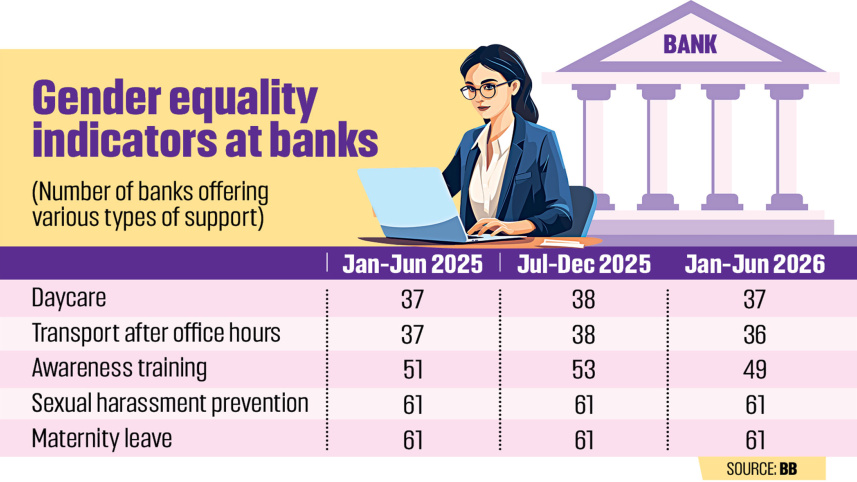
Although Bangladesh’s banking sector added 910 female staff members in the first half of 2026, essential workplace provisions for women took a step backwards, according to Bangladesh Bank (BB).
Key institutional indicators -- namely child daycare provisions, transport after office hours, and gender awareness training -- deteriorated in the January-June period of this year from the previous six months, the central bank said in its latest issue of the Gender Equality Report of Banks & FIs.

The BB said the number of female workers increased by 2.6 percent to 35,971 in the first half of this year, but provisions to ensure favourable conditions have not improved.
The number of banks having daycare facilities dropped to 37 in the January-June period from 38 six months ago. The scope for transport support for women bankers after office hours did not improve. Out of 61 institutions, dedicated transportation facilities for female employees after working hours decreased to 36 from 38.
Institutions conducting gender-equality-related awareness training programmes also dropped from 53 to 49 banks.
A similar trend was reported in the non-bank financial sector.
Daycare provisions in finance companies dropped from six to four NBFIs, transport facilities after office hours declined to 23 from 24, and gender awareness training programmes decreased to 21 companies from 23.
Fahmida Khatun, distinguished fellow at the Centre for Policy Dialogue (CPD), said the increase in female employment is encouraging. However, declining workplace support suggests that progress remains largely numerical rather than institutional.
“We need daycare facilities, safe transport after office hours and gender-awareness training for women’s recruitment, retention and career advancement, especially into senior management. If there is any deterioration in these areas, there may be increased work-family pressures, safety concerns and attrition among female employees,” she said.
Banks should therefore treat these provisions as core human resource investments, not optional benefits. Bangladesh Bank should establish measurable standards, require time-bound improvement plans and monitor compliance regularly, said Fahmida.
“Sustainable gender equality in workplaces requires not only hiring more women, but also creating safe, supportive and inclusive workplaces where they can progress.”
However, 61 banks have a sexual harassment awareness policy and give six-month maternity leave.
The BB report showed that the ratio of female bankers remained almost stagnant at around 16.5 percent over the past year, though the overall workforce increased by 2.5 percent to 217,818 in the last year.
Women accounted for one-quarter of total employees in foreign banks, while the ratio of female bankers was 17 percent in the case of state-owned banks. Just over 16 percent of the total workforce at private banks were women, according to the BB report.
Khairun Nahar Haque, head of Human Resources at Standard Chartered Bangladesh, said the multinational bank is committed to promoting equality in the workplace for all employees and applicants, irrespective of their particular characteristics, including but not limited to gender, ethnicity, disability, religion, or age.
“To uphold this, we take steps to ensure equal opportunity for all candidates, focusing on merit-based hiring practices that are inclusive and free from bias. As a result, our bank has become a preferred employer of choice, known for our inclusive work environment, learning and development opportunities and career growth prospects -- all of which ensure fair treatment for every colleague.”
The central bank report also highlighted a gap in senior leadership across banks.
While female participation stood at roughly 17 percent at the entry level and 16.37 percent at the mid-level, the ratio stood at 10.55 percent in high-level positions.
Women occupied over 13 percent of bank board seats, ranging from 17.24 percent in foreign commercial banks to 4 percent in state-owned commercial banks.
 For all latest news, follow The Daily Star's Google News channel.
Comments