


Bangladeshi vessels suspend Gulf transit amid tensions

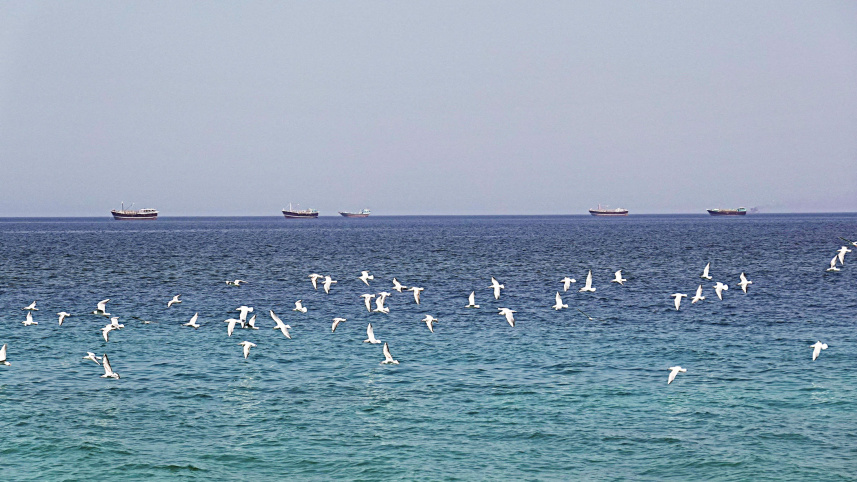
The majority of Bangladeshi oceangoing vessels -- both state-owned and private -- have suspended navigation through the Gulf region as conflict has flared between the US, Israel and Iran.
Tension escalated in the Middle East following the US and Israel’s joint attacks on Iran and the subsequent retaliation from Tehran. At the time, only one of the seven vessels owned by the national ship operator, Bangladesh Shipping Corporation (BSC), was present in the Gulf region.

The bulk carrier named Banglar Joyjatra arrived in the UAE’s Jebel Ali port on February 27 from Mesaieed, Qatar, carrying 38,800 tonnes of steel coils. While the ship remains stranded, all 31 crewmen onboard are safe and in close contact with the BSC.
On Monday, Tehran restricted vessel transit through the Strait of Hormuz, so the vessel may not be able to leave the Gulf region unless the situation improves, officials of the state-owned operator said.
Shipping through the Strait of Hormuz between Iran and Oman, which carries around one-fifth of oil consumed globally as well as large quantities of liquefied natural gas, has ground to a near halt after vessels in the area were hit as Iran retaliated to US and Israeli strikes.
There are currently 109 Bangladesh-flagged oceangoing vessels -- mostly bulk carriers and oil tankers
There are currently 109 Bangladesh-flagged oceangoing vessels -- mostly bulk carriers and oil tankers. Apart from the eight container vessels that only ply between Bangladesh and four neighbouring transhipment ports of Colombo, Singapore, and two Malaysian ports, all the other oceangoing vessels are engaged in transporting cargo across the globe, including the Gulf region.
Operators of these vessels have been rerouting their vessels in or bound for the Gulf region amid turmoil in the region.
Immediately after the US and Israel launched a joint strike on Iran on February 28, Mercantile Shipping Lines Ltd, a concern of Meghna Group of Industries, which owns 26 oceangoing vessels, suspended transit towards the Gulf region.
Mohammad Abu Taher, senior general manager of Mercantile Shipping Lines Ltd, told The Daily Star that the company restricted its vessels from advancing towards the entirety of the Gulf region regardless of the purpose -- refuelling or trade.
One of their vessels was en route to Dubai for refuelling on Saturday, Taher said. It was instructed to reroute.
SR Shipping, a concern of Chattogram-based KSRM Group, which owns 29 oceangoing vessels -- the highest among private firms -- is proceeding with deliberate caution.
Currently, two of SR Shipping’s vessels are en route to Oman and Kuwait, Mohd Meherul Karim, CEO of SR Shipping, said.
“Both vessels are still quite far from the region, and it may take them 3-4 days to reach their previously scheduled destinations,” he said, adding that the company has instructed both vessels to proceed at a slower speed.
SR Shipping has opted to monitor the developing situation for a couple more days. If the war situation does not improve, the next course of action will be decided upon, Karim said.
In the prevailing situation, it is a wise decision for ships to avoid the risky Gulf region, said Azam J Chowdhury, chairman of Bangladesh Ocean Going Ship Owners’ Association.
Chowdhury is also the chairman of East Coast Group, which owns and operates several oil tankers and gas carriers that transport crude oil and gas from the Gulf region through the Strait of Hormuz.
He mentioned that one of their mega oil tankers -- Omera Galaxy -- with over one lakh tonnes of crude oil left Jebel Dhanna Port in Abu Dhabi, UAE, immediately before the war started. Currently, none of their tankers is in the region.
 For all latest news, follow The Daily Star's Google News channel.
Comments