


Bangladesh faces $4.8b surge in annual energy import bill
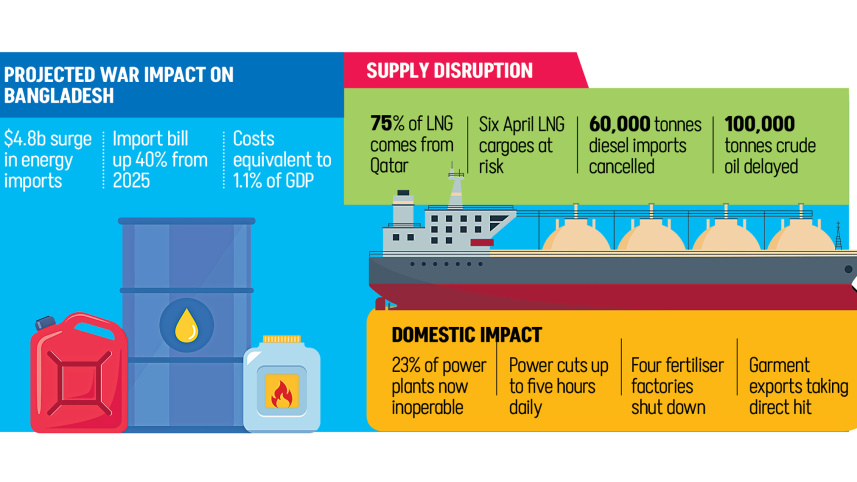
Bangladesh’s annual fossil fuel import bill is projected to soar by $4.8 billion, a 40 percent increase from 2025 levels, due to the Middle East crisis, according to a new analysis by Zero Carbon Analytics (ZCA).
The financial shock of oil, gas, and coal prices will cost the equivalent of 1.1 percent of Bangladesh’s 2024 gross domestic product if current elevated levels hold for a year. The country spends roughly $12 billion annually on energy imports, according to government data.

“This type of crisis is repeating itself, echoing the price shocks caused by Russia’s invasion of Ukraine, causing the costs of Bangladesh’s dependence on fossil fuels and its delayed energy transition to mount,” the ZCA analysts wrote in a March report.
It noted that the Russia-Ukraine conflict had sent Bangladesh into an economic crisis, with GDP levels only recovering in 2025. Asian liquefied natural gas (LNG) rose by 390 percent in the year leading up to Russia’s invasion, followed by a 48 percent increase in the five months after it, resulting in power demand shortfalls and months of power cuts. In October 2022, blackouts left 130 million people without power.
The hefty price tag, driven by the ongoing conflict in the Middle East, threatens to severely drain the country’s foreign exchange reserves, reducing its import cover ratio from 5.7 months to 4.9 months.
“The increased import bill will also weigh on the country’s currency, which could push up inflation and apply greater pressure on the central bank to raise borrowing costs,” wrote the international research group that provides analysis on global energy transition.
The crisis exposes Dhaka’s deep vulnerability to volatile international energy markets, as 46 percent of the country’s total energy supply came from imports in 2023. In the fiscal year 2024-2025, imports accounted for 65 percent of its power needs.
Much of this vital fuel flows through the Strait of Hormuz, where shipping is now severely disrupted. Bangladesh imports around 1.4 million tonnes of crude oil through the strait annually under long-term contracts with Saudi Aramco and Abu Dhabi National Oil Company.
An Aramco cargo of 100,000 tonnes bound for Bangladesh is already delayed in the Gulf because of the war, noted the ZCA report.
Supply pressures are emerging across multiple energy sectors. Confirming the squeeze on refined products, the Bangladesh Petroleum Corporation (BPC) reported in early March: “Around 60,000 tonnes out of the 293,000 tonnes of diesel planned for import in March have been deferred or cancelled.”
Simultaneously, Qatar, which accounts for 75 percent of Bangladesh’s LNG imports, has suspended production and shipments. Deep LNG dependence is driving fiscal distress across the power sector.
Six out of seven LNG cargoes scheduled for April in the import plan of the state-owned Petrobangla -- which is mandated to manage oil, gas and other mineral resources -- are expected to pass through the strait. Delivery of half the remaining cargoes is uncertain, according to reports.
David Hasanat, president of the Bangladesh Independent Power Producers’ Association, highlighted the scale of the generation deficit, noting, “23 percent of Bangladesh’s power plants are inoperable due to gas shortages.”
The acute shortages are fracturing the domestic industry. After the shutdown of four fertiliser factories, the country’s vital garment export sector is also taking a direct hit.
Mahmud Hasan Khan, president of the Bangladesh Garment Manufacturers and Exporters Association, said, “Power cuts have increased to up to five hours a day since the war began, and diesel supplies are insufficient to run back-up generators.”
Despite these compounding emergencies, Bangladesh’s transition to clean energy remains stalled. The country needs to deploy 760 MW of renewable capacity annually to hit its 2030 targets, yet only 358 MW were in the construction pipeline as of February 2026.
International Energy Agency (IEA) data shows that renewables’ share of the energy mix has stagnated at around 2 percent between 2020 and 2023, with little increase in 2024.
According to the Institute for Energy Economics and Financial Analysis (IEEFA), just 1,446.3 MW of capacity was added between December 2008 and December 2025.
Dhaka, meanwhile, is advancing 41 proposed new LNG power plants at an estimated cost of $50 billion. This would add 35 GW of capacity, tripling current capacity, and would be largely reliant on imported LNG.
“The funds spent absorbing volatile prices are a missed opportunity for Bangladesh to finance renewable energy, which would insulate the country from future crises,” the ZCA report argued.
 For all latest news, follow The Daily Star's Google News channel.
 Policy interventions could provide immediate relief. IEEFA analysis suggests that cutting import duties on solar panels and inverters could unlock crucial rooftop projects.
“A single 1 MW rooftop plant could save around $180,000 in imported fuel costs each year and insulate Bangladesh from a cycle of future fossil fuel price shocks,” the IEEFA said.
Comments