


Bangla QR adoption faces resistance over merchant fees

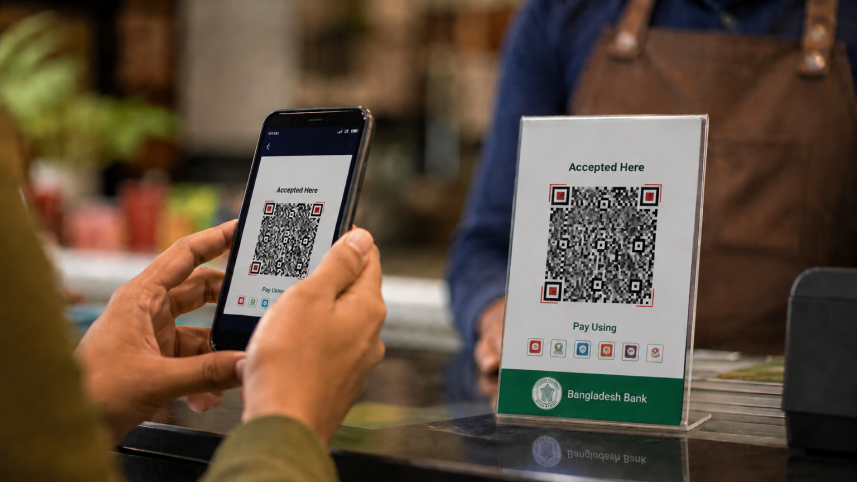
The minimum Merchant Discount Rate (MDR) -- the fee merchants pay on each Bangla QR transaction -- is discouraging adoption of the interoperable payment platform, industry insiders say, even after Bangladesh Bank made it mandatory from July 1.
Industry insiders say many merchants pass this fee on to customers by raising prices. Those who do not lose up to 1.15 percent of their receipts, making the fee a major obstacle to wider adoption.

The central bank has set this minimum MDR at 1 percent, including VAT, for transactions on the Bangla QR system under the National Payment Switch Bangladesh (NPSB). Previously, there was no minimum. The maximum rate was capped at 1.15 percent.
Industry insiders say many merchants pass the fee on to customers by raising prices
Apart from the MDR, incomplete interoperability between banks and mobile financial service (MFS) providers, limited smartphone use, weak internet access, data privacy concerns, and low digital literacy are also hindering Bangla QR adoption, according to bankers.
Syed Ibrahim Saajid, head of digital banking at City Bank, said public awareness of cashless transactions must be increased by highlighting their benefits, while small merchants should be encouraged through incentives rather than fees.
“Otherwise, it will be difficult to make Bangla QR widely popular,” he said. “People need to become accustomed to QR-based payments through sustained awareness campaigns. India also provided incentives during the early stages of promoting QR payments.”
Md Mahiul Islam, a member of Bangladesh Bank’s Bangla QR working committee, said expanding Bangla QR is one of the government’s key priorities.
“The central bank has undertaken several initiatives. At this stage, the focus is on raising public awareness and encouraging adoption,” he said.
“We expect significant progress within the next three to four months,” said Mahiul, who is also a deputy managing director and head of retail banking at BRAC Bank, told The Daily Star.
He added that the central bank is also “reviewing the pricing mechanism” to determine how the charges should be structured.
Arief Hossain Khan, executive director and spokesperson of BB, said merchant acquirers have invested in building the necessary infrastructure and therefore charge a fee for the service.
“However, as transaction volumes increase, the fee can be reduced. We are discussing whether the charge can be lowered,” he said.
He added that the minimum fee was introduced as some companies, whose main business isn’t merchant acquiring, were offering the service for free to grab market share, which he called an “unsustainable practice”.
According to BB officials, Bangla QR use is growing steadily, with daily transactions now reaching around 200,000.
The country has about 18.5 lakh Bangla QR merchants. Half are in urban areas, as per BB data.
Among MFS providers, bKash leads with roughly 500,000 merchants. Among banks, Pubali Bank has the largest network, with about 200,000 merchants. Dutch-Bangla Bank, Mutual Trust Bank, Islami Bank Bangladesh PLC, Bank Asia, BRAC Bank, DG Pay, Seba Fintech, and Nagad are also expanding their merchant bases.
As part of the “Cashless Bangladesh” initiative, the Ministry of Local Government, Rural Development and Co-operatives last August ordered all city corporations and municipalities to require Bangla QR for retail trade licence issuance and renewal.
BB had also directed all banks, MFS providers, and payment service providers (PSPs) to replace their own QR codes with Bangla QR by June 30, 2026.
To support the initiative, full interoperability among banks, MFS providers and PSPs has recently been enabled, allowing merchants to receive funds instantly after transactions.
 For all latest news, follow The Daily Star's Google News channel.
 The government has also formed a steering committee headed by the BB governor and launched nationwide merchant onboarding and public awareness campaigns.
Central bank officials say the broader goal is to reduce cash use, improve transparency, and expand financial inclusion.
Under the system, a customer of any participating bank, MFS provider, or PSP can scan any Bangla QR code and pay instantly.
To promote Bangla QR, the BB board on Wednesday decided to create a Tk 100 crore fund. The fund will subsidise merchant charges for small merchants.Sources at the meeting said the subsidy mechanism and eligibility rules are not yet finalised. BB is expected to issue a policy soon, specifying which small merchants get a 100 percent subsidy and how it will work.
Comments