


Attacks on Iran rattle global markets, DSE hit hardest
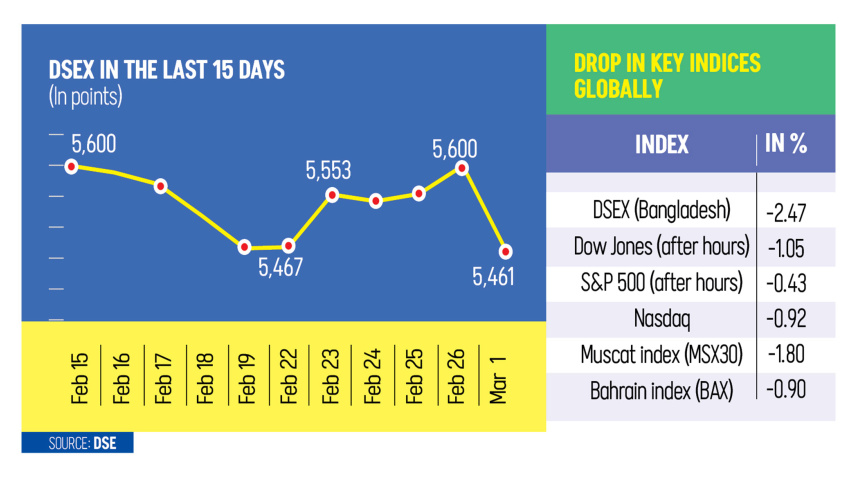
Bangladesh’s stock market took a heavier hit than most of its global peers following the United States and Israel’s attacks on Iran, as investor panic and weak market safeguards amplified a selloff that rattled bourses worldwide.
The DSEX, the benchmark index of the Dhaka Stock Exchange (DSE), fell 138 points, or 2.47 percent, to close at 5,461 yesterday.
 For all latest news, follow The Daily Star's Google News channel.
 The DS30, the blue-chip index, dropped 52 points, or 2.40 percent, to 2,117.
By comparison, losses in other markets were more contained. In the US, in after-hours trading, the Dow Jones Industrial Average fell 1.05 percent, the S&P 500 dropped 0.43 percent, and the Nasdaq declined 0.92 percent.
In stock trading, after-hours trading refers to electronic trading that takes place after the regular market session ends.
In the Gulf region, Saudi Arabia’s benchmark index, the largest in the region, fell 2 percent. Oman’s Muscat stock index (MSX30) declined 1.8 percent, and Bahrain’s BAX dropped 0.9 percent.
“The US and Israel’s attack on Iran is a significant global event with major implications for the world economy, and investors in Bangladesh reacted to that,” said Md Moniruzzaman, CEO of Prime Bank Securities.
He noted that the DSEX initially plunged over 200 points as panicked investors rushed to sell, before recovering somewhat as calmer investors stepped back in.
“The capacity of our investors to analyse global events is comparatively weak, which is why panic tends to set in quickly,” he said.
“If the conflict prolongs, oil prices will rise, the global economy will suffer, and inflation may climb further. All sectors will be affected… but by how much depends on careful analysis. Some sectors may remain unscathed. Investment decisions should be based on analysis, not fear,” he added.
For instance, he pointed out that in Gulf markets, shares of oil companies actually rose during the selloff, buoyed by expectations of higher oil prices in the wake of the conflict.
Striking a similar tone, Saiful Islam, president of the DSE Brokers Association of Bangladesh, said, “Investors here were panicked, fearing broader economic damage from the US and Israel’s invasion of Iran.”
Gulf markets, he explained, were partly cushioned by optimism around future oil company profits, while markets in other countries were stabilised by the active participation of mutual funds and institutional investors.
“In Bangladesh, mutual funds, which act as shock absorbers, are not functioning at the level seen elsewhere. That gap amplified the market’s reaction,” Islam said.
Yesterday, turnover on the DSE also fell sharply, dropping 18 percent to Tk 775 crore.
Comments