


AI dreams crash into stark $7tn reality
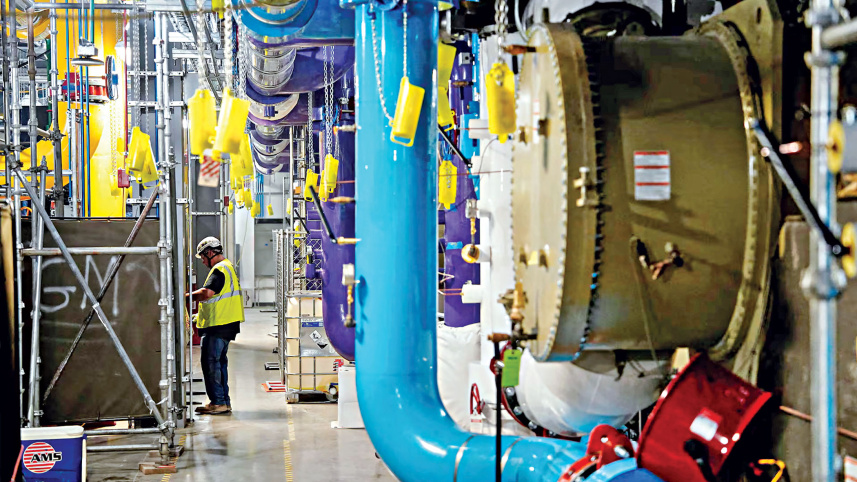
Artificial intelligence is squeezing the planet’s resources. Serious questions have yet to be answered about whether there’s enough labor, copper, water and other basics to build and operate all the data centers now under consideration. Even if AI titans manage to solve these problems, there’s an even bigger and stickier supply matter to work out: money.
Large-language hoopla ushered in the new year, picking up where it left off in 2025. Standing in an 800,000-square-foot warehouse, Mississippi Governor Tate Reeves on January 8 unveiled what he called the single-biggest investment in state history, a $20 billion project by Elon Musk’s xAI for a sprawling complex with nearly 2 gigawatts of computing power. All told, more than 50 GW of such US projects have been announced, according to a running tally being kept by Barclays analysts, with a similar figure touted across Europe.

It’s a staggering amount of computing power, and one that’s especially hard to comprehend given the similarly imposing financial commitments. The sheer size reflects exuberance over how AI models such as OpenAI’s ChatGPT and Google’s Gemini will upend productivity and economic output worldwide. A closer look, however, suggests it will be exceedingly difficult, maybe impossible, to fund all the envisioned expansion.
Data centers are measured by the amount of peak electricity it takes to operate and cool the servers. Roughly 110 GW of such projects are already in the planning stages, at least based on tallies from public statements. Nvidia boss Jensen Huang, whose company supplies most of the processing power for training and running AI, reckons it costs $60 billion to $80 billion to construct a 1 GW compound housing thousands of server racks. His numbers are higher than most. Using a $36 billion per GW figure from Bernstein analysts would translate into some $4 trillion to pay for all the currently slated data centers. At the bottom of Huang’s range, however, the implied outlay is $6.6 trillion.
The ambition eclipses one of the largest public works projects in history. Authorized by President Dwight Eisenhower in 1956, the US Interstate Highway System cost about $500 billion in today’s dollars. It ran considerably overbudget and took more than three decades to complete. AI proponents aim to spend 13 times as much over, roughly speaking, just five years.
Without taxpayers to foot the new technology bill, it will fall to private investors instead. Although AI hype is rampant and 13-digit sums are casually thrown around these days in reference to everything from corporate valuations to government interest payments, it’s an implausible sum to raise in such a short period of time.
Big technology companies pinning their futures on AI are tapping deep pools of money. Alphabet, Amazon.com, Meta Platforms, Microsoft and Oracle have already committed significant amounts and, theoretically at least, have even more at their disposal. Combined, the fivesome is expected to generate $5.5 trillion of operating cash flow from selling software subscriptions, advertising, cloud storage and other goods and services over the next five years, according to estimates gathered by Visible Alpha.
They are also borrowing heavily to compete in the cutthroat data-center arms race. Amazon alone raised a record $37 billion in US bond markets last month, followed by a $17 billion euro-denominated deal. Alphabet earlier sold a rare 100-year tranche as part of its $32 billion debt package in February. All told, projections from BofA analysts suggest $1 trillion of such hyperscaler-related investment-grade issuance is possible through 2030.
Retirement funds and other large investors will be getting in on the AI action, too. There’s nearly $700 billion of capital committed to direct-lending and infrastructure funds managed by Brookfield Asset Management, Blackstone and others, according to research firm Preqin.
Additional lending capacity lurks inside markets, as well. Morgan Stanley analysts anticipate about $50 billion annually on average from asset-backed and commercial mortgage-backed securities related to building AI-related facilities over the next few years. High-yield bonds and leveraged loans should provide another $150 billion through 2030, JPMorgan analysts forecast. Some of the data centers themselves might even be throwing off cash by then, although assuming a 9 percent yield on cost, the interest payments on associated debt will chew up a chunky amount.
Put it all together and, on paper at least, there should be about $7.5 trillion of funding available, comfortably ahead of the $6.6 trillion cost estimate, using Huang’s lower bound. Other factors bear closer scrutiny first.
For one thing, the surplus assumes that hyperscalers like Microsoft will devote every last drop of their operating cash flow to data centers for the next five years. Their shareholders might start squawking about missing stock buybacks and dividends, to say nothing of the lack of capital expenditure on anything else. Allocating every dollar sitting inside private credit and infrastructure funds would similarly create an intolerable amount of concentration risk and opportunity cost.
Moreover, the all-in economic costs may be higher still. The per-GW assessments exclude potentially vast expenses related to shoring up the reliability of old and overburdened utilities to safeguard electricity transmission and ensure that retail customers don’t suffer either. If the upper limit of Huang’s range turns out to be more accurate, because of inflation or other reasons, even the full amount of projected capital would fall short.
When added to some of the likely physical limitations of rolling out so much promised AI capacity, the money problem becomes even starker. Timelines could easily be extended, just as they were for US highways. Engineers, or AI itself, may discover ways to significantly reduce the cost along the way. The technology’s anticipated productivity gains and revenue opportunities also could easily be exaggerated, which would greatly curb the enthusiasm of investors. The most likely outcome, however, is that a considerable slug of the announced data center plans will turn into so much vaporware. Even in today’s world of financial abundance, putting $7 trillion into one industry so quickly would be squandering a precious resource.
 For all latest news, follow The Daily Star's Google News channel.
Comments