


$10 oil price rise could add $80m to monthly bill
Bangladesh’s monthly import bill could rise by up to $80 million for every $10 increase in oil prices, as escalating conflict in the Middle East drives up global energy prices, according to the report prepared by BRAC EPL Stock Brokerage Ltd.
The warning came yesterday as oil prices rose about 1 percent following US and Israeli strikes on Iran, which have disrupted supplies in the region.

Iran has closed the Strait of Hormuz, the only maritime gateway to the Persian Gulf. Around one-fifth of global oil exports pass through this route.
Brent crude climbed $1.1, or 1.4 percent, to $82.52 a barrel by 1143 GMT, after closing on Tuesday at its highest level since January 2025, Reuters reported. The BRAC EPL report cited analyst warnings that a prolonged blockade could push prices well beyond $100 a barrel if the escalation continues into a second week.
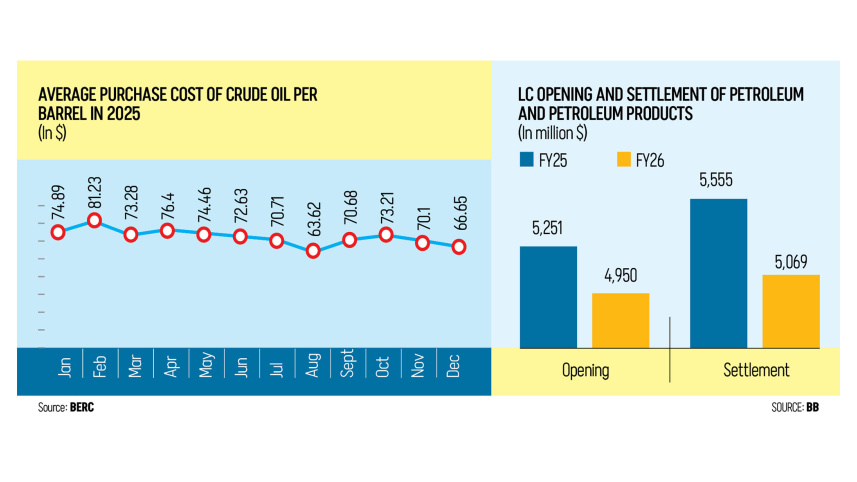
Bangladesh spends roughly $1 billion to import more than 60 lakh tonnes of petroleum a year and relies heavily on the Hormuz route
Bangladesh bought crude at an average of $72 a barrel in 2025, according to the Bangladesh Petroleum Corporation (BPC).
Amid rising concern, the government held an emergency meeting yesterday. Officials discussed whether energy supplies from alternative sources could be secured in time if the disruption in the Gulf continues.
The report said war risk premiums have surged. Insurance costs for vessels operating in the Gulf have risen to 1 percent of ship value, up from 0.2 percent before the strikes. That has added hundreds of thousands of dollars to individual voyages.
Major insurers have begun cancelling war risk coverage for the Persian Gulf. About 150 tankers have dropped anchor, effectively stalling 20 percent of global oil and LNG shipments.
“Bangladesh’s immediate exposure is the higher delivered cost of crude and refined products, amplified by freight and insurance premiums,” the report said, adding that disruption in the Gulf now poses a direct operational risk for the country.
It added that contingency plans are under discussion, including prioritising gas for fertiliser and power generation while raising coal-based output to offset the “Hormuz risk”.
Bangladesh spends roughly $1 billion per year to import more than 60 lakh tonnes of petroleum and relies heavily on the Hormuz route. It sources most petroleum from the Middle East, and more than half of LNG imports in 2025 passed through this chokepoint.
The country meets nearly 30 percent of its gas demand, equivalent to 2,650 mmcfd, through imported LNG as domestic output continues to fall short.
On March 2, Oxford Economics projected that LNG prices could rise 30 percent to an average of about $14 per million British thermal units (MMBtu) between April and June, up from $9 to $10 at present.
Against the backdrop, state-run Rupantarita Prakritik Gas Co Ltd has floated tenders to purchase two LNG cargoes from the spot market for March 15-16 and March 18-19 deliveries, according to people familiar with the matter.
The BRAC EPL report said foreign exchange reserves stood at $30.27 billion in late February 2026, calculated under the IMF manual, providing a stronger buffer than a year earlier. However, it said the first impact of the conflict is likely to appear in the marginal dollar price of trade credit, particularly in letter of credit (LC) margins and forward premiums.
It said imported energy inflation leaves little room for absorption without wider knock-on effects.
“Under the current automatic pricing architecture, energy price changes transmit faster into transport, irrigation and food distribution costs, raising the probability of sticky headline inflation if the war premium persists into the April-May period, potentially forcing a reversal of the planned monetary easing if the war premium is not neutralised by June,” it added.
The report said a shift towards a more accommodative monetary stance is expected under the new governor of the Bangladesh Bank to support growth.
It said policymakers are likely to focus on ensuring dollar liquidity for commercial banks and could reintroduce import curbs on luxury goods, similar to measures taken during the 2022 Russia-Ukraine war, to contain imported inflation.
 For all latest news, follow The Daily Star's Google News channel.
 The Gulf Cooperation Council (GCC) accounts for 51 percent of remittance inflows to Bangladesh, with the United Arab Emirates and Saudi Arabia together contributing about one third of the total, the report noted. Historically, higher oil prices have strengthened fiscal spending and labour demand in the Gulf.
“This acts as a stabilising medium-term force on remittance continuity. Our take is that remittances can cushion US dollar liquidity to some extent but cannot fully neutralise a sustained energy import shock.”
On exports, the report said that higher freight and insurance premiums will increase the landed cost of Bangladeshi goods. Airspace disruption will cut belly cargo capacity and force rerouting. Belly cargo refers to goods transported in the lower deck or “belly hold” of a passenger aircraft.
As of March 4, global insurers had designated the Gulf a “Listed Area”, lifting premiums by 300 to 400 percent, it said.
“Expected longer lead times will require higher inventory buffers and may increase the risk of delivery-linked discounting. The competitiveness challenge, therefore, is whether Bangladesh exporters can preserve on-time delivery economics. Exporters with stronger balance sheets, better forwarder diversification, and resilient buyer relationships should be structurally better positioned,” it concluded.
Comments