


A handful of paddy and a mountain of debt: Farmers' struggle for survival as harvest fails

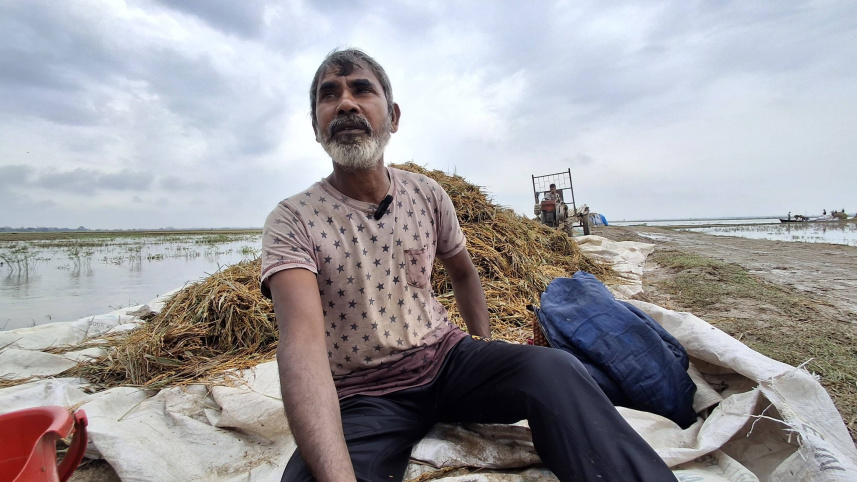
For months, Swapan Kumar Das began his days before sunrise, tending his paddy fields with a single hope -- a good harvest that would ease his financial burden.
That hope has now been washed away.

“I borrowed Tk 150,000 from neighbours and a moneylender,” said Swapan, 56, from Uttarhati village under Ajmiriganj upazila of Habiganj.
“I thought if my 17 bighas yielded well, I could repay the loan and bring some relief to my family.”
His fields had turned golden in recent days, signalling a promising harvest. But relentless rainfall over several days caused water levels in the haor to rise rapidly, submerging his entire crop overnight.
“When I went to the field in the morning, everything was under water,” he said. “I stood there holding a handful of paddy. It felt like everything was over.”
Across Uttarhati and nearby areas, the stench of rotting paddy filled the air. Fields that glowed with ripened crops just days ago have turned into vast stretches of murky water, with only the tips of submerged plants occasionally visible.
“My year-long dream has shattered in a single night,” he said.
“How will I survive with a seven-member family, including four children? Our food, education — everything depends on paddy.”
In nearby Bhirat village, farmer Girindra Das faces a similar loss. He cultivated boro paddy on 23 bighas of leased land, hoping for a profitable season, but has only managed to harvest three bighas so far.
“The rest is now under water,” he said. “We cannot even find workers in this weather.”
With continuous rainfall and little sunlight, farmers are struggling to salvage what remains. Some wade through waist-deep water to cut paddy by hand, while others attempt to collect crops using boats. Drying the harvested paddy has become nearly impossible.
Ajmiriganj Upazila Agriculture Officer Md Ruhul Amin said a total of 14,560 hectares of land were cultivated in haor areas this Boro season.
“About 1,600 hectares of cropland in low-lying areas of Badalpur, Sadar, Jalsukha, Shibpasha and Kakailcheo unions have already gone under water,” he said.
He added that efforts are underway to assess the full extent of the damage.
Ajmiriganj Upazila Nirbahi Officer SM Rezaul Karim said authorities have started preparing a list of affected farmers and held emergency meetings with local representatives to address the labour shortage.
Meanwhile, Md Sayedur Rahman, executive engineer of the Bangladesh Water Development Board, said rainfall may continue at a light to moderate intensity over the next 24 hours.
“Even if water levels in the Khowai and Sutang rivers decrease, the Kushiyara river may continue to rise in the Ajmiriganj area,” he said.
For farmers like Swapan, however, the immediate concern is survival.
 For all latest news, follow The Daily Star's Google News channel.
Comments