


Wheat can flourish in coastal belt
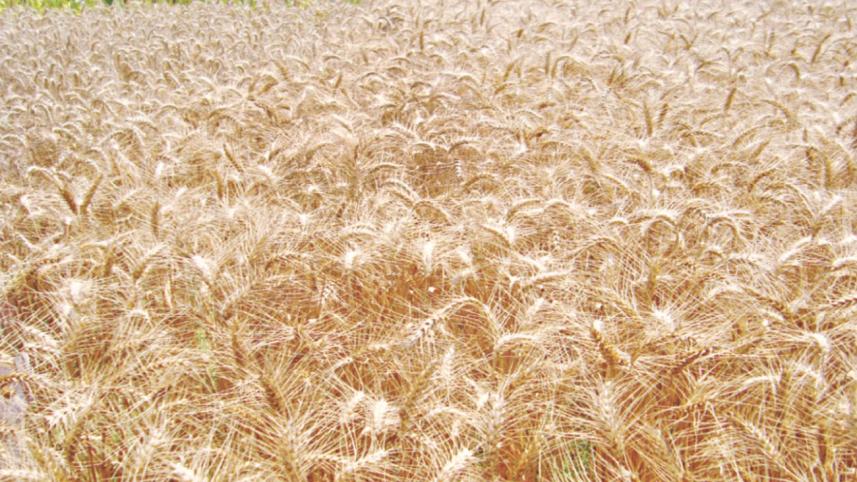
After six years of research, Bangladesh Institute of Nuclear Agriculture (BINA) scientists in Mymensingh released on October 9 2016 their first-ever wheat variety suitable for both saline and non-saline conditions. The high-yielding Binagom-1 variety promises to bring new success in wheat cultivation to the saline areas of the country's south.
According to AA Hasan, former director general at the BINA, seeds were first obtained from the Nuclear Institute for Agriculture and Biology in Pakistan and planted in both saline and non-saline conditions, including on around 25 trial plots in different districts of the south. The best panicles were collected from the test crops in order to further refine the variety, with three progenies selected for their higher yields.

The salt-tolerant variety matures in 105 to 110 days, with medium amber-coloured grains, and can produce up to 3.5 tonnes per hectare with an average production of 2.9 tonnes in saline areas. In non-saline soils production can reach 4.2 tonnes per hectare with an average of 3.8 tonnes.
The variety is also resistant to diseases like black point and leaf blotch, which together with its tolerance to differing soils is a win for farmers. Scientists hope that thousands of farmers in the coastal districts of Barisal and Khulna will benefit from the new strain.
According to BINA scientists, some 10 lakh hectares in southern districts remain fallow due to salinity and lack of rain in the winter season. The production of the new wheat variety has the potential to close the gap between current national wheat production level of 13 lakh tonnes and the country's annual demand of 40 lakh tonnes. As such it will reduce the need for imports.
“If 50 percent of that fallow land can be used in wheat cultivation, some 15 – 20 lakh tonnes of wheat will be added to the present production,” one of the scientists explained.
At present another variety, BARI Gom-25 is cultivated in the southern region on a small scale, but the new variety promises up to 15 percent higher yields. The BINA has a target to produce one tonne of breeder's seeds and one tonne of Truthfully Labelled Seeds to hand over to the Bangladesh Agriculture Development Corporation and the agriculture extension department, ready to reach farmers in time for the 2017 season.
The research team was led by chief scientific officer Md Abul Kalam Azad, assisted by BINA scientists Md Kamruzzaman and Sahmina Yasmin, among others.
 For all latest news, follow The Daily Star's Google News channel.
Comments