


Trump lashes at federal judges
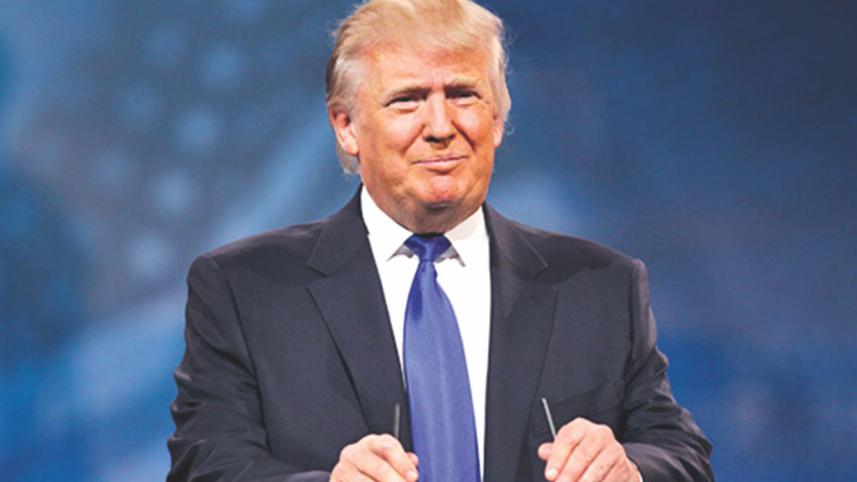
US President Donald Trump yesterday lashed out at the federal judges mulling whether to reinstate his controversial travel ban, calling them "so political" and saying even a "bad high school student" would see the law was on his side.
"I think our security is at risk today," Trump told a meeting of sheriffs from around the nation, as he defended his executive order, which was blocked nationwide by the federal courts a week after it went into effect.

Trump's executive order barred entry to all refugees for 120 days, and Syrian refugees are blocked indefinitely. Travelers from Iran, Iraq, Libya, Somalia, Sudan, Syria and Yemen are barred from entry for 90 days.
"I don't ever want to call a court biased, so I won't call it biased and we haven't had a decision yet," Trump said.
"But courts seem to be so political, and it would be so great for our justice system if they would be able to read a statement and do what's right."
The Republican president, now in his third week in office, said even "a bad high school student" would think he was right about his reading of the law -- which he read out loud -- with comments interspersed.
"If these judges wanted to, in my opinion, help the court in terms of respect for the court, they'd do what they should be doing. It's so sad," said Trump, who noted he had listened to the hour-long appeals court hearing on Tuesday.
The Ninth Circuit Court of Appeals is expected to rule by week's end on whether or not to reinstate the travel ban, which created chaos at airports both in the US and abroad, and prompted large protests.
The measure was suspended last Friday in a lower federal court, re-opening US borders to the thousands of refugees and travelers who had been suddenly barred from the country.
The Justice Department has argued that the federal court in Seattle overstepped by suspending the measure, and that national security is at stake -- a position hammered home by Trump.
But the three-judge appeals court panel often appeared skeptical during Tuesday's hearing, with Judge Richard Clifton at one point calling the government's argument "pretty abstract."
The White House insists the decree is in the interest of national security, giving the new administration time to beef up vetting procedures to keep potential terrorists out of the country.
Its detractors claim it violates the constitution by discriminating against people on the basis of their religion.
TOUGH GRILLING
Three federal judges grilled lawyers from the Justice Department and Washington state Tuesday night as they considered whether to lift a US-wide block on President Donald Trump's travel ban.
The appeals court judges sparred with attorneys over the President's use of sweeping executive power, questioned the connection between the seven affected countries and terrorism, and launched into tough questions over whether the ban discriminated against Muslims.
During the telephone hearing, the lawyer representing the Justice Department, August Flentje, argued that the President had wide powers relating to immigration and national security. He contended that federal judges did not have the power to review Trump's executive order, which bars citizens of Iraq, Syria, Iran, Libya, Somalia, Sudan and Yemen from entering the US for 90 days.
It also prevents entry for all refugees for 120 days and indefinitely halts the admission of refugees from Syria.
From the start, Flentje repeatedly sought to emphasize the government's position that a lower court acted beyond his powers when it suspended the President's executive order last Friday. Flentje argued that the President acted within his constitutional powers.
"This is a traditional national security judgment that is assigned to the political branches and the President and the court's order immediately altered that," Flentje argued.
The three-judge panel at the Ninth Circuit Court of Appeals pressed Flentje on whether the government could show that the seven countries affected by Trump's ban were connected to terrorism.
 For all latest news, follow The Daily Star's Google News channel.
 "Has the government pointed to any evidence connecting these countries with terrorism," asked Judge Michelle Friedland.
Flentje, special counsel to the assistant attorney general at the Justice Department, countered that the lower court had overruled the President's judgment about the level of risk from those countries. "The district court's decision overrides the President's national security judgment about the level of risk and we've been talking about the level of risk that's acceptable," he said.
Judge Friedland fired back: "Are you arguing then that the President's decision in that regard is unreviewable (by a court)?"
Flentje paused and eventually answered, tentatively, "yes."
Judge Richard Clifton called the government's argument "abstract," noting that procedures were already in place to vet visa applicants.
MUSLIM BAN
Judge William Canby asked whether Flentje's logic could be taken to its most extreme conclusion: whether the President could simply say the United States will not admit Muslims into the country.
"Could he do that?" asked the judge. "Would anyone be able to challenge that?"
For the Justice Department, Flentje argued that the travel restrictions in Trump's executive order did not amount to a Muslim ban. "That's not the order," he said repeatedly.
But Judge Richard Clifton pressed him further. "We'd like to get to an answer to that question."
Eventually, Flentje capitulated and said a US citizen with a connection to someone seeking entry might be able to challenge the executive order if that were the case.
INTENT TO DISCRIMINATE
While the President's name was barely mentioned during the hearing, Trump's words were at the front of the judges' and attorneys' minds.
Washington state Solicitor General Noah Purcell, representing his state and Minnesota -- which are challenging the Trump executive order along with advocacy groups -- was pressed by Canby to explain how the executive order demonstrates a direct intent to discriminate against Muslims when only a relatively small percentage of Muslims hail from the seven banned countries.
Comments